


The Visitor Centre today is ... Lumière Winery, Japan
Updated: Aug 11
From Samurai to Sommeliers. We visit Lumière, the pioneering winery that helped transform a humble table grape into one of Japan's most celebrated wines.

Mention Japanese drinks and most people will immediately think of sake or whisky. Wine though tends to be an afterthought, or not even a thought at all, despite the fact that Japan has been producing it for well over a century. I've been lucky enough to travel to many wine regions, but I do enjoy exploring those that fly a little under the radar. While visitors flock to Japan for temples, cherry blossoms, onsen and bullet trains, its vineyards remain something of a well-kept secret. So, when we found ourselves back in Japan, I made sure to carve out a few precious days from our itinerary for a pilgrimage to the country's wine heartland, Yamanashi.
The assumption that Japan doesn't drink wine is wide of the mark. The country imports vast quantities from France, Italy and beyond. And the country boasts one of the world's largest communities of trained sommeliers, with almost 40,000 accredited professionals. So, the challenge has never been persuading Japanese consumers to drink wine, it has been persuading them, and the rest of us, to drink Japanese wine.
As if to prove the point, we met up with former Japanese colleagues for a sushi dinner in Toyota City during a recent trip. When the drinks menu arrived, I asked the server for Japanese wine. "No, no," came the response, "drink French." Our dinner companions looked at me equally bemused, and promptly ordered beer.
What is with this country, I thought. Their whisky is exceptional, surely their wine, like everything else in Japan, would be equally crafted and refined. After paying what felt like a small fortune for a single strawberry in Kyoto, only to discover it was one of the best I'd ever tasted, I probably shouldn't have been surprised that Japan takes the same care over its grapes.
My escape from the neon lights, crowds and sensory overload of Tokyo, was found less than two hours west of the city. Hopping in a hire car on a gloriously clear day, the journey to the Kofu Basin transported me and my husband to where vineyards sit alongside peach orchards, persimmon trees and family farms, with the delight of a snow capped Mount Fuji keeping a watchful eye on us in the background.

It is here that you'll find Lumière Winery, one of Japan's most influential wine producers, and a place whose tour was so memorable that I've been talking about it ever since.
If charming Yukiko Amano, her ring binder and the self service dispenser of delights cannot persuade you that Japan's dangerously drinkable wines are worth your time, then I don't know what will.
Japanese Wine - A Wine Industry Hidden in Plain Sight
If Japanese wine feels like a recent discovery, that's only because most of it never leaves Japan. Which raises an obvious question: how did a country better known for sake and whisky end up in 2026 with more than 550 wineries and over 725 wine producers?
The answer begins in Yamanashi, although not with wine. Long before modern wineries appeared, this was fruit country. It still is. Their fruits are so prized that they are often shipped around the world wrapped in foam, like precious jewels, sometimes with a personal message and photograph from the grower tucked inside. That strawberry in Kyoto suddenly made a lot more sense.

The Kofu Basin enjoys hot summers, cool nights and well-drained soils, creating ideal conditions for growing peaches, grapes, plums and persimmons. While much of Japan depended on rice, farmers here discovered there was a better living to be made from orchards. Silk added a second source of income, with many families raising silkworms alongside their fruit trees. By the late nineteenth century, Yamanashi had become one of Japan's more prosperous agricultural regions.
It also happened at exactly the right moment in Japanese history. In 1868, as Britain was in the middle of the Victorian era and Europe was being transformed by industry and invention, Japan underwent the Meiji Restoration. A new government swept away centuries of isolation and set about modernising the country at remarkable speed.
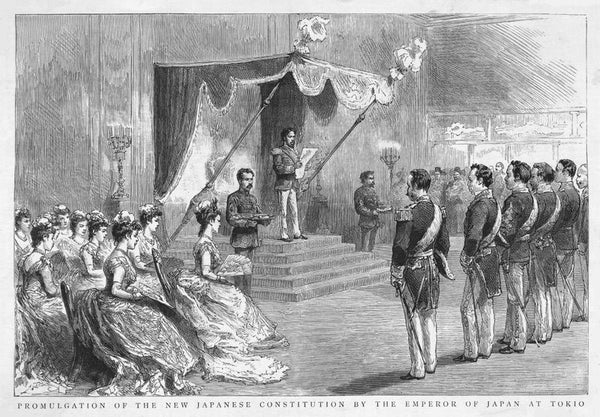
Engineers, scientists and entrepreneurs were dispatched overseas to study everything from shipbuilding and textiles to brewing and manufacturing. The thinking was wonderfully practical. If another country knew how to do something well, Japan wanted to learn how.
While future whisky pioneer Masataka Taketsuru would later head to Scotland, Yamanashi's wine pioneers looked to France. In 1877, two young men, Masanari Takano and Ryuken Tsuchiya, were sent there to learn modern viticulture and winemaking.

They returned home armed with French techniques, new equipment and plenty of ambition. The problem was that Japanese drinkers weren't quite ready for dry European-style wine. The business failed. But failed experiments often become successful legacies. They left Yamanashi with knowledge, skilled winemakers and the confidence that wine could be made commercially. Among them was Tokugi Furiya, who founded Furiya Winery in 1885, the business that would eventually become Lumière.
Nearly 150 years later, Yamanashi is still Japan's wine heartland, producing around 30 million litres a year, a third of the country's wine. Yamanashi's reputation was officially recognised in 2013, when it became Japan's first Geographical Indication (GI) for wine. Think Champagne, Scotch whisky or Stilton. A GI protects products whose character is closely tied to where they're made.

Yet on a global scale, Japanese wine remains tiny. France and Italy each produce well over four billion litres a year. California alone dwarfs Japan's entire output. That isn't a question of quality. It's simply a question of scale.
Most Japanese wine has traditionally been consumed at home, giving producers little reason to build export markets. As a result, generations of wine drinkers outside Japan simply never encountered it.
It reminded me of my first encounter with Niagara Riesling. I came home wondering why nobody seemed to talk about it, only to discover that finding a bottle in Britain was easier said than done. Japanese wine gave me exactly the same feeling.
The surprise isn't that Japanese wine is finally receiving international attention. The real surprise is that it remained hidden in plain sight for so long.
From Samurai to Winemaker - Lumière Winery's brand history
What do you do when your livelihood disappears overnight? You reinvent yourself. During the pandemic I swapped a career in commercial design for one in writing. I always knew I could go back, or even do both. Tokugi Furuya didn't have that luxury.
For many of us, the word samurai still conjures up images of swords and Tom Cruise in The Last Samurai, rather than vineyards and wine presses. Yet that's exactly where this story ends up. Furuya had served as a samurai during the final years of the Edo period, fighting for the Tokugawa shogunate. When the Meiji Restoration swept away the old order, he found himself on the losing side of history. Some former samurai became teachers or civil servants. Others turned to business. Furuya looked beyond the family swordsmith workshop, and the land his family owned in Yamanashi, and chose wine. In 1885, he founded Furiya Winery.
The business would later become Koshu-en before eventually adopting the French name Lumière, meaning "light". Yukiko explained that the family admired the great wines of Bordeaux and hoped their winery would become "a light for Japanese wine culture". I must admit, every time I hear the name Lumière I still picture the candlestick from Beauty and the Beast.
In 1918, Lumière was granted the status of Imperial Warrant Purveyor, supplying the Japanese Imperial Household.
By the 1950s, however, wine in Japan was still largely regarded as a sweet drink. Reading that immediately took me back to the bottles many of us grew up seeing on British dinner tables: Black Tower, Blue Nun and Mateus. Easy-drinking, slightly sweet and hugely popular.
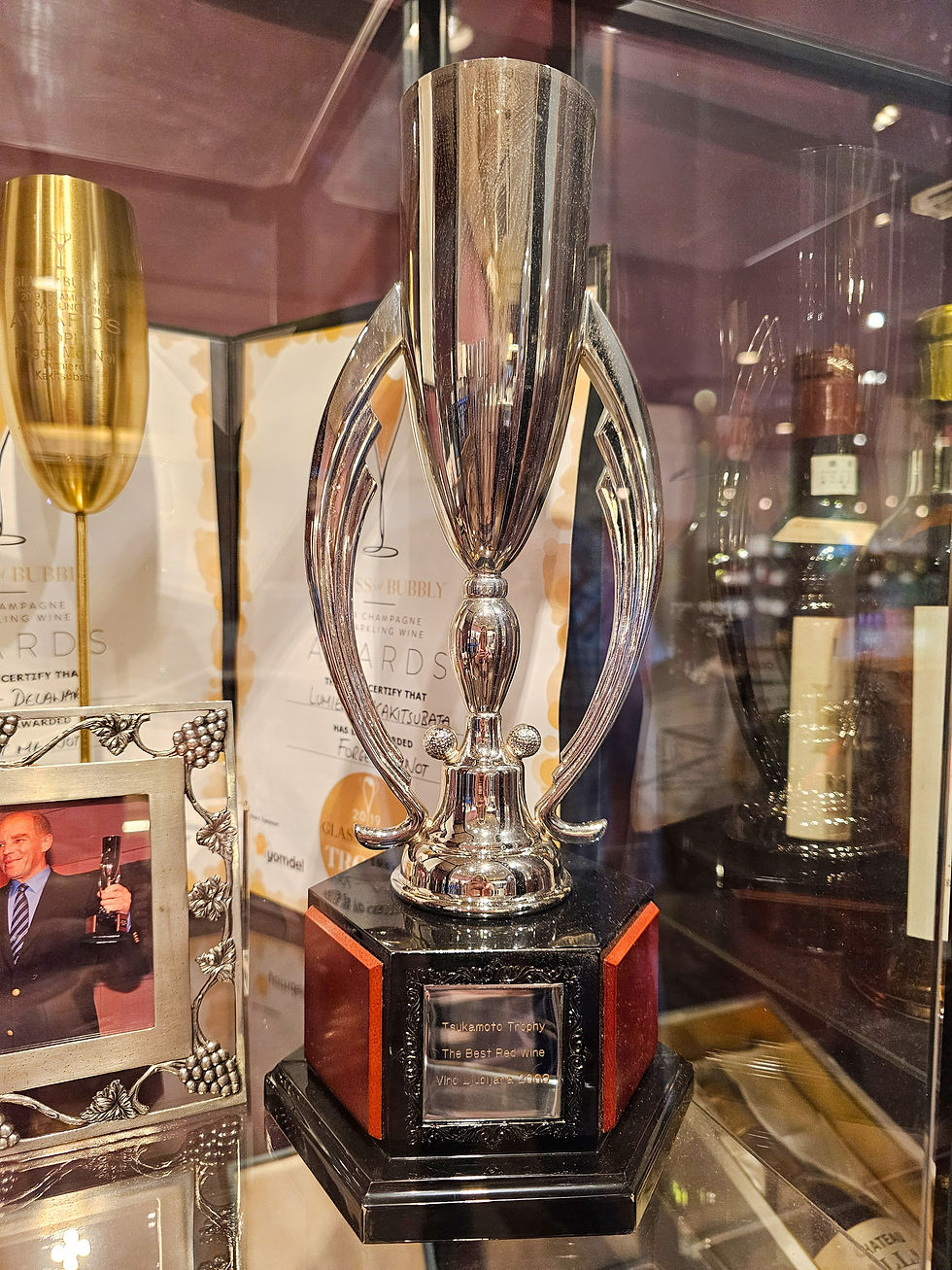
The man determined to change that was fourth-generation winemaker Toshihiko Tsukamoto. After studying under renowned fermentation scientist Professor Kinichiro Sakaguchi, he set out to create authentic wines to rival those of France. His wines would go on to win international awards, be served at President Bill Clinton's state luncheon during his 1996 visit to Japan, and establish Lumière as one of the country's most respected wineries.

Five generations on, the winery remains under the stewardship of the founder's family. Today, President Shigeki Kida continues that spirit of innovation through natural viticulture, barrel-fermented Koshu, orange wines and traditional-method sparkling wines. The techniques may have changed beyond recognition since Tokugi Furuya's day, but the willingness to embrace new ideas remains part of Lumière's DNA.
Visiting Lumière Winery: What to Expect
Lumière Winery's visitor centre design
I'd booked an English-speaking guided tour online for both me and my husband, several months in advance, as it is best to do in Japan, to save your disappointment. I didn't do tonnes of research on the wineries prior to our trip in May. I wanted to get a genuine first impression.

Our little hire car weaved its way through a maze of narrow streets in Ichinomiya-cho, often flanked by stone retaining walls, over little bridges and past clusters of houses. Gardens and allotments filled with wood or metal pergolas, dripping in greenery, sat alongside washing lines of clothes, and the detritus of modern life.
Every patch of open space seemed to be devoted to vines or fruit, right up to the kerbs either side of the single track roads.

We parked up in the little lot in front of Lumière's modern looking tasting room, with far reaching views into the valley beyond.

The glorious weather was a welcome bonus, as we stood in front of the vineyard map, explaining, in Japanese, what we were about to see. With our guide no doubt waiting for us inside, there wasn't time to study the map in detail, so a quick blast through Google Translate had to do. It turned out to be surprisingly revealing. As well as pointing visitors towards the cellar and restaurant, it labels the different vineyard blocks, grape varieties and even the contrasting trellising systems. It was enough to satisfy my curiosity for the moment. The finer details would have to wait.

The tour starts and ends in the tasting room, converted from the house where the founder and his family once lived. It hosts a variety of activities throughout the year, from cherry blossom viewing to autumn events with live music. It was here that we met Yukiko who started the tour by showing us a small exhibition panel explaining the soil beneath our feet. The layers of gravel, sand and limestone, combined with the underground water, mean this land is entirely unsuitable for growing rice. But for growing grapes, it is perfect.
Lumière Winery's tour
Japan's laminator industry must be thriving. Everywhere we went, menus, signs and instruction sheets seemed to arrive encased in wipe-clean plastic. Which perhaps explains why Yukiko's wonderful laminated ring binder felt so perfectly Japanese.

We didn't book a private tour, but as so few English speaking guests visit, we got the VIP treatment anyway. As we stepped outside into the vineyards, Yukiko explained the unique geography of the Kofu Basin. Surrounded by high mountains, including the Japanese Alps to the west and Mount Fuji to the south, the vineyards are protected from typhoons and hurricanes. The climate here is a mix of hot summers and cold winters, with a significant temperature difference between day and night. It's why we personally like to visit Japan in November and May. Summers there can be brutal for Scottish softies like us. With more than 65% sunny days annually, she pointed out that it is "not like Scotland." Living in Scotland, I could agree. I joked that we wish we could grow grapes back home. With global warming she said, maybe one day we can.

Japan's vineyards grow over 130 different grape varieties. More than 80 of them are native to Japan, such Japan's signature grape variety. Koshu. We had to use our imagination, as, in May, there was no sign of the stunning pale purple and pink Koshu grapes, but luckily the ringbinder had a page for that. Koshu was actually the original name for Yamanashi prefecture we're told.

For a long time, nobody really knew where Koshu came from. For a thousand years, Japanese people simply ate it as a fruit, considering it a healthy delicacy for the nobility rather than a winemaking ingredient. It wasn't until about a decade ago that DNA analysis finally revealed its true provenance. It turns out that 70% of Koshu's genetics come from the Caucasus region, near the Republic of Georgia. It travelled slowly across the Eurasian continent via the Silk Road, mating with wild grape varieties along the way, before finally arriving in Japan with a Buddhist priest in the 8th century.
Just a ten-minute drive from the winery is Daizenji Temple, where the chief priest still grows grapes and makes wine for visitors today. It is a remarkable story, and it explains why Koshu pairs so perfectly with Japanese cuisine, from sushi and sashimi to tempura.

The vineyards themselves are a testament to Japanese ingenuity and I'd never seen anything like it before. They use a Pergola training system, with the vines spread widely overhead like a canopy. They aren't there for appearances.

The leafy canopy acts like a giant sunshade, protecting the grapes from the heat while allowing air to circulate during Japan's humid summers. Because Japan has limited agricultural land, this wire training system allows them to maximise the harvest in small fields too. And, if that wasn't enough, Yukiko tells us it is also very efficient, as they are much easier to pick, as you don't have to bend as much. The Japanese really do know how to make things work. I have gone on to mention the pergola system seen in Yamanashi to wine growers all over the world.
There is no shortage of manual labour here. Later in the year, each bunch of grapes is covered individually with a little hat of wax paper, put on by hand before the rainy season arrives in June to prevent mould. And when harvest comes, every single grape is picked by hand too.


Yukiko directs us further into the vineyard and we stop in front of a more recognisable set up than the pergola system. Growers are gradually adopting vertical shoot positioning (VSP), prioritising fruit concentration over yield, which is much more common back home in the UK and in Europe and beyond.
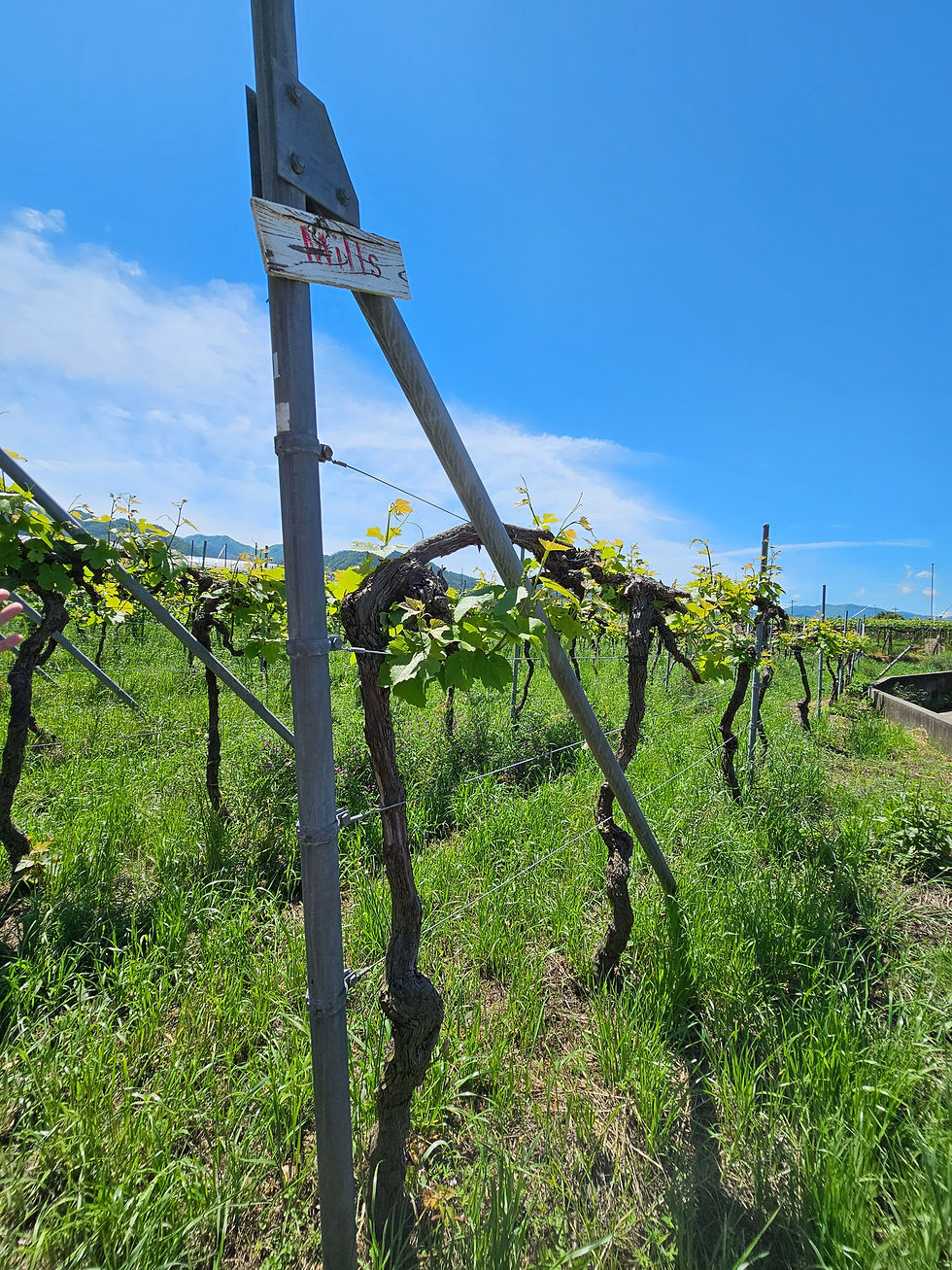
Yukiko introduced a grape variety I had never heard of: Mills. It is a hybrid created in Ontario, Canada, with a deep blackberry colour and a gorgeous lychee and rose flavour. I'm off to Ontario this month again, as I just adore the wines there. She was thrilled we'd been to Ontario to visit vineyards. We will look out for this variety when we return there.
Growing Mills is notoriously difficult she says, and most farmers in Yamanashi simply gave up. Today, only three wineries in the region still grow it. Lumière is one of them, producing a 100% Mills wine that she said pairs beautifully with spicy dishes like curry. I'll remember that the next time I order a pork tonkatsu.

You could just pick out the tiny berries that had just started to appear, being warmed up in the spring air.

The vineyard isn't immaculate by design. Grass, wildflowers and weeds are all part of Lumière's low-intervention approach to farming. It's a no dig system, using no pesticides, It reminded me of our visit to Highgrove, so I ended up chatting to Yukiko about King Charles III's philosophy of encouraging biodiversity. It's something I've tried to embrace at home too, although my version is admittedly a little more edited.
Next up was Merlot. It's one of several international varieties grown here, alongside Cabernet Sauvignon, Cabernet Franc, Chardonnay and, pleasingly, Tempranillo, one of my personal favourites. Koshu may be the headline act, but Lumière has never limited itself to indigenous grapes alone.

We were treated to views across the valley and Yukiko suggested she take a snap of us. Unfortunately she used my husband's phone and I am not in control of his camera settings - but you can see the panorama at least.

Every good vineyard in Japan needs - a shinto shrine. Hundreds of years old, this one is managed by the winery owner. Every January they pray to their gods for a good season.

We arrived at a large shed which housed the fermentation tanks and bottled stock.

As we visited when they were really just pruning and training, so it was quiet.

Lumière produces red, white, rose and orange wines. Orange wine may have become fashionable in recent years, but Lumière has quietly been making it for well over a decade and now exports it to the UK. Their Koshu grapes are fermented as whole bunches, skins, stalks and all, producing a wine that's richer, more textured and gently savoury than a conventional white. Yukiko recommended serving it with miso dishes or even sea urchin. The former sounds delightful. The latter may require a little more courage on my part.
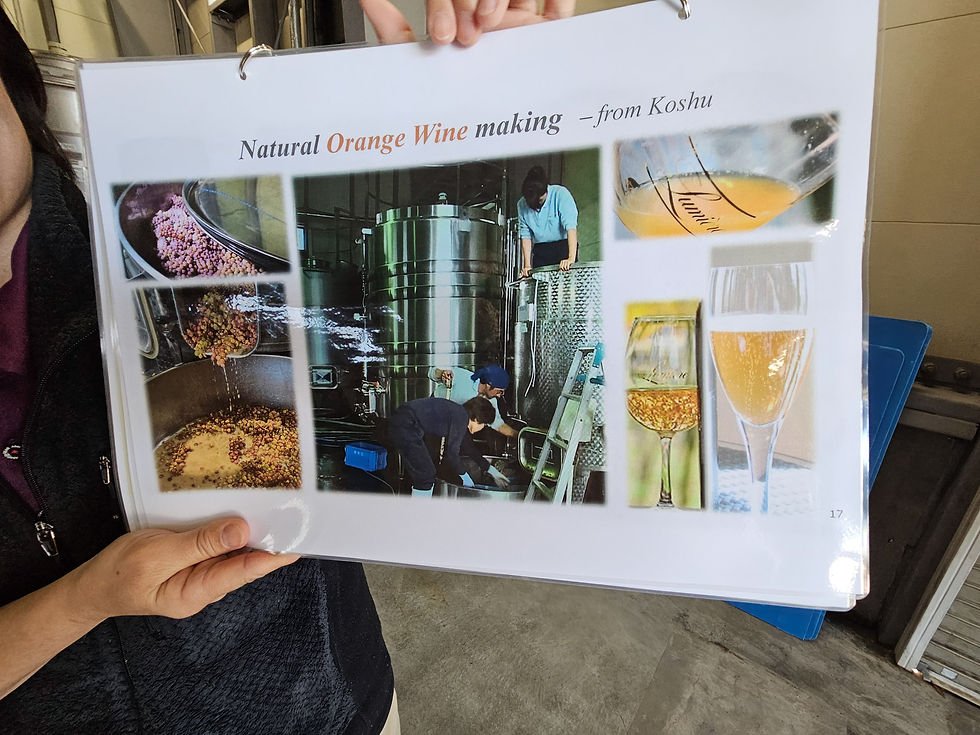
We also met one of the winemakers, a quietly spoken gentleman who immediately broke into a smile when he discovered we were from Scotland. Wine may be an international language, but it seems Scotland still makes a memorable first impression.
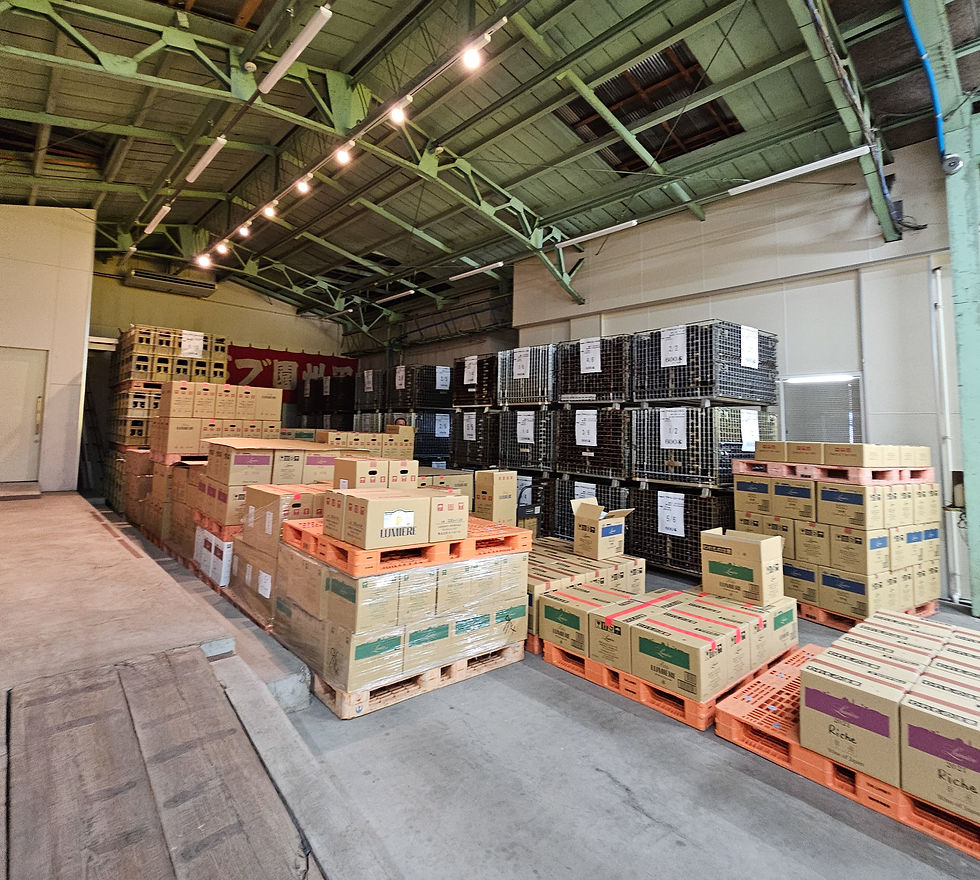
The Ishigura Stone Tank
The absolute highlight of the tour was escaping the summer heat and stepping into the cool of the Ishigura, Japan's first underground stone fermentation cellar. Built in 1901 by the winery's second-generation owner, Komanosuke Furiya, it originally housed ten enormous granite fermentation tanks, each carved from local stone. Each tank made ten thousand bottles.

Yukiko smiled and described it as "a symbol of a winery that no longer exists anywhere else in the world." She's right. There isn't another working one anywhere.

Back in 1901, of course, there was no refrigeration or air conditioning. The underground stone cellar naturally maintained a steady temperature of around 15–16°C, creating ideal conditions for fermentation.

The one remaining granite tank, which you can peer into, is now designated a Registered Tangible Cultural Property of Japan, and is still used to make Lumière's small-batch Ishigura red wine. Koshu may be Japan's historic grape, but Muscat Bailey A, used in much of the wine created in this historic tank, has a wonderful backstory of its own. It was created by Zenbei Kawakami, the man Yukiko affectionately described as the 'father of Japanese grapes'. He spent more than 30 years patiently crossing vines, making over 10,000 pollination attempts each year in search of grapes that could cope with Japan's humid climate and disease. He eventually developed more than 100 new varieties, but Muscat Bailey A became his masterpiece. I couldn't wait to taste it.

You don't just look from above, you get to see inside and we got another photo opportunity. We had a laugh as instead of saying 'cheese', we were told to say 'whisky'. The process remains wonderfully traditional. Because the wine can't be stirred in the usual way, bamboo drain boards are used to keep the grape skins and seeds submerged as the natural fermentation gases push them upwards. If a small leak appears in the stone, it is simply sealed with natural beeswax.
Lumière Winery's cellar
From the stone tank we moved into the cellar, which was originally a massive cement concrete tank built in the 1930s as part of the construction of the railway line from Tokyo to Osaka.

When modern stainless steel tanks were introduced, they knocked down the cement walls and repurposed the space to store their oak barrels.
The barrels are stacked high, and they still move them by hand, stomping the rims and rolling them into place. It is a quiet, echoey, atmospheric space where the flagship wines rest for up to 25 months before bottling.

Walking through those cool stone corridors reminded me of the chalk cellars we'd just visited beneath Joseph Perrier in Champagne. Smaller in scale, of course, but with the same quiet sense that generations of winemakers have walked these passages before you.
The tasting at Lumière Winery
It's been a while since I first came across a self service wine dispenser. I took my daughter to Milan's Expo in 2015 and we drank our way around Italy's wine regions, one squirt into a glass at a time.
They're actually called an enomatic dispenser, and keep opened wine fresh for weeks using food-grade inert gas (argon or nitrogen). You can keep your standard wine fridge, one of these is like a jukebox of vino. Press a few buttons, raise a glass and out of a little metal spout comes a perfect pour.

It is a pay as you go system and those Japanese laminators had been busy again.

There was certainly plenty to choose from, so I took Yukiko's advice and worked my way through the wines one at a time, accompanied by the gentle sound of jazz drifting through the tasting room. I began with the whites, before moving on to orange wines and finally the reds.
As my husband was driving, I had the tough job of tasting alone. What a hardship. Japan has a zero-tolerance approach to drink driving, and wineries take it seriously. You won't be persuaded into "just one small taste", which, when you think about it, is exactly how it should be.

You can choose between 20ml, 40ml, or 80ml pours, so I plumped for several smaller samples to taste a wider range of their wines.
Another handy ring binder appeared, with even more information on each wine. This is such a good idea, especially for those of us that cannot speak Japanese, or have short memories. I found myself flicking through its pages making more informed decisions on what to taste and maybe buy.

Yukiko had explained sur lie ageing on the tour, leaving the wine to rest on its sediment after fermentation, which adds a richer, creamier texture, so my first choice from the dispenser was a Lumière Koshu Sur Lie 2022. It reminded me of an English still white I enjoyed at Chapel Down. Different grape, different country, but the same bright freshness, full of crisp apple and citrus. It disappeared from the glass rather more quickly than intended.

Next came Hikari Koshu Prestige Class, which spends 18 months in oak, adding vanilla notes and real complexity. I was reminded by the ringbinder that it won a Platinum Medal at the Decanter World Wine Awards in 2021, and the menu described it as an umami-rich, gastronomic wine that was "rich and profound". The wine was both. As for me, I'll settle for feeling lucky and enthusiastic.

Lumière also offers a tempting menu of small dishes to accompany the wines. Having somehow managed to miss my usual Japanese breakfast, the iconic Lawson egg mayonnaise sandwich, I was in need of something to nibble on. Hiroshima oysters? Stewed beef tongue in a red wine jus? Tempting, but no. Yamanashi pork belly, marinated in Lumière's own red wine for three weeks? No contest. Now, I'm no sommelier, but the salty, smoky richness of the pork worked beautifully with the wine.

The dispensers next offered two blind tasting pours, a red and a white, which I happily played along with. I am not sure I got the answer right, but it's the taking part that counts.

I'd been looking forward to the Muscat Bailey A ever since Yukiko told us about Kawakami's 30 years of patience in the vineyard. I pressed 10 on the dispenser for the Kami-Iwasaki Muscat Bailey A, and it did not disappoint. We live by the Perthshire Fruit Triangle, one of the world's finest soft fruit growing regions, where the same well-drained soils and long summer days that make Yamanashi so good for grapes produce some of the best strawberries, raspberries and Tayberries you will ever taste. The climate here is rather different, admittedly, but that first sip was like tasting home.

All good things must come to an end, so my final squirt from the dispenser was Hikari Cuvée Spéciale 2016. I was powerless to resist a tasting note promising dark cherries, figs and vanilla, three of my favourite things. It's a blend of Merlot, Petit Verdot, Cabernet Sauvignon, Cabernet Franc, Tannat and Tempranillo. Fabulous.

Restaurant Zelkova
The 900-year-old zelkova tree that gives the restaurant its name stands just outside the window, a rather fitting neighbour for a winery that's been around since 1885.
Restaurant Zelkova is open for lunch from 11:30am until 2pm, but is closed on Mondays and Tuesdays. Guess which day we visited?
From everything I read, and from the menu peering through the window, it serves contemporary French-inspired cuisine made with the best produce from Yamanashi, thoughtfully paired with Lumière's own wines. It sounds like the perfect way to round off a visit to Lumière. Sadly, it will have to wait until our next trip to Japan.

The shop at Lumière Winery
Next up was a little retail therapy. I allowed myself just one bottle to bring home, as we knew we could buy a few more from the distributor in London. My suitcases were already bulging with 3 weeks of Japanese crafts and spirits.
I left behind the Samurai and Princess bottles wrapped in kimonos. Though looking back they were very cute and did play into the Samurai founders story.

Local cider anyone? They also make plum wine.


The biggest surprise wasn't the quality, it was the prices. A bottle of Lumière Sparkling was ¥5,280 JPY, roughly £25. I'd been expecting a much bigger dent in my wallet.

The ¥110,000 JPY (£500) Lumiere Brandy was too much of a risk in the suitcase. Distilled and aged for 30 years it did come in a pretty Baccarat decanter.

The Château Lumière 2015, the winery's signature full-bodied red blend, came in a box with a can of Gyu-Tan, which is the aged beef tongue on their snack menu. It is a famous regional delicacy in Japan. I wasn't sure I could bring meat home, so that was another we had to leave behind. At ¥7,150 JPY, it was only about £33.

So, which bottle came home with us? We went for what Google Translate confidently described as "good wine". What more recommendation did we need? Our choice was a numbered bottle of 2021 Lumière Hikari Koshu, made entirely from grapes grown in the very vineyard we'd been standing in earlier that day. The same barrel-fermented wine that won a Platinum Medal at the Decanter World Wine Awards in 2021.

Another reason it found its way into my suitcase was the label. Throughout our trip I'd been collecting temple stamps, each beautifully finished with hand-brushed Japanese calligraphy. The bold character on the bottle is Hikari (ひかり), meaning "light", a lovely echo of the winery's French name, Lumière. It's still sitting unopened in our house in Scotland. Not for much longer, though. A Japanese food and wine evening with friends seems the perfect excuse to relive a little of Yamanashi.
Imports & Distributors
Good old Amathus Drinks in the UK, sell several bottles from Lumière's range. The family owned wine and spirits importer, distributor, retailer, and wholesaler was founded in 1978 and you can buy through its retail stores and online shop.
Is a trip to Lumière Winery worth it?
Lumière combines history, innovation and a genuine sense of place, but it's Yukiko who we remember most.
Yukiko is a professional ambassador for Japanese wine, travelling the world to tell its story. But standing in a vineyard in Yamanashi with her laminated ring binder, she was simply someone who tried her absolute hardest to make sure we understood and enjoyed every bit of it. We shared a few laughs, swapped stories and learnt an enormous amount along the way. I've seen some wonderfully clever uses of technology in visitor attractions, but Yukiko reminded me that the best ones still begin with people.
Those simple laminated pages have become the subject of many conversations I've had with visitor attraction professionals since. When expensive technology fails, or guides struggle to communicate in another language, I often find myself saying, "Think ring binder." Sometimes the simplest solution really is the best.
I also loved the fact that Lumière never felt like a tourist attraction. No crowds queuing for tastings, no oversized gift shop to negotiate, no sense that the experience had been polished to within an inch of its life. We were simply stepping into a working winery where people have quietly been making wine for nearly 150 years. Somehow, that made it feel even more special.
Five generations have each inherited not just a business, but the accumulated knowledge, judgement and confidence to leave it in better shape than they found it. That kind of continuity is rare anywhere in the world.
As I write this, I have bottles of Lumière's orange wine on order from Amathus and a bottle of Hikari Koshu Prestige Class waiting patiently at home in Scotland. I suspect none will stay unopened for much longer. Since that day in Yamanashi, I have gone on to visit wineries in the Finger Lakes, Willamette Valley, Niagara-on-the-Lake and the Texas Hill Country, with Hokkaido already on my to-do list. Every one of those trips began with the same question Yukiko planted in my head: what else have I been missing? I'm even planning a trip to Georgia, (the country - not the state), to trace the Koshu grape back to where it all began.
Plan your visit to the Lumière Winery
Address
624 Minami-noro, Ichinomiya-cho, Fuefuki-shi ,Yamanashi 405-0052 JAPAN
Website: LUMIÈRE
How long was the visit?
60 minutes for the tour and another hour for the tasting, plus a little longer chatting to our lovely host and enjoying the tastings.
Lumière Winery tickets
We paid for our tickets and this was not any form of advertisement.
An English tour is available, but must be booked in advance. They can run one per day, during weekdays only, for a minimum of 2 guests. You choose when you want to visit and they will email you with possible times.
Guided Tour & Wine Tasting (3 glasses) : JPY 2,000 per adult - roughly £10 per person - so worth every penny!
Opening times
It's always worth checking with Lumière for their current opening times, as they can vary.
They have a shop : Open 9:30 - Close 17:30
And the tasting dispenser operates from 9:30 - 16:30 (JPY 100~400 per glass)
Getting to Lumière Winery
We hired a car and made a 2 day visit to the Yamanashi area. It is 5 minutes from Chuo Highway Katsunuma I.C.
By train:
From Tokyo Area:
90-mins by “Express Kaiji” from Shinjyuku Station to Enzan Station or Katsunuma-budokyo station on JR Chuo Line.
15-mins by taxi from Enzan Station, or 10-mins by taxi from Katsunuma-budokyo Station.
From Nagoya Area
15-mins by chuo-local-line from Kofu Station to Yamanashi-shi Station.
15-mins by taxi from Yamanashi-shi Station.
Highway Bus:
20-mins walk from “Chuoshakado” Highway bus stop
or 30 mins from “Katsunuma” Highway bus stop
Where to stay when visiting Lumière Winery
If you want stunning views and excellent customer service then, trust me, there is one place to stay in Yamanashi. We had a truly memorable overnight stay at the Fruit Park Fujiya Hotel, which we booked through Booking.com. I cannot recommend the hotel enough as were treated so well.
On arrival we were immediately upgraded to the simply massive Royal Suite Room with views over Mount Fuji, which, for our anniversary, was a bonus. The bathroom was the size of my lounge back home.

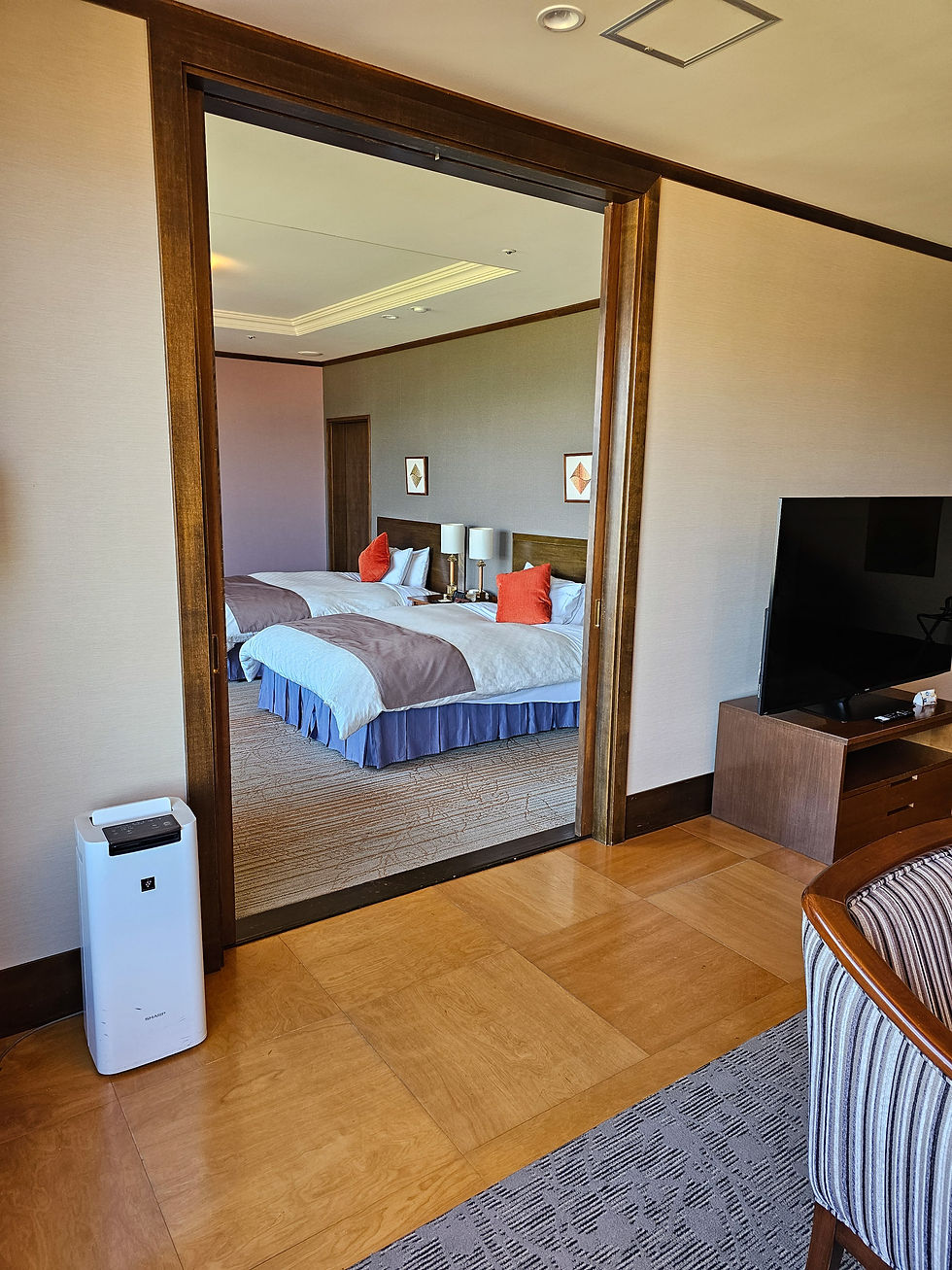
But the view was to die for. I just sat and looked at the mountain for hours luxuriating in all the space. I think it's the largest hotel room we've ever stayed in.

We were in Japan for 3 weeks, and we can say all of our stays were good, but the staff here were simply exceptional. There's an onsen on site, a French and a Japanese restaurant and a shop. We plumped for Japanese that night and had a lovely dinner full of local delicacies which were presented beautifully.

When they noticed us using Google Translate to read the menu, someone appeared with a menu onto which they had just scribbled handwritten English notes.

At breakfast were were shown to seats so we could watch a movie being filmed in the hotel, apparently with a big female star as the lead, which everyone was very excited about. Like Julia Roberts we were told. We were none the wiser. They were so excited that we had visited them, as they get so few Western guests, that they made us feel as Royal as the suite they put us in. Sadly we only had a few hours there, but we would return in a heartbeat.
What else is there to see close to Lumière Winery:
The main draw in this area for most people is the Yamanashi and Koshu Valley wine region. With around 90 wineries to choose from we had to be selective for our 2 day trip.
We managed just three vineyards and I'll post a guide to the other two soon. But I will return to tour some more, as they were a revelation.
Chateau Mercian, owned by Kirin, is one of Japan’s most influential wineries and has played a key role in the development of Japanese wine, hence why we visited. Renowned for its Koshu, Chardonnay, and Merlot wines, it offers tastings of both local and international varieties. With a wine museum, restaurant, and spacious grounds, it is an excellent destination for wine lovers and families alike.

Mars Hosaka Winery was our last wine stop on this trip. Not really a tour, we found it was a viewing gallery and a very nice tasting room. However, the wine and service were delightful and a bottle certainly came home with us.

98wines was one I was gutted to miss. Check out their website as they're graphic design is fun. They're a boutique winery, founded by acclaimed winemaker Yuki Hirayama, who trained in Burgundy and previously worked at leading wineries including Mercian and Katsunuma Jyozo. Opened in 2019, the winery, cald with my favourite blackened wood (Shou sugi ban), sits high above the valley with stunning views of Mt. Fuji and focuses on producing premium Koshu and Muscat Bailey A wines. Visitors can enjoy tastings of its wines as well as espresso-based coffees in the stylish tasting room. It's website is all in japanese, and after a lot of emailing we just couldn't get a visit to fit into our schedule as tours are not that regular here.

98wines - Image Nihonmono Grace Wine is one of Japan’s most acclaimed family-owned wineries, founded in 1923 and internationally recognised for its elegant, age-worthy Koshu wines. A pioneer in modern Japanese viticulture, the estate is known for its high-altitude vineyards and site-specific wines that express the unique terroir of Yamanashi. Visitors can enjoy tastings in the winery’s welcoming cellar door, while discovering wines crafted by the renowned Misawa family, including award-winning Koshu, Chardonnay, and Bordeaux-style blends.
Suntory Hakushu Distillery is an hour's drive from the hotel we stayed in. Getting on a Japanese whisky tour is often like winning the lottery - literally! I've won once and failed several times. This was another failure. You have to enter a lottery on their website and wait to see if you're lucky enough to get a tour slot. It takes some forward planning, months in advance. If you don't manage to secure a spot, you can enjoy the whisky museum, shop, and bar for free, but you'll still need to make a reservation online just for that! Your reward - excellent whisky and some of the best distillery tours you'll go on.
We have to mention Fuefukigawa Fruit Park, who's gardens and domes sat in front of our hotel. It celebrates Yamanashi’s reputation as Japan’s “Fruit Kingdom.” Often compared to Cornwall’s Eden Project thanks to its futuristic glass domes and educational exhibits, the park combines fruit orchards, tropical greenhouses, gardens, cafés, and family-friendly attractions.

And train nerds might find the Yamanashi Prefectural Maglev Exhibition Center open. It offers a glimpse into the future of rail travel, showcasing Japan’s revolutionary superconducting maglev trains capable of speeds exceeding 500 km/h. Located beside the Yamanashi test track, visitors can explore interactive exhibits, view record-breaking prototype trains, and occasionally watch high-speed test runs. The centre also tells the story of the delayed Chuo Shinkansen project, one of the most ambitious railway developments in the world. I would have loved it, but sadly this was yet another that wasn't open when we were in Japan. I did manage the SCMaglev and Railway Park in Nagoya though, so this train nerd was happy. A guide for that is coming soon.
Further reading
If you liked this article then check out our other guides to Spirit and Alcohol brands.
Please note - I'm real
I visit every brand visitor centre and experience myself. My feedback is real, based on a single visit, but informed by years of experience designing and exploring brand experiences all over the world.
I love writing my own reflections, diving into a brand's history, doing the research and looking at spaces through the eyes of a commercial interior designer. With over 30 years of working with customers, I also enjoy watching how guests interact with guides, displays and spaces. Everything I share is honest, personal and entirely human, not AI generated.
That authenticity is important to me, and if it's important to you and you want to work with me, or share your experiences or want to suggest others, then I am happy to be contacted via this website.
Photographs: ©Julie White unless noted otherwise
Disclaimer - The views and opinions expressed are solely my own. I paid for the tours in full and any comments reflect my personal experiences on that day. Please drink responsibly. Please visit and garner your own thoughts and feel free to research the brand and the visitor centre in question.

Comments