


The Visitor Centre today is ... Pendleton's Washougal Woolen Mill
Updated: Aug 11
A guide to Pendleton's Washougal Woolen Mill in Oregon, one of America's last working mills, where over 160 years of history, craft, story and innovation are woven into every visit.

From Worstedopolis to Washougal, this is the story behind one of America's most famous brands, and how I gatecrashed their staff photo.

I'm drawn to objects for my home that are practical, beautiful and lived in. As a craft and heritage loving interior designer, not much beats the feel and look of a proper heavy, patterned, real wool blanket. They have such soul. I love the way they feel wrapped around me on a cold evening, maybe around a fire, marshmallows toasting with a whisky in hand. They are just at home folded over the arm of a sofa, or draped at the end of a bed, adding a pop of colour and softness to a room. A good wool blanket is timeless.
At home in Scotland, I have a few favourites. A jewel-toned, recycled wool blanket from Edinburgh's TBCo sits on my sofa. It rescued a few garments from landfill and rescued me from a very cold winter. There's the stunning geometric blanket on my guest bed, a blue-toned beauty with accents of bright orange, designed by Scottish weaver Heather Shields. I'm planning trips this year to Melin Tregwynt in Wales and Cushendale, Avoca and Foxford in Ireland. At this rate, I'm going to need significantly more rooms at home, or at least a very good rotation system.
But there has always been an iconic American classic on my wish list, inspired by Native American art, a Pendleton. I'm not sure if Pendleton blankets are the best in America, but they're certainly the ones I've coveted the most. So, a trip to their Washougal Mill was a must, when I found myself in the Pacific Northwest last year.

Wool is extraordinary stuff. It's 100% natural, 100% sustainable and 100% biodegradable. Naturally fire retardant, a terrific insulator and hypoallergenic. As an interior designer, I use it all the time.
The woollen cloth industry was once massive here in the UK, and similarly in the US. Mills sprang up like mushrooms in the 19th century, but the story of most of them ended the same way. Synthetic fibres arrived, cheap imports flooded the market, and the looms fell silent. Hundreds of mills closed. Those that survived had to be ruthless about adapting, new products, new markets, new ways of thinking about what wool could be. Today, there's a renewed interest in heritage, sustainability, and transparency, and the mills, like Pendleton, that made it through are opening their doors. They're inviting people like me and you to see firsthand how craft and creativity are defying the odds.
The Pendleton brand history
Pendleton's story doesn't begin in America at all. It begins in and around Bradford, Yorkshire, a place nicknamed 'Worstedopolis,' which is exactly what it sounds like: a city built on wool.
Bradford in the 1840s was a textile powerhouse, with over a hundred mills churning out two-thirds of England's wool. The canals ran thick with trade. But there was a dark side to all that prosperity. Life expectancy was just eighteen. Yes, you read that right - eighteen! Sanitation was abysmal, pollution choked the air, and children died in alarming numbers due to disease or through accidents at work.
Into this world, in 1837, Thomas Lister Kay was born. He grew up in Shipley, and you can see from the map just how prevalent the mill industry was back then.

With no formal education, at ten years old, he started work at the mill. At thirteen, he was apprenticed as a spinner. He became a loom boss and an expert in the craft of fine wool textiles. But, like many craftsmen of his time, he was looking for something better. So, he sets sail for the land of opportunities - America.

He made his way to the East Coast mills first, then, with his family, embarked on the long, rugged journey west to Oregon, a place that had only just become a state. What he found was a frontier land, wild and raw, shaped by settlers fresh off the Oregon Trail. Crystal-clear rivers, vast natural beauty, a mild climate, it was perfect for raising sheep. Over the next two decades, Thomas watched towns spring up in the Willamette Valley like seeds taking root. Mills, factories, farms, trading posts. When the transcontinental railroads arrived, everything changed. Trade, industry and the population exploded.

In 1889, he decides now is the time to set up his own mill. He opens The Thomas Kay Woolen Mill Company in Salem, and it's a true family affair. His daughter Martha Anne, known as Fannie, is at his side. Her husband, Charles Pleasant Bishop, leaves his retail business in McMinnville to join them. (We had stayed in McMinnville, in the heart of the wonderful Willamette Valley wine region, and there's a guide coming soon for that.)
There were roughly a couple of hundred woollen mills operating across the country at the time, primarily in the industrial hubs of the North Eastern states. So, the Thomas Kay Woolen Mill found itself part of an early wave of pioneering woollen manufacturing that had expanding westward. The looms fell silent on his mill in 1962, and the building is now home to the Willamette Heritage Centre, which is open to the public.

Thomas Lister Kay died suddenly in 1900. The reins passed to his son, Thomas B. Kay, and Fannie, who had been deeply involved in the mill for years, was passed over. It was a bitter blow.

But Fannie was not the type to accept disappointment quietly. She and her husband Charles decided to build their own legacy. They looked east, to a town 250 miles away: Pendleton. A confident cowboy city, built on wool, cattle, and wheat. A place where a woman with ambition and knowledge could make her mark.

In 1909, they reopened an idle mill, and established Pendleton Woolen Mill. Their three sons, Clarence, Roy and Chauncy, who had studied at the Philadelphia Textile School, joined them. Two ran the mill; one ran the retail business. It was a family operation, and it worked, and the timing could not have been better. The famous Pendleton Round Up, one of the most respected rodeos in the country, started up a year later in 1910, drawing riders and families from Indigenous communities across the region.

Forging connections with these Indigenous communities, the brothers modernised mill operations and began crafting vibrant, richly patterned Trading Blankets, on jacquard looms, that would soon become the heart of the Pendleton brand and a staple of Indigenous culture. (More on Trading Blankets later)

By 1912, business was so good that the brothers acquired a second mill in Washougal, in the neighbouring state of Washington, where they began experimenting with lighter wool fabrics, responding to changing fashion trends. By this time there were over a 2000 woolen mills operating in the country. Currently only four volume mills are left, two of which are owned by Pendleton.

The first of the iconic blankets celebrating the National Park Service was launched in 1916 and, in 1924, Pendleton unveiled a virgin wool shirt, a garment that quickly became a wardrobe staple. During WWII, they devoted most of their production to blankets and fabrics for uniforms, but in the post-war years the brand expanded into a full range of apparel, cementing Pendleton’s place as a key player in American fashion.

In the swinging 1960s, Pendleton launched washable wool, which proved to be a game-changer, and found a new legion of forward thinking, fashion conscious fans, and the brand became part of pop culture.

Pendleton's patterns had quietly forged a place in the laid-back Californian surf scene of the 1960s. The Beach Boys wore them. Folk and indie musicians wore them, and still do. There's something about a Pendleton shirt that feels both timeless and rebellious, which is probably why it's remained a staple in music and fashion for decades.

Any fans of the cult classic The Big Lebowski, the 1998 Coen brothers film, will instantly recognise the laid-back, rugged style of Jeff Bridges’ unforgettable character 'The Dude.' His signature cozy, oversized cardigan, the Pendleton Westerley, was originally launched in 1974, and is a design you can still pick up today. I do love a good cardi.

Pendleton has remained relevant without losing its roots, through collaborations with brands like Tommy Hilfiger, Lee, North Face, and others - bringing those familiar colours and patterns to audiences who might never have walked into a mill. It's a smart strategy: stay true to who you are, but meet people where they are.

Pendleton’s connection to Indigenous communities remains strong and meaningful today. Many of the iconic woollen blankets and robes worn by the Osage Nation in the 2023 epic western crime drama Killers of the Flower Moon, starring Leonardo DiCaprio, were crafted by Pendleton, a testament to the enduring relationship between the brand and Native American culture, not just as inspiration, but as collaboration.

Though born in the rugged landscapes of Oregon, and rooted in American history, Pendleton has travelled far beyond the Pacific Northwest. Their iconic woollen treasures are cherished in homes and sold in boutiques across the world. I found myself wrapped in one of their limited edition blankets in a hotel room in Kyoto, Japan, due to their collaboration with Ace Hotels. There's something rather lovely about that: a blanket born from a frontier mill, now warming a traveller in Japan.

Pendleton remains privately owned, with Bishop family members still on the board. It's a situation that's becoming rarer. In a world of fast fashion and disposable trends, Pendleton's products honour the past while embracing the present, and they've become must-have staples for design-savvy explorers.
Trading Blankets
For many Indigenous communities across America and Canada, Trading Blankets mark life's important moments and define a sense of place. They're woven into celebrations and family milestones. Each pattern carries meaning. Each colour tells a story. Passed down through generations, they become heirlooms, treasured and sacred.

Once made using hides or pelts, in the early 1900's Pendleton's designer Joe Rawnsley spent time with tribes in the Pacific Northwest, listening and learning the symbolism behind every motif. Back at the mill, those conversations became designs. Bold, warm, durable blankets woven on Jacquard looms, blankets that honoured the traditions they were inspired by and the tribal communities loved them.

Today, Pendleton Woolen Mills continues to collaborate with indigenous artists and supports initiatives such as the American Indian College Fund, which provides scholarships and educational support, part of an ongoing effort to keep craft, culture and opportunity closely linked.

Pendleton's relationship with Indigenous communities is a complex one. In recent years, they've taken clearer steps to recognise authorship and share benefit more openly. This mutual respect sees half of their annual blanket production being sold to Indigenous communities. The wider conversation around cultural appropriation continues, rightly so, and, like many heritage brands, Pendleton's story reflects both an appreciation of craft but also an evolving understanding of what respect and collaboration should look like. It's not a simple story. It's a real one.
Visiting Pendleton Woolen Mill, Washougal: What to Expect
Pendleton's Washougal Woolen Mill Design
Trying to fit too much into a three week vacation is nothing new for me. I travel with a spreadsheet, with brand experiences carefully slotted in between the usual, and often unusual, tourist destinations. With two mills to choose from, it was a toss up between the Pendleton Mill several hours away, or one much closer to our accomodation in downtown Portland. Washougal won out.

The visitor centre is a simple affair. An outlet shop, open to anyone even if you don't have time for a tour, with a subtle dusting of brand history and education throughout.
Milling around the shop, pardon the pun, were a group of people we imagined had, like us, arrived for the morning tour slot. When someone called everyone over for a photo, we joined in. This must be what they do before a tour. What a nice idea we thought. Makes you feel part of the family.
No, that wasn't it. Turns out they were all Pendleton employees, from other mills and stores, on a staff field trip. We had just gatecrashed the staff photo! They didn't mind. In fact, when I asked if I could have a copy for my socials, they happily obliged. We all laughed about it later, as I met some of the characters again, now back in their outlets around Portland. It was like meeting old friends.
Pendleton's Washougal Woolen Mill tour

The tour starts in the shop, where we are handed headsets and given the obligatory health and safety briefing before we sit down to watch a short brand video. The maximum number for the tour is twelve. We were just five, and we were the only two from out of state.

Our guide was Katie, who has worked at the mill for 17 years. It's something of a family tradition, as her father works there too. In fact, many of the people there come from family who have worked at the mill for generations. As Katie said, it gives the place a sense of continuity and pride.

There's a few red brick buildings, including an old boiler room with a steam whistle which goes off four times a day. I'm glad my hotel isn't next door to that. There is also a machine shop, where parts are made to rebuild the aging machines.

We enter the factory, phones sadly now switched off as per the rules, and are greeted with a deafening rhythm. Thank goodness for the headsets, as there is almost constant noise. The place is huge, about 300,000 square feet, and nearly 200 people work there. Due to the nature of the tour route, the process as I write it below is not exactly what you experience. You are guided back and forth through what is a working factory after all, so, for our safety, and so we don't just get in the way, we have to snake through several buildings, and the story unfolds in sections that are not strictly chronological. But, I'll tell you the process in sequence, to make it easier to understand.

Everything starts with fleece. Although most of their wool comes from US sheep farmers, they supplement this with bales from all over the world, arriving stuffed into hessian sacks the size that Santa would struggle to fit through french doors, let alone down a chimney.
This is no staged experience. You're seeing the people and the process up close. About 250 lbs of scoured virgin wool is tipped into a metal basket, in the shape of a ring which, after the wool is saturated with dye, creates a massive coloured doughnut, which swings alarmingly from chains suspended from the ceiling in front of us.

Newly dyed, the wool is put into a radio frequency dryer, basically like a microwave, to take some of the moisture out of the fibre.
Then its put through carding. Long rollers whirr, covered in wire, and gently separate the fibres, helping them to lie in one direction. Noone wants an itchy, scratchy blanket after all. It's a time honoured process, and it creates little fluffy, white woolen clouds that Katie places in our hands before she guides us to the next set of machines.

The fibres are separated into hundreds of strands, called roving, and spun.

Threads dance through the air in rich, earthy colours, deep reds, soft greys, ochres and blues. We're told to twist the wool fibres we've been holding between our fingers. Hey presto - we have yarn. It's the twist that locks the fibres together and gives it the strength. Hundreds of wooden bobbins rattle away in front of us, being wrapped with miles of coloured thread. It's quite hypnotic.

They create over 500 colours and we're shown wheeled cart after cart filled with rainbow coloured cones, like a massive artists palette, all of which go into the complex designs of the blankets and cloth. Mill-end cones we're told can be bought by crafters and the wooden bobbins themselves can also be bought in the shop as souvenirs.
Carts of specific coloured cones arrive at the looms to be woven, each set of colours like a recipe for each piece of cloth. First they need to create the warp, which can contain a staggering 4000 strands of yarn. Like a giant cat's cradle (that string game you used to play at school), the yarns are threaded through the eye of heddles, a bit like big metal needles, which lift and lower to separate the warp from the weft. It is this that creates the all important pattern.
But there's two types of loom here clattering away, and both make different cloth. For the iconic patterned trading blankets, Pendleton used Jacquard looms, where each individual warp thread can be controlled separately, hence why they can create such bold, complex geometric designs and pictorial patterns.

The dobby looms, which group threads together to create textured weaves with lots of repeats, they were weaving plaid, their shuttles flying back and forth. Each sounded like a steam train hurtling along a track. The noise was extraordinary. I stood there trying to imagine what it must have felt like to work here in the early days, hundreds of people surrounded by this sound, this relentless rhythm, day after day. You'd go deaf, I thought. Or mad. Probably both. (You can watch the process on Instagram here and here).

Spooling out of the side of the looms are ribbons of frilly trimmings. I can't remember what the technical name was for them, (maybe it was the selvedge) but nothing here goes to waste. Katie tells us you can buy bags of these trimmings in the shop and that crafters love them for sewing projects or to stuff toys. Even baseballs are filled with scrap Pendleton yarn.
The fabric now needs to be finished. Long snakes of cloth are fed through machines that first wash it, then dry it, before it is napped, or brushed, to created extra softness.

Where we saw little to no human involvement on the old machinery, suddenly there were eyes and hands all over the cloth, workers checking for minute flaws, inspecting loose threads, pulling out tiny scissors to nip off bits here and there. We're reminded again by our host, that people are really the key to the whole process.

The cloth is checked and checked again. Patterned blankets were being hand cut, sewn, labelled, bound and packed in front of us. Plaid throws were having their tassels trimmed. They make a thousand blankets a day here, and this hand finishing was something I had not appreciated, and obviously is part of why their products are so expensive.
Katie talked about Pendleton collabs with the likes of Nike, Filson, Ugg boots and even everyone's favourite wizard, Harry Potter. I certainly checked those out when I got home.

We had walked about a mile, making sure to stay within the yellow lines on the floor. The one thing I have to mention is that you won't be dawdling. The tour is delivered at pace, to make sure we see everything. It wasn't too fast for us, but maybe if English wasn't your first language then you might struggle. They could do with some info graphics above the machines, like they had say at the Louisville Slugger Factory tour, so you would know what you were look at. That would be useful, if you had been distracted, like me, watching patterns appear in front of you. There's a lot to see from in between that yellow tape on the floor, so where we could we were guided behind and round machines, to get a closer look. That being said, some of the processes were happening a little too far away for us to really see, and some reams of fabric coming off the looms were even top secret. Avert your eyes folks.
There are machines here that date from the late 1930s and 40s. It's very much a story of “if it ain’t broke, don’t fix it.” But there are some that have been replaced, with more efficient Italian models. I guess it proves that they are investing in the future. I just hope it doesn't mean job losses.
And then we're back out into the sunshine, and the headsets thankfully came off. Katie guides us back into the store and shows us a few key products that had been mentioned in passing on the tour, or that she felt added to the story.
99% of the brand's wool jacquard blankets or fabrics are made in Washougal. Some of the cotton products are licenced out we're told. We are shown the Beachboys shirt. They were originally called The Pendletones apparently, which no one knew.
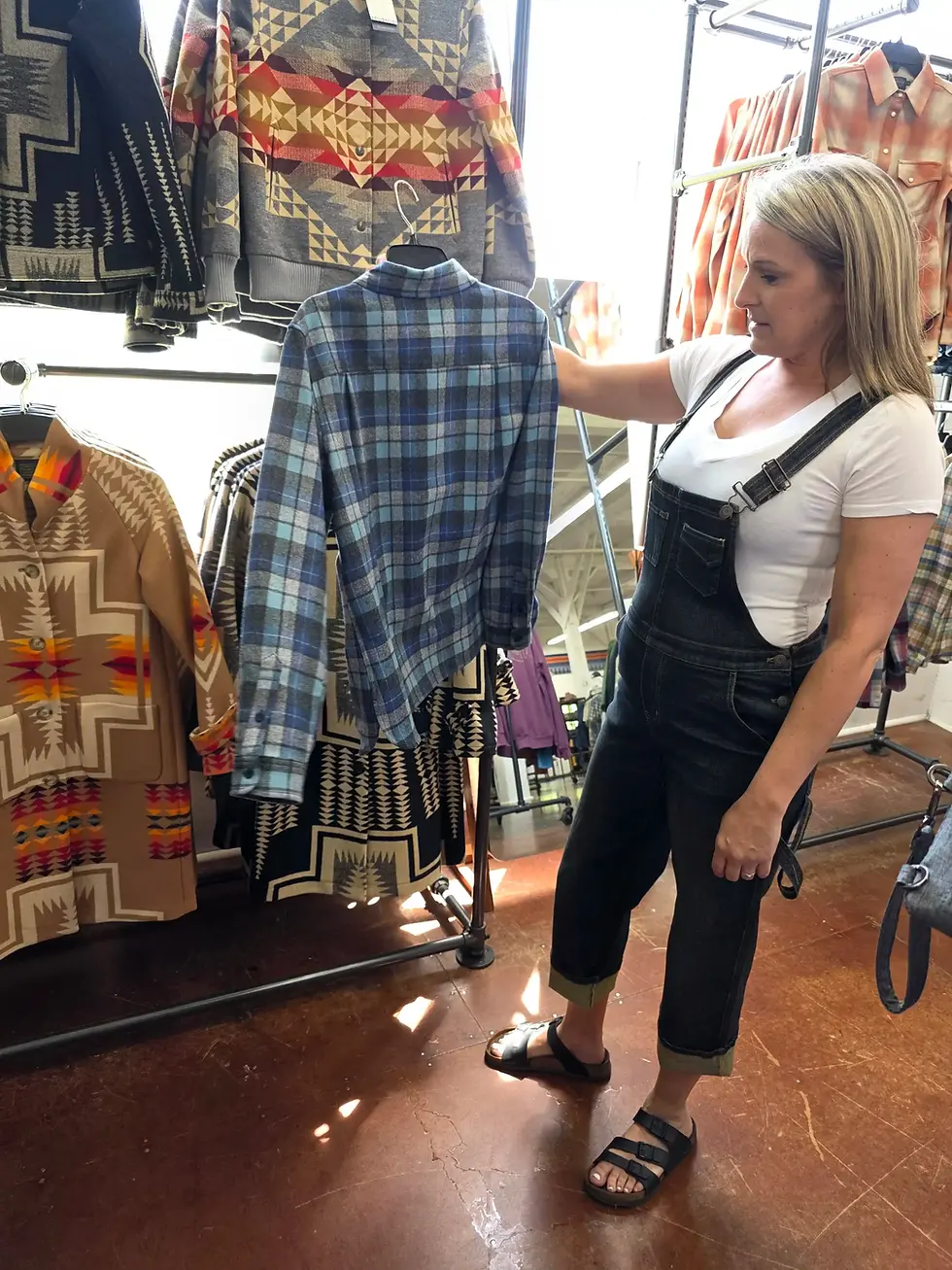
Katie points out how wonky the store building is. There's not a straight pillar in the store, and when the graphics were added a few years ago around the walls, she tells us they had a nightmare matching the pattern up, as none of the walls are even either. The store has been in this building since 1995. Before that it was a shack in the parking lot.
We got a few tips like washing instructions etc, to maintain the finish of the garments. The blankets can't be washed, but we were told how they could be repurposed. I know I have turned some of mine into cushions or used them in upholstery. They make excellent wall hangings and headboards.
Next we were shown the seconds area, where everything is at a discount.

Katie talked about the brand's Pioneer blankets, made from excess yarns, that creates random stripes and colours. They're sold at half price, so nothing goes to waste here. Katie admitted that some were fabulous and some not her favourite. But, as she said, there's a blanket for everyone here, and some patterns just talk to you.
After a brief chat about the state of the wool industry in the UK, and the resurgence in craft makers for tartan, plaid and tweed, we filled in the paper feedback form and were left to our own devices.
Shop at Pendleton Washougal Woolen Mill

It was refreshing to see the brand history and ethos, displayed simply yet effectively around the store, printed on wooden panels. Oregon and Washington are lands of timber, the top two softwood lumber producers in the nation, accounting for a third of the building materials produced in the US.

The brand show off their sustainability credentials around the store. Effective, transparent communication of verified actions (e.g., certifications, energy savings) turns eco-efforts helps engage conscious consumers and justifies the premium price tags. It is certainly something that I look for.

Remember I mentioned that the scraps were bagged up for crafters. I didn't quite appreciate the bags would be this enormous.

There are boards of old and new photos and a mini loom, that shows of a little of the process for those not doing the tour.

And I am a sucker for vintage finds from a brand's past put on show, and punch card clocking in machines are a personal favourite. I remember using one, maybe not this old, but there's a nostalgic clunk sound playing in my head every time I come across one. (I keep finding them in visitor centres, like the one in Strathisla Distillery)

The blanket choice was overwhelming, even with helpful displays showing each pattern.

The brief history behind the Trade Blanket on show next to shelves filled with them, does deliver a deeper understanding for customers. These aren't just decorative items after all.
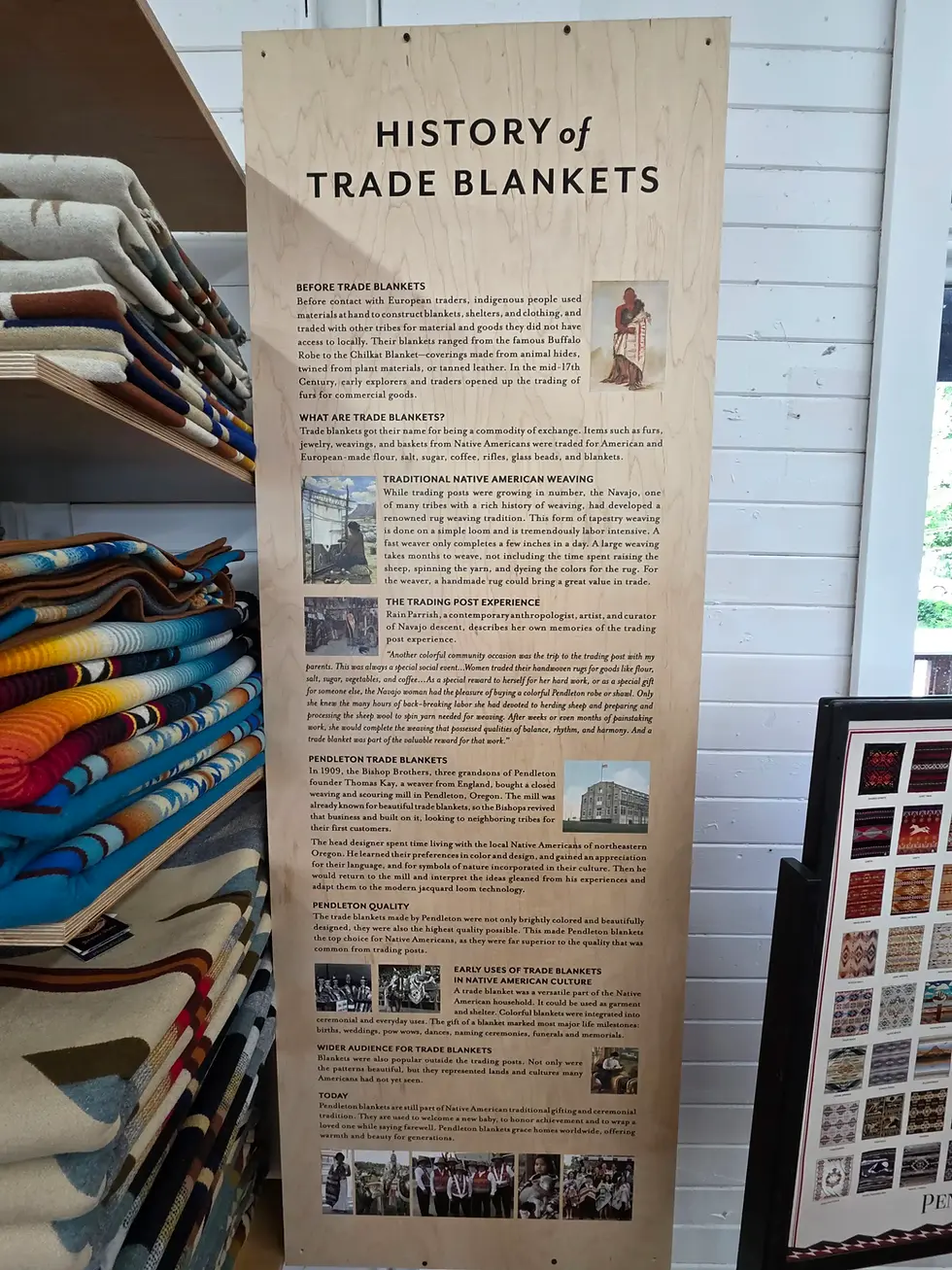


The historical information puts them into context and details dotted about referring to the American Indian College Fund, which I mentioned earlier, makes them feel even more special and makes customers feel they are making a positive impact through their purchases.

And if the tribal blanket style is not your thing, then there's the National Park blankets to choose from.

Each blanket has a special woven label with the park name and an image of an important natural landmark.

It is another example of giving back whilst decorating your home, as the brand supports the National Park Foundation, the official charity of America's National Parks and has raised nearly $2.4 million from proceeds from these colourful keepsakes.

Maybe you need something more rugged? The brand's best selling Yakima Camp Blankets might be more your thing.

Now for my biggest regret. I ummed and ahhed over this stunning olive, terracotta and grey toned Seven Springs blanket for nearly half an hour. It was a considered purchase at $550, plus I was faced with buying yet another suitcase to lug home (I'd already bought an extra one and was travelling with three already). My bedroom is dusty pink so would have needed a repaint job to make it work too. To buy or not to buy - that was the question.

What made it harder was that these come with a Scottish link, which is where I live for goodness sake! They honour the methods behind overshot blankets, woven on simple four-shaft looms, brought to America by Scottish Weavers. In search of cheap land and freedom from feudal landlords and religious persecution back home, they settled in North Carolina, grew their own flax and cotton, and raised sheep for wool. There were so many Scots in North Carolina, it was dubbed 'New Scotland'. Coloured with natural dyes, the historic Appalachian examples are museum exhibits. I eventually decided to leave this one behind and have since found the Abington Hall Throw in various colours that just might make it to my home yet.

When you are already spoilt for choice with patterns, why not buy some towels? I did. The super soft White Sands set now graces my guest bathroom, it's subtle pop of dusty pinks and blues complimenting walls and furniture painted in Farrow and Ball colours.

Not everything is wool. Maybe you want a few of these cotton cushions (or pillows if you're an American)?
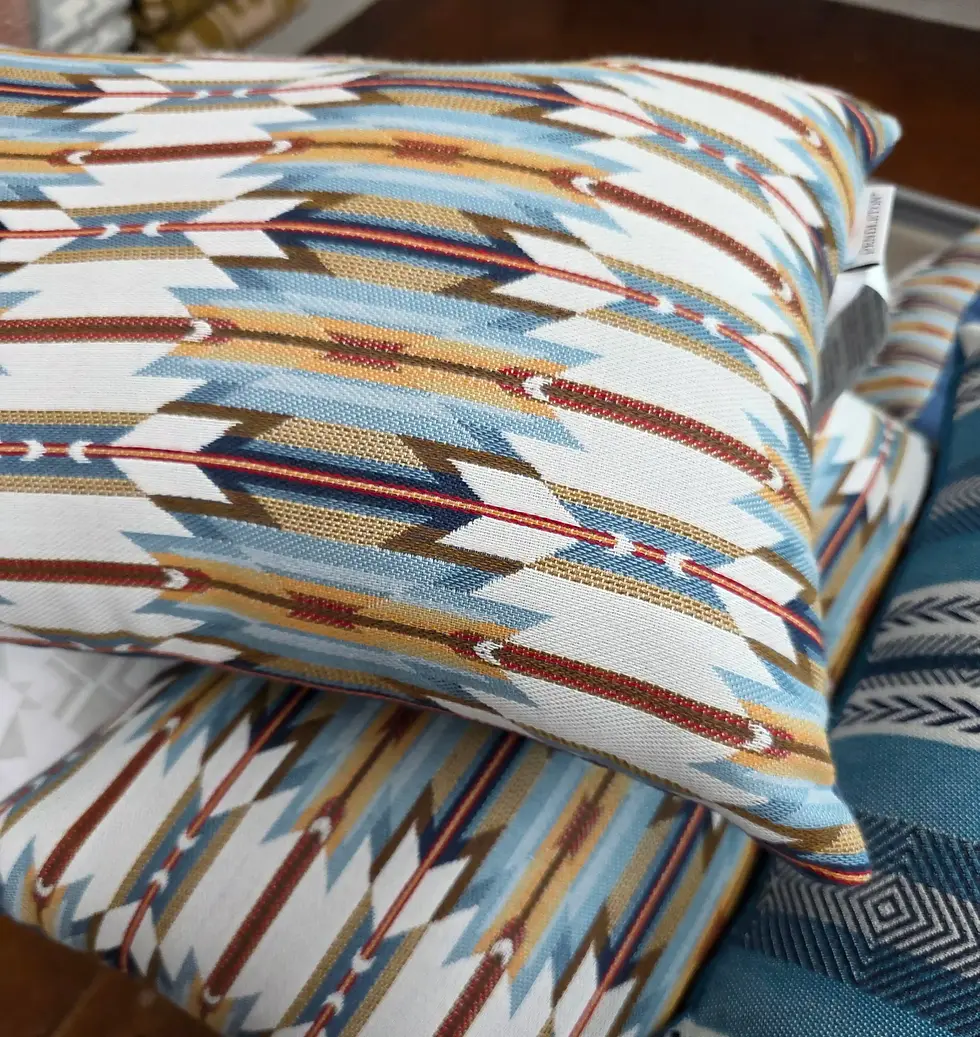
And there's always clothing, accessories and a plethora of other goods to consider.

I ended up with two Chief Joseph cushions, a design launched way back in the 1920s, honouring the Chief Joseph, the Northwest's Nez Perce leader, who fought for peace and became famous in 1877 for leading his people on an epic flight across the Rocky Mountains, when they were forced off their homeland forever. It's another item that gives back, as a portion of the profits from this design supports grants to promote the preservation of Native American language, and helps Indigenous people seeking careers in healthcare.
Pendleton Passport
The Pendleton Passport is a great idea, though I couldn't really make much use of it as I only had one more day left in the area.

I had been in Salem days before, drinking wine in one of the many vineyards, and didn't even know about the old Thomas Kay Woolen Mill. I am an avid ink stamp collector, so am kicking myself that I didn't get mine stamped. They offer a personalised, tangible record of a journey, an interactive keepsake. I have books of them from all over the world.
I am always encouraging brands to produce something similar to the passport, as the nostalgic and simple joy of gaining stamps in a book is often underestimated. You can read more about the benefits of a Passport scheme on my guide to the Kentucky Bourbon Trail. Our trip had us collecting stamps on the Bend Ale Trail, in the McMenamins Passport, in the Passport To Your National Parks® booklet, and even our old favourite, Portland's Distillery Row Passport, is set to return soon. Get stamp hunting folks.
Is a visit to Pendleton's Washougal Woolen Mill worth it?
Pendleton's Washougal Mill has survived two world wars, the collapse of the textile industry, and the rise of fast fashion. But what really surprised me was how alive it still felt. There’s something oddly emotional about watching a blanket being made from scratch, something that’ll be given as a gift, wrapped around someone, kept for generations. Seeing how much goes into it, how much care and skill is needed at every stage, makes you appreciate it differently.
The Washougal Mill experience isn’t shiny or polished. It’s honest. And that’s exactly what makes it so special. (This video shows you the process - and Katie our lovely guide.)
The store has enough brand information to put their goods into context. Their sustainability efforts are in evidence. The recognition of the Indigenous communities that inspire their patterns is there for all to see. The staff are welcoming and friendly.

I might have regretted leaving the heavy blanket behind, but I did, however, leave with a set of mugs, several towels, two cushions and a wooden bobbin and plenty of memories. Not bad for someone with luggage restraints. The wool fabric is also available to purchase by the yard at the Woolen Mill store in Portland, in case inspiration strikes and you decide to create your own project. If you knew my sewing skills, or lack of them, you'd appreciate why I'll leave this up to the experts.
If you find yourself in the Pacific Northwest, go to one of the Pendleton experiences. Take the tour, see the looms, run your hand across a newly woven bolt of fabric. Try to fill up your passport. It’s not every day you get to witness living history, still working, still relevant, and still making beautiful things that matter.
Plan your visit to Pendleton Washougal Woolen Mill
Address
2 Pendleton Way, Washougal, WA 98671, United States
Website: Pendleton
How long was the visit?
We spent an hour on the tour and another hour in the store.
How much are tickets?
Tours are free and this was not part of any advertising. They must be booked in advance though online.
Opening times
Pendleton Woolen Mill does not offer tours on weekends or holidays, and the tours run at 11am and 1pm. The shop is open though Monday to Saturday 9am - 5pm and Sundays 11am - 5pm.
Getting to Pendleton Washougal Woolen Mill
From Portland it is a 30 minute journey and from Vancouver, WA it is just a 20 minute drive along the WA-14 to the Washougal Mill. There is ample parking outside. It can be done by public transport but requires several changes, so don't bother and Uber it if you need to.
Where we stayed for our trip to Pendleton Washougal Woolen Mill
We were based in Portland for 7 nights and stayed just off my favourite street, NW23rd. Several of Northwest Portland’s historic Victorian homes, full of old world charm, like the one we stayed in, have been reimagined as boutiques, galleries, theatres and restaurants.

You can book this basement flat through Airbnb, and Zoe was an excellent host, who recommended lots of places to eat and things to do. There are 2 double bedrooms and free street parking with a permit, which Zoe arranged for us.
What to see around Pendleton Washougal Woolen Mill
I could write down hundreds of suggestions for things to do in and around Washougal and Portland, as it is an area I hold close to my heart and return to often. Check out my guide to Aviation Gin for some suggestions, and Visit Washougal's website, but here are a few more, tried and tested by me, that you can add to your itinerary.
The Columbia River Gorge area is just breathtaking. Drive 40 minutes from the mill along the Oregon side of the valley, and take a break from I-84 at a very famous rest stop, Vista House at Crown Point, and you'll be rewarded with great photographs of the gorge. Get another perspective of the octagonal gem, dating from 1918, from the Portland Women's Forum State Scenic Viewpoint just up the road.

20 minutes drive from the mill in Washougal and you will find Fort Vancouver National Historic Site, which was the Hudson's Bay Company fur trading headquarters and a major political, cultural, and commercial center of the Pacific Coast during the early 1800s. If you appreciate a costumed guide like I do, then there's a plenty of fun to be had here, with lantern lit tours, an old village, historic reenactments, gardens and a visitor centre. If that isn't your thing, then the small but perfectly formed Pearson Air Museum might be more up your street.

Drive for an hour east from the mill and you'll end up in windy Hood River. Its waterfront is definitely blustery, with winds funnelled through the gorge, now harnessed by water sports enthusiasts. Known as the Wind Sports Capital of the World, you can watch kiteboarders one minute then grab a coffee at Stoked Roasters and Coffee House, or a beer and a bite at pFriem Family Brewers, before you wander round the town's independent shops.

Travel a few minutes south from Hood River and you'll discover the Hood River Fruit Loop, farm to table restaurants, cideries, wineries and farms such as Packers (tip - great fun for kids) known for their fruit and flowers. Sitting amongst lavender fields with views of snow capped mountains is better in real life than any Instagram picture.

Drive for 2 hours from the mill and then lace up those walking boots for a 6 mile loop hike at Bird Creek Meadows. Now, this is on Yakama Nation land, so you will need to check what months it is open for visitors. You will discover beautiful wildflower meadows, some great views of Mount Adams, Washington's second highest mountain, and the Hellroaring Canyon, plus lots of small lakes and waterfalls. Top tip - go anticlockwise for an easier romp.

Further reading
If homes and gardens are your thing then we have guides on our site such as our guide to Yankee Candle Village, Magasin Du Nord Museum, RHS Garden Bridgewater or the John Lewis Heritage Centre. Guides to places like Wedgewood, Noritake Ceramics, and Royal Copenhagen coming soon.
A book I found very useful was Pendleton (Images of America) by Elizabeth Gibson, available through all good book shops.

And for more information on trading blankets then check out Barry Friedman's site. He provided many of the blankets used in the film Killers of the Flower Moon and is an industry expert on their history.
Please note - I'm real
I visit every brand visitor centre and experience myself. My feedback is real, based on a single visit, but informed by years of experience designing and exploring brand experiences all over the world.
I love writing my own reflections, diving into a brand's history, doing the research and looking at spaces through the eyes of a commercial interior designer. With over 30 years of working with customers, I also enjoy watching how guests interact with guides, displays and spaces. Everything I share is honest, personal and entirely human, not AI generated.
That authenticity is important to me, and if it's important to you and you want to work with me, or share your experiences or want to suggest others, then I am happy to be contacted via this website.
Photographs: ©Julie White unless noted otherwise - On this occasion Pendleton agreed that I could use images off their website and social media accounts
Disclaimer - The views and opinions expressed are solely my own. I paid for the tours in full and any comments reflect my personal experiences on that day. Please drink responsibly. Please visit and garner your own thoughts and feel free to research the brand and the visitor centre in question.


Comments