


The Visitor Centre Today is ... Rosewood Winery
From bees to bottles: How Rosewood Winery blends generations of beekeeping with ambitious wines and mead on Ontario’s Beamsville Bench.

The Global Buzz
The world has gone a bit bee mad.
David Beckham turned beekeeper in the pandemic and now jars up out his own Golden Beez Honey, and recently launched his own BEEUP honey snack company. Beyoncé's making honey for her kids. Morgan Freeman turned his 124-acre ranch in Mississippi into a bee sanctuary!
Hollywood is even getting in on the apiary action. In The Rivals of Amziah King, one of my favourite actors, Matthew McConaughey, stars as a charismatic, mandolin strumming honey farmer and bee whisperer, taking on crooked agricultural tycoons in Oklahoma.

There's a sequence in it where McConaughey holds a queen bee between his fingers, which attracts a swarm of bees to cover his hand. Was it done with CGI, or worse, AI?
Absolutely not. That's 12,000 live bees swarming up his arm, filmed in one continuous 40 minute shot. Brave? Definitely, especially when you learn that McConaughey is allergic to bee stings.
We are all now drizzling fiery, chili-infused hot honey over absolutely everything, so much so that the New York Times recently crowned it the 'King of Condiments'. Meanwhile mead has completely broken free of its stereotypes. It's not Vikings or monks that just made the stuff, mead is one of the fastest-growing segments of the global craft beverage scene.
When the war in Ukraine broke out, my aunt and uncle opened their home to a mother and her young daughter fleeing the conflict. They quickly became an irreplaceable part of our extended family. It was through them, over chaotic family dinners in Wales, often featuring Natalia's wonderful multi-layered cakes, that I first learned Ukraine is also a global superpower when it comes to bees. They produce more honey per capita than almost anywhere else on Earth. They're the market leader in Europe, and the fifth biggest exporter of honey globally.
So, when we discovered a vineyard in Ontario that not only had Ukrainian roots, but also offered a beekeeping experience, we just had to visit. At Rosewood Winery we found a delicate relationship between people, passion, land and nature, where hives are as much part of the story as the vines.
But just days later, nature would test that balance.
From Ukraine to Ontario - Rosewood Winery's brand history
Rosewood Winery is built on two things: a dream and a promise. Its stunning agricultural estate, up on Lincoln’s Beamsville Bench, has become renowned for its low-intervention, farm-crafted wines. But its roots can be traced way back. 92 years back in fact, and it's a family legacy that has travelled across continents.
The winery was founded by Eugene and Renata Roman, both of them born in Canada.
But it was Eugene’s father, R.W. Roman, who, as a teenager in Western Ukraine, fell in love with beekeeping. When he eventually crossed the Atlantic, he brought his knowledge and his passion for honey with him. His dream: to make honey wine in Canada.

He spent five years trying to secure permission from the authorities in Ontario. The application was rejected every time, and he returned to looking after the family’s hives and churning out jars of amber goodness. His son Eugene never forgot how disheartened his father was.

Years later, Eugene and Renata fell in love with Niagara-on-the-Lake during their honeymoon. It is here that the promise was made. He vowed that one day they would build a winery there.

It's a place that can have that effect on you. I should know, as we returned there to renew our wedding vows on our 25th wedding anniversary. I'm still waiting for my husband to build me a vineyard, but as we live in Scotland I will let him off.
Eighteen years after their honeymoon, Eugene and Renata bought a property in Beamsville, planted vines and brought the family hives down from Nobleton.
Rosewood opened its cellar door in 2008, with its first wines made from the 2006 harvest. The dream that had begun with R.W. Roman’s bees back in Ukraine, was finally taking shape, with vines and hives growing side by side on the Bench.
2026 sees the vineyard celebrating its 20th harvest. It seemed like the perfect time to visit.
Visiting Rosewood Winery: What to Expect
First impressions - Rosewood Winery
I'd been to two of the vineyards on the Beamsville Bench ten years ago, but only in passing. This time was no different. Our tours were scheduled as journey breaks between Toronto and Niagara on the Lake, not that it's a particularly long drive, but that does depend on the frightful Niagara bound traffic.
It turned out to be a decision we would regret. Not because the wineries weren't any good. Far from it. They were so good we wished we had stayed there for a few more days, to really dig down into what makes this area so special.

On a glorious July day we turned into the drive that leads up to Rosewood Winery, passing a pretty lake with it's own mini island on one side, and rows upon rows of vines and wildflowers to our right. There's a signpost showing the distances to a few of Rosewood's neighbours, because Rosewood are not alone here.
Before we get to the bees, the wine and the honey, we need to talk about the Bench. Rosewood sits on the Beamsville Bench, between Hamilton and St Catharines, where the Niagara Escarpment rises behind the vines, and Lake Ontario stretches out below. It is part of Ontario’s Niagara Benchlands, a wider wine-growing region, home to nearly 50 vineyards. The vines benefit from long autumns and a slow ripening season, and the views are truly spectacular. The climate can also be unpredictable, as we were about to discover.

At the top of a slight hill sits the main winery building, a sophisticated, symmetrical off-white structure.

It was very elegant and understated.

Well tended flower beds and terraces filled with colourful pots greeted us.

The interior design is simple and crisp. White shiplap contrasts with black accents, stone floors, beautifully tactile rippled tiles and potted foliage. As a designer, I liked it very much.

The Rosewood tour
We lucked out with a private tour, only because no one else had booked that same timeslot, and started, as all great winery tours should, with a glass of wine, poured for us by our gem of a guide, Anne.
Not your average tour guide, Anne Cumby, Rosewood’s Estate Sommelier, describes herself as a hospitality “lifer.” She told us she had the best job in the world. A serious barista bosslady, her love of cooking and people brought her finally to wine tourism and education. She certainly knew her stuff. But this wasn't a stuffy, technical laden experience. The welcome was much warmer.

I’m not usually a sparkling fan, but a recent trip to the Champagne region in France has encouraged me to try a few more bubbles in my life. So I was quite happy when Anne poured a glass of Rosewood’s NV Charmat for my husband and me.
This non-vintage sparkling wine project began with the 2016 harvest. Small volumes of base wine from successive vintages were aged separately in neutral French oak before being blended and given a second fermentation in tank, using the Cuvée Close, or Charmat, method, basically making the bubbles in bulk before bottling.

Anne described it as a little bit like a family reunion, with the older wines bringing wisdom and the younger ones adding energy. Anne suggested it would make an excellent breakfast wine, although she wisely advised against wasting orange juice on it. It was fresh, lively and a fitting way to start the afternoon, though I then had to awkwardly juggle my glass while taking photographs and video on my phone to accompany this article.
I'm not sure haggis, which we often have as part of our cooked breakfasts, would pair well with it I told her. Anne was open to finding out. There is a Scottish shop in Niagara-on-the-Lake selling delicacies such as oatcakes, tablet and tinned haggis. Trust me, though. Don’t bother with the haggis. It is not a patch on what we get over here.
Anne also described herself as the keeper of Rosewood’s stories. It is a role that suits her. This was not a conveyor-belt tour delivered from a script. She knew the family, the land, the vines, the hives and the people behind the bottles, and was clearly delighted to share the lot.
It also helped that her family was from England, so we swapped stories of where we had lived and visited, before we went a bit off-piste chatting about seeing legends such as Willie Nelson, Queen and Paul Simon in concert. Music is so often a great bonding topic.
Our first stop was the brand-history wall, where black-and-white family photographs were hung on a wooden display designed to resemble a honeycomb.
An eye full of dreams and a pocket full of bees

Anne began to fill in the gaps between the photographs, helping to bring the family story to life. When R.W. Roman emigrated to Canada he was not simply dreaming vaguely about making mead one day. He was experimenting with recipes in his garage, waiting for the licence that never arrived. Anne described his story as an "eye full of dreams and a pocket full of bees." You see, after Prohibition in the 1920s, the Liquor Control Board was formed, the LCBO, and they put a licensing freeze on the making of alcohol over 7%. It lasted a lot longer than you might think. For nearly 50 years! That was why Inniskillin, which we had visited a few days before, were the first post-Prohibition winery to gain a license in the region, way back in 1975. Sadly R.W. never got to see that as he passed away before the freeze was repealed.

After R.W.’s death, Eugene helped his mother keep Holly Park Apiaries going. Every Saturday, he drove roughly 70 kilometres from Pickering to Nobleton, loaded the van with honey at the family’s apiary and set off towards Niagara to make deliveries before turning round for the journey home. Eight to ten hours a day, every day, a weekly cycle of driving, lifting and delivering that kept the family business alive.

Eugene then meets his wife Renata, who is obsessed with France, French culture, food and wine. One day he promised, he would buy her her own winery. I'm sure she believed him as much I would have believed my husband. But they had their own lives. She was a physiotherapist with her own practice. He invented the laser that invented the internet for IBM. You can't just give that up can you? They sold the beekeeping brand but kept some of the hives and found a neglected plot of land. Finally, in 2008, Eugene’s promise to Renata came true. Rosewood opened its cellar door, with its first wines made from the 2006 vintage, and the family’s long-awaited winery and meadery was finally up and running.

Eugene and Renata then spent more than two decades turning the family’s bees into a working winery, meadery and hospitality business. They planted the vines, built the cellar, opened the doors and did the difficult work of making Rosewood viable.

Anne showed us a photograph of William, the third generation, alongside Charlie, the vineyard dog. William Roman grew up surrounded by the business, but that does not mean he was automatically destined to join it. He initially studied business at McMaster University with a future in technology in mind. Then, halfway through his degree, he changed direction, enrolled at Niagara College and committed himself to wine and beekeeping.

Since then, he has worked vintages in New Zealand and British Columbia, gained further wine qualifications and returned to Rosewood as its General Manager.
William, Anne explained, is both a dreamer and a doer and she told us about one of the bigger building projects. The original winery was much smaller than the building we were standing in, so William had it lifted and moved backwards to create space for the patio. Not extended, not knocked down and rebuilt: lifted and shifted.
As someone from Scotland, where we tend to treat moving an entire building as a fairly radical suggestion, I found this astonishing. It is a huge undertaking, not a casual bit of renovation. Yet Anne explained it so matter-of-factly that, for a moment, it sounded like the sort of thing you might put on a weekend to-do list.
The property was not a blank canvas when the family bought it either. An old barn stood where the car park is now. Rather than dismantle it and pay to have it taken away, they buried it around 30 feet underground, below the frost line, and built the car park above it. It is still down there somewhere.
After hearing that, I began to suspect that “we’ll just make a few changes” means something rather different in the Roman family. My husband may want to take notes.
From the patio to the vines
We passed a room where a large table was set out for a pre wedding dinner. A vineyard is a great place to tie the knot, or in fact celebrate anything.

Then it was out onto the new patio, under the welcome shade of a new pergola, before we stepped in between the vines.

The vines we walked through are part of Renaceau Vineyard, Rosewood’s original estate vineyard, planted in 2003. The winery also has a second estate site, Blackjack Vineyard, in Jordan, Ontario, on the Twenty Mile Bench, developed between 2007 and 2010. It is around 20 acres and gives the family another landscape, another set of growing conditions and more room to work with varieties including Riesling, Pinot Noir, Chardonnay and Pinot Gris.

The soil here is deep clay with some dolomite and limestone. We got talking on the tour about where Niagara's grape-growing story actually began, and Anne wasn't quite sure of the answer, so I had a little dig afterwards. It turns out grapes were here long before European varieties arrived. Indigenous peoples were harvesting native wild grapes growing throughout the Niagara region, primarily for food, and there are even early European accounts of wine being made from them. The commercial wine industry came much later, initially using North American grape varieties before European Vitis vinifera varieties began to take hold.

We walked past the Cabernet Franc, and Anne pointed out Chardonnay, Cabernet Sauvignon and Petit Verdot too. On the other side of the road, the vines climbed the hill with Riesling, Gamay and Pinot Noir. There’s a real sense at Rosewood of farming with the land rather than simply farming from it. Their approach is low intervention, with minimal chemicals and plenty of attention paid to what grows between the vines. Nothing is too tidy here, by design, and there's wildflowers and nearly 1000 lavender bushes that add to the flora and fauna. And, perhaps unsurprisingly for a winery that keeps bees, pesticides are firmly off the menu.

One of the things that makes growing European grape varieties in Niagara possible is something you barely think about: phylloxera. It's a tiny pest that attacks grapevine roots, and when it arrived in Europe in the 19th century it devastated vineyards across the continent. The solution was to graft European vines onto phylloxera-resistant North American rootstock. So when you’re drinking a Niagara Chardonnay, Riesling or Cabernet Franc, the fruit may be very much European in origin, but the roots underneath it are often North American. Ontario grows dozens of different wine grapes, although a relatively small group dominates the industry and Anne used her coffee background to describe some of the flavour profiles of the grapes they had on site.

Harvest we were told, happens anywhere from the end of August all the way to the end of October, depending on the weather that year.

One thing that really messes with your head when you look at North American weather maps on the TV is the latitude. Here in Kinross, I'm at about 56°N, whereas Rosewood in Niagara is down around 43°N, roughly 13 degrees farther south, sitting around the same latitude as northern California and Burgundy, So despite the Canadian winters we tend to picture, Niagara is actually much farther south than Scotland. It also made me think about how wine-growing regions are shifting as the climate warms, with places such as Yorkshire now having increasingly good harvests. Wine geography is clearly not quite as straightforward as the maps on the telly make it look.

We watched a tractor pulling a machine through the vineyard, spraying the vines to protect them from mildew. The spray was organic we're reminded. It was oddly hypnotic, going in and out of every row.
Across the driveway is another beautiful building, with columns, arched doors and windows fronted by beds of hydrangeas. This is one of the the estate houses, which the family use.

But in the basement beneath it, is something very special. This is where they have their library. Not for dusty old books, this is a library of wine. My kinds of library, back vintages rather than paperbacks.
The garden and the kitchen
That same relationship between land and product continues into the garden. When Estate Chef Peter Pietruniak arrived, he brought with him years of culinary experience gained throughout the world, but also a passion for all things seasonal and local. He's a bit of a star. He's worked at world renowned, Michelin starred restaurants aorund the world, for the likes of Heston Blumenthal.
Even the prosciutto is aged in the cellar.

The kitchen garden is not presented as a flawless piece of garden design. It is a working garden, which means it has enemies, as does mine back home. Deer, rabbits, squirrels, a groundhog and squash beetles were all apparently doing their best to eat the results before they reached the kitchen. I know the red squirrels so beloved in Scotland are the reason I abandoned raspberries, as they got to them quicker than I could.

We swapped tales of companion planting, gluts of rhubarb, successes and failures. How we both tried dog pee or chilli liquid to deter the pests, and even the use of tumble-dryer sheets, which were flapping in the breeze, to discourage the deer. We joked that it's probably all in vain.
The tomatoes looked way better than mine ever did though. There were veg beds crammed with leeks, beans, peppers, courgette, cabbages, artichokes, dotted with tomatillo and fennel plants. Turn around and you could see currants, cherries and trellises of raspberries. I wondered how my few beds back home were faring in the unpredictable Scottish summer.
A vineyard with bees
The hives are not simply decorative. Rosewood have around 8 million bees. They're not all on the one property though. There wouldn't be enough wild pollen and nectar to feed them all if they were. The apiaries are dotted throughout the Beamsville Bench, some on land rented from other local Niagara farmers.

As bees generally forage within a few kilometres of home, the vineyard landscape has to work for them as well as for the visitors who come to admire it, so the vines are interplanted with lavender, clover and other flowering plants to give the bees the food they require. The grapevines themselves, it turned out, do not use the bees for pollination.
A few days earlier, in Chicago, we had driven through an atmosphere so thick with wildfire smoke that the skyline was replaced with a tobacco tinged haze, and smelt like the back room of a pub circa 1985. The smoke, we were told, had blown down from wildfires in Ontario. So I asked Anne how the bees coped when the air turned that bad. I had always assumed smoke made bees sleepy and obliging. This is partly true, although the beekeeper’s smoker is doing something rather more complicated than sending them off for a little nap. A small amount of smoke interrupts their alarm signals, which is why beekeepers use it when opening a hive. Wildfire smoke is a different proposition altogether. Prolonged smoke can scramble the visual cues bees use to navigate, making it harder for them to find their way between hive and flower. They may stay inside, forage less and become more protective of what they already have. Suddenly they're not so keen to share their precious resource with us.
A fragile balance
It is tempting to look at a vineyard on a sunny afternoon and see only the idyllic version of farming. The estate depends on a delicate balance of weather conditions. The lake and the escarpment help create the microclimate, but they cannot guarantee perfection.
A few days after our visit, the heavens opened and the Niagara region saw torrential rain and severe flooding. Vineyards were under water, and we wondered what would become of Rosewood's vines and its bees down in their ditch behind the kitchen garden. I contacted the brand to be told that sadly many of the bees had been washed away. The news was a sobering reminder that this relationship between people, land and nature is not fixed or guaranteed.
The production
Our tour continued with the crush pad. Unlike old-school mechanical screw presses that crush everything in their path, a bladder press like this one applies uniform, controlled pressure. This squeezes out the pure, high-quality juice without breaking the bitter grape seeds or tearing the skins, resulting in a much smoother, less astringent wine. It sat next to a door labelled Honey Room, which had us intrigued, though we were watching the birds flying back and forth to their nests perched precariously on rafters and wires along the walls.

Rosewood’s wines are made using a low-intervention approach, including only wild fermentation. Rather than adding a single yeast culture to create a completely predictable result, the team turns to their winged companions for something unique. As the bees fly across the estate, they collect wild yeasts on their bodies and deposit them directly onto the skins of the grapes. When these grapes are crushed, these yeasts drive the fermentation. It creates a wine that is literally the taste of a place. It makes the process slower and there is certainly more risk involved, but that only adds to the flavour and character of the wines they produce.

The production area is a bit of a logistical juggling act. They're making about 9000 cases of wine a year, but the stainless-steel tanks don't sit idle in between harvests. This is when they turn their hands to around 1000 cases of mead to fill the gap. That's what Jesse, one of the winemakers we saw, was attending to when we were there in July. Talk about efficient.


What exactly is mead?
Whereas wine is fermented from grapes, mead is crafted by fermenting honey, water, and yeast. And despite the myth that it is always cloyingly sweet, it can actually be fermented until it is crisp, sparkling, or bone-dry, much more like the ones we sampled later at Rosewood. The flavour completely depends on the flowers the bees visited and the entire ecosystem of the hive.

The cellars
Through another door and we found a couple of clay amphoras from Spain, which they use for aging smaller runs. We mentioned that Georgia was to be our next wine trip, where they bury their egg-shaped earthenware vessels underground to ferment, age, and store their wine.

Through another door was the pièce de résistance, the beautiful red barrel cellar, with the illuminated bee logo on the far wall.

There's a couple of hundred barrels down here, most of which are neutral French oak.

It was here that Anne introduced us to MLF. Not the KLF, who's rave tunes I danced to in the late 80s. MLF is malolactic fermentation, which the brand uses in several of their wines, like their Flora Rosé, the White Rabbit White blend and their highly popular Gewcci, made from Gewürztraminer grapes. It's a natural process where bacteria convert sharp, tart malic acid into smooth, creamy lactic acid. Anne described it a bit like sandpaper, where oxygen is polishing the edges. Too long and it takes all the character out. Just long enough and there's smoothness but still a little texture. We learn something on every visit. To be fair, it's not everyday you get a sommelier doing your tour.

I have to mention the consistent bee branding. It's everywhere and so simple yet effective. It reminded me of the city of Manchester's historic bee emblem, denoting the city's hard work ethic, community unity, and resilience. All things present at Rosewood too.

It was very atmospheric. We chatted about why their wines had proprietary names rather than grape variety labels. I think that's important nowadays to address wine snobbery, or built-in bias to certain grapes. I know plenty of folk who hate Chardonnay or Merlot for example, and never try one. I blame the movie Sideways. Just like a gin distiller or a master blender, the winemaker's goal is to recreate a specific, trusted style every year. If one harvest makes the Chardonnay too heavy, they can dial it back and add a bit more Pinot Gris or Riesling to keep "White Rabbit" tasting exactly like the crisp, easy-drinking white that makes it such a fan favourite. And why not have a bit of Lewis Carroll whimsy.

The cellar is a space you can linger in a little longer, if you're booked onto the Archive Tasting, which runs from Friday to Sunday. That is where you get to sit surrounded by barrels and enjoy back vintages and exclusive pours. Imagine four courses of wine, old and new, side by side, all picked by Anne, with a small plate designed by the chef to pair perfectly with the wine based on its tasting notes. At $120 CAN each it might sound expensive, but as we told her, we'd visited a winery in France where one of our tours with a tasting cost £150 ($280 CAN) each! Trust me, that tour was not a patch on this one. The exchange rate was helping us though.

The tasting
After all the tour information, it was time to rest up and enjoy the view. We ordered a flight of Rosewood wines, four x 1.5oz pours, and found a spot on the patio, breathing in the delicate, herbal notes of lavender whilst watching bees buzzing around collecting nectar. It was idyllic.

This is an area you can book out for a private event - if you have 32 friends with you. Mine would have to pay for their own flights, the wine kind as well as the plane kind.

First up was their 2025 White Rabbit. 100% wild fermented and aged in stainless steel, it's a blend with just over half being Riesling and the rest made up of Pinot Gris and Chardonnay. It was just how I like it, crisp like a juicy green apple, with a touch of citrus and the wild fermentation giving it a bit of a mineral hit. It went down very well on such a hot day.

Next up was the 2025 Flora, proving everyday is indeed a rosé kind of day. 'Best enjoyed chilled with a side of friends' the blurb says. I did wish my friends were there to take it all in. Another wild ferment, it is mostly Gamay (72%) with the rest made up of Cabernet Franc.

I make jam from fruit in my garden, so this tasted like my homegrown strawberries and conference pears, not overly sweet. I could have drunk a bottle quite happily. But it is great with food and I was getting peckish.

We had dinner reservations in Toronto, so thought a few light bites, or “vineyard tapas”, as we had started calling it, would hit the spot. I have never met a sausage I did not like, so the estate-made Berkshire pork and herb sausages with sauerkraut and mustard were our first pick.
If these were the heritage Berkshire pigs I know from back home in the UK, they are considered the Wagyu of pork for a reason. As a vulnerable rare breed, they should be revered as such. Packed with flavour, they were fabulous, and the rosé’s acidity cut through the richness of the meat beautifully. I could have eaten another plateful.
Fun fact: the Berkshire pig is considered the oldest identifiable hog breed in the UK, with references dating back to the 1600s. It became the first officially recorded pedigree breed in Britain during the late 18th century and arrived in the Americas in the early 1800s.
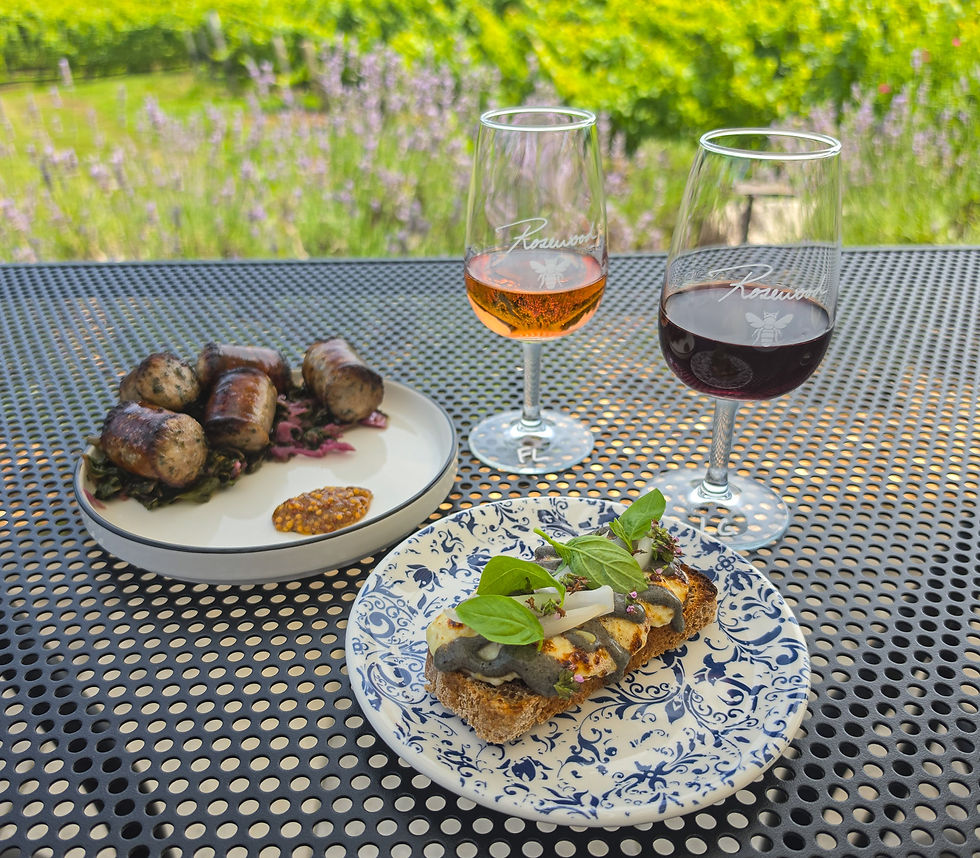
Having already demolished their sourdough and honey butter we turned to their seasonal menu for a final morsel.
You cannot beat a good cheese on toast in my opinion. Alongside an artisanal sausage roll, it has to be one of my favourite foods. So when I saw that they had crowdie on the menu, I was sold. Crowdie is a Scottish cheese, a sumptuously soft, unripened cow's-milk cheese, tangy and spreadable. This was from a local dairy no doubt, as Rosewood prefer to source from independent farmers in Niagara and Southern Ontario. Topped with golden beets and walnut pesto it did not last long. They suggested it paired with the Reisling, but I had it with their 2023 Looking Glass, which was a bit special. 78% Cabernet Franc, 15% Cabernet Sauvignon and 7% Petit Verdot, all three grapes are fermented separately and then aged separately for nearly 2 years in neutral French oak, before being blended and bottled with zero filtration. It was bone dry and full of bright acidity, savoury earthiness and dark fruit, which worked surprisingly well with the creamy crowdie and sweet, earthy beets. Yum.
Last up was the 2024 Mead Royale, a semi-sweet traditional mead made from Rosewood's Niagara Escarpment wildflower honey. Honeyed and little gingery, with a lovely caramel note it would have been great with a slice of cake, and as the last glass of the flight it was a great way to finish.
The shop

The shop is small but perfectly formed as they say.

There is mead. Their Mead Royale, which we sampled as part of our flight, is a steal at $20 CAN. There are a few others, plus a Meadhattan, should you fancy a cocktail and fries night.

Blau was another bottle that caught my eye, largely because I loved the name. It sounds like a blue wine, Blau is German for blue after all, but it is actually a bright, bone-dry red made from 100% Blaufränkisch grapes. At $25 CAN, it is an approachable way to try something outside the norm. It is vegan-friendly, bottled without being filtered or artificially clarified, and should be served slightly chilled. A red wine for people who want to try something other than rosé perhaps. I'd never heard of the grape before but will keep an eye out for it over here.
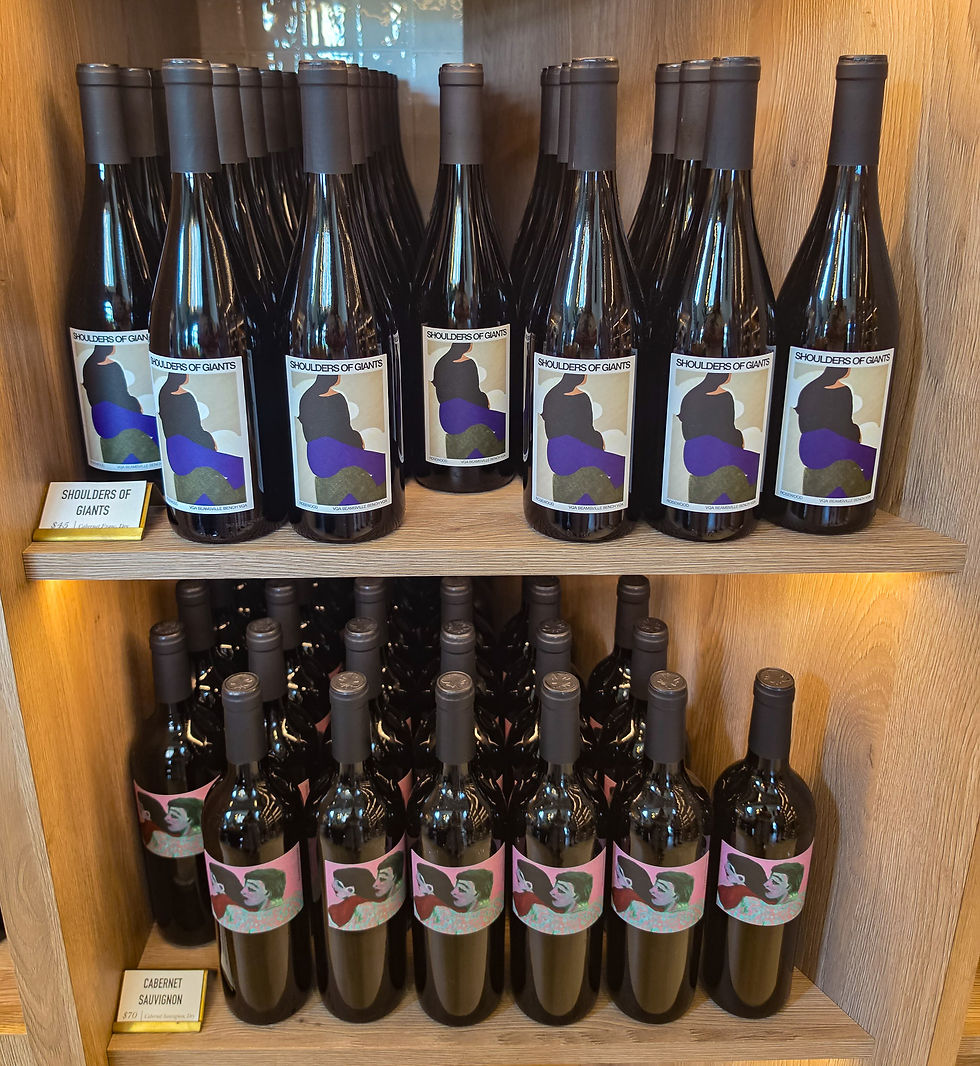
With bottle names like White Rabbit, Waited On The Thunder and Lock Stock & Barrel, Shoulders of Giants caught my eye too. It is a $45 CAN Cabernet Franc made from old vines at Rosewood’s Renaceau Vineyard. The name comes from Isaac Newton’s line about seeing further by standing on the shoulders of giants. With 20 months spent ageing in French oak, it is apparently rich, structured and made for settling in with a good meal rather than knocking back casually on a random Tuesday.

Night Moves had me at the label itself. It looked like a throwback to rugby club Christmas discos of my youth, all tinsel, backcombed hair and rubbish chat up lines.
It is made from Gamay Noir, a grape that was new to me until my trip to Niagara. I liked it so much that I now find myself drinking Gamay back home in Scotland too. Light, fruity and bone-dry, Night Moves is the sort of red I would happily serve slightly chilled, preferably with music on and the salt and vinegar crisps already open.
Their Low Fidelity Pinot is another one that would be perfect for us menopausal women who just can't cope with the heavy chiantis any more. I managed to score an extra tasting and it was light-bodied, bone-dry and full of bright red fruit.

It was good to see that they had a few back vintages for sale too.

Do they lean into their honey products? You bet they do. There are beeswax candles in various shapes and sizes, plenty of different honeys, honeycomb and fudge.

Rosewood has also just launched a new product made from 100% beeswax.
I did not bring any home with me, partly because I was not entirely sure what I would do with it and partly because international travel has a habit of making innocent-looking natural products unexpectedly complicated. I still remember the argument at Berlin Airport when security classified a Christmas-market candle as a liquid, justified with the line: “When it melts, it is a liquid.” Trust me, never again.

There is a local honey company near me in Scotland, Webster Honey, which runs workshops and classes. I may book myself onto one and learn what I should actually be doing with beeswax before attempting to become a wax expert. For now, I will leave that particular craft to Rosewood.

I think they could do even more, turning a few honey based goodies into viral trends like the famous butter tarts at nearby 13th Street Winery, which were so delicious I went back twice for them! Rosewood do sell hot honey, which has exploded in popularity.
Maybe honey cakes like a Medivnyk, the Ukrainian layered cake that our lovely friends were so good at making, or a spelt and honey bread to take away, something that could go with the cheese and charcuterie packs.

They do, however, have plenty of bee logo merch alongside apparel and a selected range of homewares. Even dogs get Rosewood wine toys.

I fancied the mug, but the suitcase weight allowance had me double guessing.

I was very happy to find stickers and iron on patches. I collect them, and know plenty of folk who do the same. My Rosewood bee patch now adorns one of my trusty travel holdalls. Everyone will get to see it on my travels.

Beekeeping experience
Now for something unique for a winery in the Niagara region. Rosewood have offered a Bee Experience since the Spring of 2026, during which visitors get gussied up in protective gear, venture out into the hives and learn a little about the craft of beekeeping. It is only offered between May and September, so the bees are having a little beauty sleep and taking time to recover as I write this.

Usually my months of meticulous planning deliver a travel schedule where I can set aside time for activities such as this. I love a brand experience that goes beyond the standard tours after all. This one is only available on Saturdays for example. Guess when our flights, booked a year before, in and out of Toronto were? Saturday. Typical!
At just $60 CAN per person it's a bargain, as you get up to 180 minutes of tuition. It's on my to-do list for when I return.

What made the suitcase?
It was a tough choice. I only had room for one bottle and, after a three-week road trip, my duty-free allowance had already been thoroughly tested. Strict decisions were required.
The iron-on patch made it home without a debate. Choosing the wine was harder. In the end, we went for 2024 Mead Blanc.

Anne knew I loved Riesling, but she also knew I wanted to take home a proper reminder of Rosewood’s beekeeping legacy. Mead Blanc felt like the perfect compromise: a pyment-style mead made with 97% Riesling and 3% honey. After a quick sample of it in the bar, our decision was final.
It's bright, fresh and gently sweet, with the Riesling bringing its familiar citrusy lift and the honey adding something softer underneath. It is a little bottle of Niagara joy that manages to represent both halves of Rosewood’s story: the vineyard and the hive. I can't wait to share it with friends in Scotland.
Is Rosewood Winery worth visiting?
Some vineyards in Niagara want to feel like their Californian counterparts. Rosewood's award winning wine and meads are top notch, and their restaurant doles out plates that are not just Instagram worthy, but hyper local gastronomic delights without the pretension. The vibe here is classy, but with a bit of edge. Experimental, fiercely authentic and family owned, more like you find in the Willamette Valley, Walla Walla or Asheville.
Take a tour, if you only visit for the infectious enthusiasm of our guide, Anne. Her beaming smile, easy humour and obvious wine knowledge made for a fabulous way to spend an hour.
If you like great wine that is surprisingly gentle on your pocket then you're also sorted. Everything we tasted could have scored the precious spot in our suitcase, which made choosing so difficult. Be warned. they make a limited number of cases, so they sell out fast.
Take the time to enjoy a tasting with something fabulous to accompany it on the patio, watching the bees buzzing through the lavender. Even better, book on a Saturday and add in the Beekeeping Experience. I was gutted to have missed that.
I have a free suggestion (I'm feeling generous) - a cookery book. Chef Peter get writing.
Follow up - What I paired with the Mead Blanc (the suitcase 'star')
Those wonderful wine memories that I stuff lovingly into the nooks and crannies of my suitcase, come back to Scotland , and wait for their moment to shine. For the Mead Blanc I created a honey inspired supper, and invited friends, one of whom is a chef. I'm always daunted to cook for him, so I plumped for something bomb proof, raiding my garden for a few of the ingredients, to give us that farm to table vibe we had at Rosewood. Unscrewing the bottle cap and there was a gentle fizz. The wine was light, zesty with a subtle sweetness that was in no way overpowering. Served cold, it would have been perfect for a refreshing tipple in the garden. But this was October in Scotland and there was a chill in the air that had us hunkering inside with the underfloor heating on. Proper sweater weather.
I served up a Pear and Stilton galette with walnuts and honey, a Marks & Spencer's recipe using my home grown pears, shop bought puff pastry (don't judge me!) and local heather honey. I love blue cheese, so I might have been a bit more liberal with my stilton sprinkling. It was gorgeous.

After a selection of cheese and charcuterie, all served with a drizzle of honey, it was time for dessert. For this I made a Warm peach, pistachio and honey cake, another online recipe, and it was a winner, and even better cold the next day. It was forgivingly easy, packed with fruit and had a great crumb.

Both recipes are now firmly part of my dinner party repertoire.
I am sure Chef Peter would approve.
Plan your visit to Rosewood Winery
Address
4352 Mountainview Rd. Lincoln, ON, Canada
Website: Rosewood Winery
How long was the visit?
Our tour lasted an hour, with another 90 minutes for the tasting and lunch.
Rosewood Winery tickets?
We paid for our tour, purchases, food and drinks, and this was not any form of advertisement.
Winery Tour & Tasting from $40 CAN.
Opening times
It's always worth checking with the winery for their current opening times, as they can vary.
Open Sunday through Thursday 11am - 5pm. Friday and Saturday 11am -6pm.
Tastings and experiences by reservation. Walk-ins welcome.
The Wine Shop is open daily.
Getting to Rosewood Winery
If you're staying in Toronto getting to Rosewood Winery is easiest by car. It'll take around 90 minutes, depending on traffic. In fact I don't even know how you'd get there on public transport.
We were staying in Niagara on the Lake but visited Rosewood on our way back to the city. It's around 40 minutes from the popular tourist town.
Where to stay when visiting Rosewood Winery
This was our third trip to Niagara on the Lake and each time we have stayed in a different Airbnb.

This last cottage, Secret Garden Cottage in Old Town Niagara-on-the-Lake, available on VRBO was by far the best. Exactly as it is in the pictures, we were spoilt with space and comfort. It was walking distance into town, and quiet, with the added benefit of being next to a small convenience store and greek deli. I will return again.
What else is there to see close to Rosewood Winery
We were based in Niagara on the Lake, which we love, as we wanted to be in wine country. But there is more to the area than wine.
Dundurn Castle National Historic Site is, if you're lucky, about a half hour drive from the vineyard in Hamilton. Former home of Sir Allan Napier MacNab, railway magnate, lawyer and Premier of the United Canadas back in the 1800s, it will deliver Downton Abbey vibes. Its tour showcases the contrast between life upstairs and downstairs.

If whisky or gin are more you thing, then why not head for a tour or tasting at either Forty Creek Distillery in Grimsby, or Dillon's Small Batch Distillers in Beamsville.
The St. Catharines Museum & Welland Canals Centre offers an incredible, elevated viewing platform to watch massive international freighters navigate a 326-foot engineering marvel up close. The museum covers things like Canada's national lacrosse history and the city's vital role as a terminus for the Underground Railroad.
We had great fun at the Fort George National Historic Site in Niagara on the Lake. A time capsule of the War of 1812, visitors can explore meticulously reconstructed wooden barracks, officers' quarters, and a rare original stone powder magazine, while interacting with costumed guides who recreate the daily lives of British soldiers defending the Niagara frontier.

And, of course, we have to mention the famous big bit of water half an hour from the vineyard. Niagara Falls, on the Canadian side especially, is epic. Ignore the often tacky tourist parts and stick to near the water. We have visited three times and we're still not bored of it. Being a lover of history and travelling with an engineer, this last trip we thoroughly enjoyed an afternoon at Niagara Parks Power Station, learning all about Nikola Tesla and the visionaries behind creating power from the Horseshoe Falls.

Better still, you descend in a glass elevator to a tunnel, which comes out at the foot of the falls for a totally different angle on this natural wonder. Spectacular.
Further reading
If you liked this article then check out our other guides to Spirit and Alcohol brands.
Please note - I'm real
I visit every brand visitor centre and experience myself. My feedback is real, based on a single visit, but informed by years of experience designing and exploring brand experiences all over the world.
I love writing my own reflections, diving into a brand's history, doing the research and looking at spaces through the eyes of a commercial interior designer. With over 30 years of working with customers, I also enjoy watching how guests interact with guides, displays and spaces. Everything I share is honest, personal and entirely human, not AI generated.
That authenticity is important to me, and if it's important to you and you want to work with me, or share your experiences or want to suggest others, then I am happy to be contacted via this website.
Photographs: ©Julie White unless noted otherwise
Disclaimer - The views and opinions expressed are solely my own. I paid for the tours in full and any comments reflect my personal experiences on that day. Please drink responsibly. Please visit and garner your own thoughts and feel free to research the brand and the visitor centre in question.

Comments