


The Visitor Centre today is ... George Eastman Museum
Updated: Aug 11
If the Kodak Visitor Centre tells the story of the brand, the George Eastman Museum tells the story of the man. And it is a fascinating story indeed.

"A Journey Through Photographic History, where every picture tells a story."
That was the tagline for my guide to the Kodak Visitor Centre, covering a brand I have a long, personal history with. Kodak revolutionised photography by making cameras and film accessible to everyday people like me, helping to popularise the snapshot and preserve billions of memories worldwide.
While the Kodak Visitor Centre is very much a brand experience, or, as we call it in the design trade, a brand home, in Rochester, New York, you soon realise that Kodak's influence stretches far beyond photography. One of the world's most influential technology and manufacturing companies didn't just change how we all took photographs; it helped shape the very city it called home.
You might catch a show at the Kodak Centre, a venue housed within what was once part of Kodak's vast industrial complex. That's where I found the brand's visitor centre.

You can't miss the iconic Kodak Tower either. Completed in 1914, the 19-storey building became the headquarters of the Eastman Kodak Company and remains one of Rochester's most recognisable landmarks, with the famous yellow Kodak name still emblazoned across its roof.

If you like your classical music, dance or opera, then head to the Eastman Theatre. Built in 1922, the stage has hosted some of the world’s greatest musicians, conductors and artists, such as Bernstein, Stravinsky, John Williams, Yo Yo Ma and Jennifer Hudson. Sir Winston Churchill even graced the stage there in 1932 on a lecture tour.

You can even tour parts of the Kodak factory, although getting access requires jumping through a few hoops. Sadly, I wasn't successful this time around, but perhaps now that I've spent more time documenting the brand and its heritage, I'll have better luck on a future visit. I do enjoy a good factory tour.
But no trip to Rochester, in my opinion, would be complete without a visit to the George Eastman Museum. This was the home of Kodak's founder. While the museum operates independently as a non-profit educational institution rather than a corporate attraction, you'd be hard-pressed to separate the man from the legacy he created.
It is also the world's oldest photography museum, housing a collection so vast and significant that it practically charts the history of photography itself.
What I loved most was that this isn't just a museum about cameras and photographs. As you wander through Eastman's beautiful home, explore the galleries and spend time in the gardens, you begin to understand the person behind the brand.
Here, his interests, ambitions, philanthropy, and, of course, his passion for photography are woven into the very fabric of the building, offering a glimpse into the life of an innovator who changed our visual culture forever before leaving it on his own uncompromising terms.
George Eastman - The Man behind Kodak
If you read my Kodak Visitor Centre piece, you will know the broad strokes of the company’s history. But George Eastman, the man behind the brand, has a fascinating story in his own right.

Born in 1854 in Waterville, a small farming community in upstate New York, Eastman was not born into great wealth. His father ran a business college and a small nursery; his mother took in boarders to make ends meet.

When George was six, the family moved to Rochester. Before he turned eight, his father died, the family's finances collapsed, and he left school early. By fourteen, he was helping to support his mother and two sisters, working first for an insurance company and later as a junior clerk at the Rochester Savings Bank.

Life, however, was not entirely work and responsibility. He tried learning the flute, apparently without much success. He studied French, collected art, took dancing lessons, and tinkered with mechanical devices at home. He had the restless curiosity of someone who was always looking for a better way of doing things.
The moment that changed his life came when he was twenty-three. A colleague suggested he take a camera on an upcoming trip to the Caribbean. Eastman bought the equipment but never took the trip. Instead, he became utterly fascinated by photography itself.
At the time, taking a photograph meant lugging around a microwave-sized camera, tripod, fragile glass plates, chemicals, and often a portable darkroom. The plates had to be prepared, exposed, and developed while still wet. Eastman was convinced there had to be a better way. For three years, he experimented in his mother's kitchen, often working late into the night after finishing his day job at the bank. Hundreds of experiments failed. But eventually, sheer persistence won out.

He developed a machine capable of coating dry photographic plates that could be prepared in advance and stored for later use. It was an important technical breakthrough, but more significantly, it revealed the idea that would define the rest of his career. Eastman was not simply interested in making photography better for professionals. He wanted to make it easier for absolutely everyone.
In 1879, he sailed to London to patent his invention - a 25-year-old from upstate New York taking on the world. Back home, with a US patent in place, he and old friend Henry Strong set up the Eastman Dry Plate Company on 1 January 1881 in Rochester.
Then came the products that changed everything. In 1884, he invented a lightweight roll film holder system. Four years later, he had designed a camera with the roll holder built directly inside the box.

But what to call it? He simply liked the letter K - strong and distinctive - and after experimenting with combinations, Kodak was born. "A trademark," he later explained, "should be short, vigorous, incapable of being misspelled." It was all three.

Customers took photographs and returned the entire camera. Kodak developed the film, printed the photographs, and sent the camera back loaded and ready. The famous slogan captured the simplicity perfectly: "You press the button, we do the rest."

Demand grew rapidly. In 1889, Kodak shipped machinery to Harrow, northwest London, establishing large-scale manufacturing in Britain. Orders flooded in from around the globe. That same year, Eastman received a letter that must have caught his attention. It was an order from Thomas Edison. Edison was developing his motion-picture camera and needed photographic film. The relationship that followed helped create an entirely new industry. Edison built the camera. Eastman supplied the film. Together, their technologies helped lay the very foundations of modern cinema.

The brand's Brownie camera was advertised as being able to be operated by any school boy or girl, and was produced for 86 years, from February 1900 until 1986. It was this very camera that was my first, a gift when I was eight, and what ignited my passion for photography.
Kodak's products would go on to record some of the most important moments in modern history, rather than just my family and travel snaps. Among the most remarkable are the photographs taken by Herbert Ponting on Captain Scott's famously unsuccessful Antarctic expedition of 1910-13 - images so extraordinary that Ponting himself called them "the most remarkable negatives in the world."

When he later fell on hard times during the Depression, it was Eastman who quietly sustained him with equipment and correspondence. Kodak film went on to record coronations, Olympic Games, state occasions, and countless moments that shaped the twentieth century.
Kodak motion-picture film recorded coronations, Olympic Games, state occasions, newsreels, and countless moments that shaped the twentieth century.

For all his success, Eastman remained a surprisingly private man. He never married and lived quietly in his Rochester mansion from its completion in 1905 until his death. He became one of the richest men in America, but was unusually progressive as an employer - introducing profit-sharing, employee stock ownership, and disability benefits long before such ideas became commonplace. During his lifetime, he donated about seventy-five per cent of his wealth (around $3.25 billion today) to universities, hospitals, dental clinics, and cultural institutions. He became one of the largest private donors to the education of Black Americans, with a $9 million donation to Tuskegee and Hampton institutes. Did he want his name above the door? Not at all. He donated anonymously under the simple pseudonym "Mr Smith."

On Eastman's seventy-fifth birthday, Thomas Edison sent a message that beautifully captured the respect he commanded:
"On this your birthday, I send you my hearty congratulations, not because you are seventy-five years old, but because you have successfully fought the storms and vicissitudes of a strenuous life and have achieved great and enduring things."
By then, Eastman was suffering from a painful and progressive spinal condition that increasingly limited his mobility. Facing the prospect of life in a wheelchair, he chose not to wait for the inevitable. On 14 March 1932, at the age of 77, he took his own life in his Rochester home, leaving a characteristically brief note: "To my friends: my work is done. Why wait?"

Visiting the George Eastman Museum: What to Expect
George Eastman's Mansion and Gardens
Farming and gardening were in George Eastman's blood. In 1902, he purchased 8.5 acres of farmland on East Avenue in Rochester and set about turning it into his private estate. His 35000-square-foot mansion, completed in 1905, was in Colonial Revival style, so grand but not overly showy, which feels rather in keeping for a man who liked to keep himself to himself.
The grounds were set out as a working farm, with formal gardens sitting alongside rows of greenhouses and potting sheds.
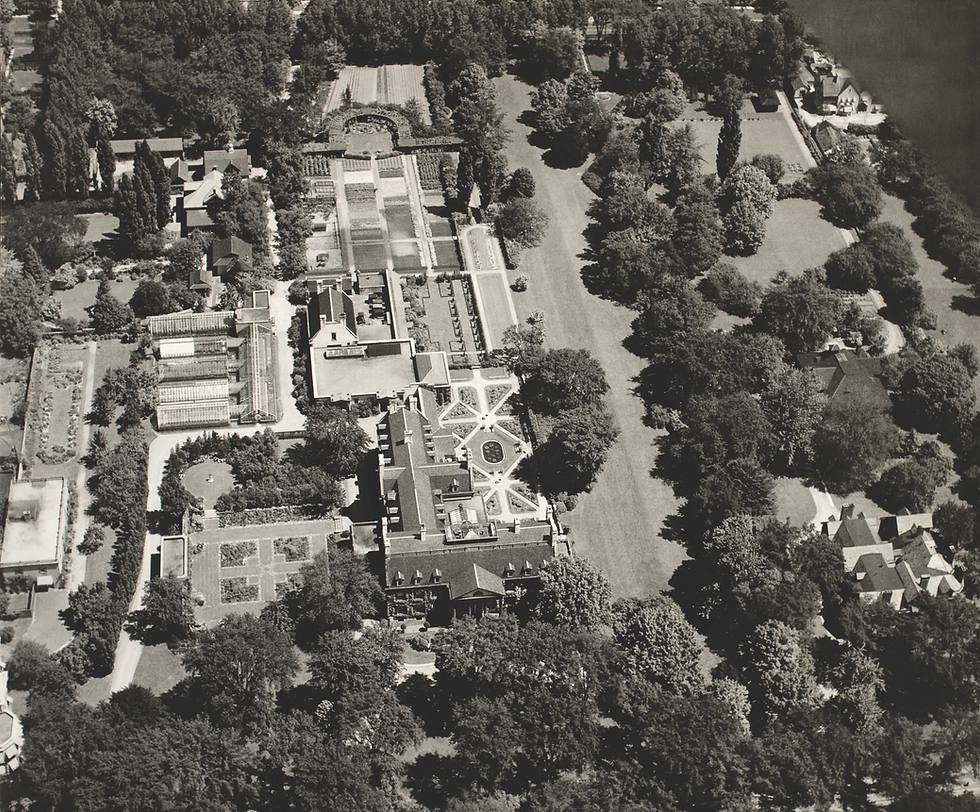
To help shape the interiors, Eastman brought McKim, Mead & White, one of the most celebrated architectural practices of the Gilded Age. The firm had already left its mark on the original Penn Station and parts of the White House, so he was clearly not cutting corners.
When he later decided he wanted a larger conservatory for better acoustics, the solution devised by architect William G. Kaelber was, frankly, extraordinary. The entire rear section of the mansion was physically cut away and moved more than nine feet using hydraulic jacks, tracks, and wheels. That's some cut-and-paste job.
When Eastman died, he left the mansion to the University of Rochester, with the hope that it might serve as the president's residence. It was a generous thought, though perhaps not an entirely practical one. A 50-room estate, it turned out, proved rather a lot to manage without a full complement of staff.
So, in 1947, the George Eastman House was chartered as an independent nonprofit educational institution, and the university handed over the property. When it opened to the public in 1949, it was the world's first museum dedicated entirely to photography.
For decades, the collections were displayed in the rooms of the house itself. But as the archives grew, it became increasingly clear that a historic home was not exactly the ideal environment for storing fragile nitrate films and delicate daguerreotypes.
George Eastman Museum
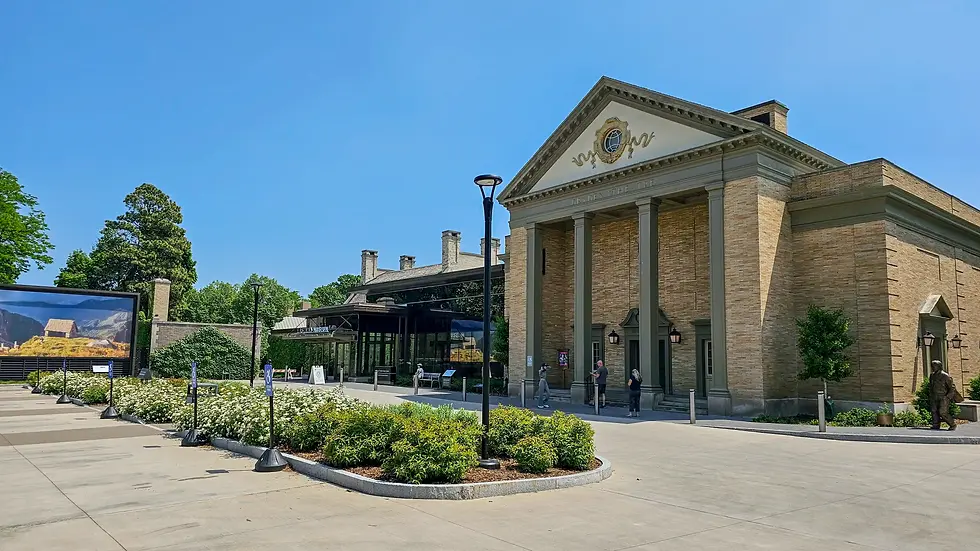
In 1989, a modern 73,000-square-foot facility was built alongside the mansion, cleverly tucked mostly underground, so as not to disrupt the historic landscape above. It is a thoughtful piece of design, though it does mean that what most visitors actually get to see is just a fraction of what is held here. Behind closed doors, and all manner of clearance checks, are stairs down into the archive, tantalisingly close and yet very much off limits.

Entrance - The Thomas Tischer Visitor Center
Opened in 2020, the $5 million Thomas Tischer Visitor Center was created to provide the George Eastman Museum with a more convenient, welcoming and accessible entrance and visitor hub. Designed by Flynn Battaglia Architects, the contemporary pavilion incorporates the preserved façade of George Eastman’s historic garage.

Once you've checked in, you can enjoy the wall displays on George Eastman's life.

Although created for children, I found the I Spy activity surprisingly rewarding as an adult.

Here I was hunting shapes, lettering, colours, and things beginning with letters - which is why my phone gallery from that day is full of close-up typefaces, random labels, and the inner workings of mechanisms I would never have stopped to look at otherwise.

I did something similar at Ny Carlsberg Glyptotek, a gallery I have visited multiple times, and both times it got me to notice things I had walked straight past before. It's a clever nod to the way museums are changing, moving away from 'do not touch' glass cases and towards things that actually get you looking closely.

I often design similar scavenger hunts for tours and groups. We can all do with playing a little more.

One of the most Instagrammable spots was a wall display of dye samples, used to create the iconic Technicolor film look.

There's so much to see, and photographs are encouraged. I left with several hundred on my phone, and know that they won't be up to the standard of those taken by the photography nerds that might read this. Don't judge them too harshly!
The Collections
The sheer scale of what is held here is genuinely difficult to wrap your head around. The museum houses over 400,000 photographic objects, tracing the medium from its birth in 1839 right up to the present day. It is, in every sense, the full story of photography under one roof.
The core of the collection was built on three major private acquisitions, including that of Gabriel Cromer, whose extraordinary collection of early French photography was spirited out of Paris by Kodak just months before the German invasion in 1939. It is one of those details that stops you in your tracks.
Today, the archives hold works by everyone from Louis Daguerre and Ansel Adams to Andy Warhol and Dorothea Lange. Some of the names will be immediately familiar; others, I'll be honest, were new to me. The photography world has its own constellation of heroes, and unless you are deep in that world, you will not know all of them. But that is rather the point of a place like this.
History of Photography Gallery

Camera geeks will be in heaven as they check out the permanent collection, charting the evolution of photography equipment. I won't show them all, but picked out a few favourites that caught my eye.
You'll spot items like this mahogany-bodied Debrie Parvo movie camera from 1912. This compact piece of kit became the industry standard for silent-era cinema and recorded five minutes of film, with operators busily hand-cranking it as they shot.

I still remember buying my Canon EOS Rebel 300D nearly two decades ago. It was my first DSLR and, although it helped me produce a fair share of terrible photographs, it completely changed the way I approached photography. Seeing Kodak's 1989 Tactical Camera at the museum was a reminder of just how far ahead the company was. Never intended for commercial sale, the prototype was developed for potential military applications and combined a modified Canon F-1 camera body with Kodak's pioneering digital imaging technology. Long before digital photography became mainstream, Kodak engineers were already building working DSLR-style cameras that helped lay the foundations for the technology we use today. You can read more about Steven Sasson's groundbreaking work in my guide to the Kodak Visitor Center.

In another case, there's a 1962 Questar Standard 3.5 inch telescope, renowned for its "Rolex-like" craftsmanship. Ignoring all the tech specs, I liked it for the moon and stars charts on the sleeve and hood. It became a favourite among amateur astronomers, scientists and even NASA personnel. Its secret weapon was Pyrex glass, made by Corning just down the road, which stopped the mirrors warping. Corning Museum of Glass is another brand home that you should visit. It is a 90 minute drive from Rochester, and was the next stop on my trip, and it is where you will see first-hand how their innovations in glassmaking helped advance fields ranging from astronomy and photography to modern technology. (Guide coming soon).

Eastman Kodak played an indispensable role in pioneering space photography, acting as the technological "eyes" for NASA's historic lunar and planetary missions. In one case is their 1967 Lunar Orbiter Photograph Subsystem, an automated photographic minilab crammed into a space satellite. Derived from classified military spy satellite technology, it successfully mapped 99% of the moon to find safe Apollo landing spots.

The iconic 1968 "Earthrise" photograph taken by William Anders on Apollo 8 was shot on custom-formulated Kodak Ektachrome film.

And, a year later, on Apollo 11, astronauts used a Kodak camera with a specialised trigger handle designed for thick, pressurised gloves to capture close-up photos of the lunar surface as they walked on it. That camera is still up there.
There are often 3 or 4 special exhibitions running at the same time during the year. They are on a diverse range of topics, with links to photography or film.
And dotted around the building and his mansion, are even more examples of film and photography equipment.

Inside the George Eastman Mansion and Gardens
For many visitors, the house and gardens are the main draw, and it is easy to see why. Tours of the house are offered daily and you can also do a garden tour between May and October. It is well worth using the audio guide as it gives a much deeper experience.
You enter through the Palm House and Colonnade, stepping almost immediately into a world of Edwardian elegance that feels a long way from the modest upstate New York childhood Eastman had left behind.

Information on how the garden developed are displayed on the walls.

The dining room ceiling plasterwork is rather special, and the audio guide does it justice. The painstaking restoration of these rooms deserves more than a glance. We were told it was modelled after the White House in Teddy Roosevelt's time, which says something about the social circles Eastman was moving in by then.

The heart of the home is the vast, light-filled conservatory - the room that, as you may recall, required moving the back of the house to create. Eastman filled the house with plants, giving it a greenhouse warmth that I rather admire, especially as I seem to kill every potted plant I have indoors.

Now, we need to talk about the elephant in the room - literally. Eastman was an avid big-game hunter, and the mansion makes no attempt to hide it. Rather than removing the trophies, the museum keeps them on display as a teaching tool. No one is perfect, and this is a complete, unfiltered portrait of the man.

The billiard room was designed to feel like a British pub - wooden panelling, a gas-lit chandelier, striking stained glass windows. The roundels show the modes of transport of the time, and in the cue stand you will still find Eastman's own cue, his name etched in mother-of-pearl at the base.
In the same room, look out for a rare ornate blanket chest, a gift from Czar Nicholas II. The Czar and his family were obsessed with photography and had bought several Kodak cameras for private family snapshots. The chest was his way of saying thank you to the man who made their favourite hobby possible.

The library is lined with books and dotted with photographs - family snaps alongside images from his travels. George especially liked a wilderness getaway, though more glamping than camping.

He took an active role in designing his own equipment and clothing, working with Abercrombie and Fitch, and had numbered suitcases made with a full catalogue of their contents for ease of packing. Definitely a man after my own heart.

His double-sided desk sits in pride of place in the adjoining sitting room.

The home is full of hidden features.

A wall panel in the grand staircase conceals a large personal safe - and visitors are given the instructions to open it, which is a lovely touch.

What you won't see is his bedroom. On March 14, 1932, Eastman invited some friends to witness a change of his will. After some joking and warm conversation, he asked them to leave so that he could write a note. Moments later, he opened his safe, took out his Luger pistol, retired to his bedroom and shot himself once in the heart. His suicide note, found by the household staff, "To my friends, My work is done, Why wait?" sits in a display case and gives a poignant pause.

George Eastman's Pipe Organs
While trophy hunting should remain a thing of the past, his house was built with all the cutting-edge conveniences of 1905, many that we recognise today, including air conditioning, an elevator, a central vacuuming system, internal telephone wiring and surround sound, thanks to George's pride and joy, a huge Aeolian Opus 1416 pipe organ.

George loved his classical music, and this was the biggest residential organ in the world at the time. He built not just his house, but his routine around it. Every single morning, a professional organist would play for him while he ate breakfast. He'd return for dinner and to entertain guests at parties. When the organist wasn't available, or just when George had a whim for something different, then up to ten perforated paper rolls could be fed into the mechanism, allowing for long, continuous, automated concerts while he read the morning newspaper.

Over 6,000 pipes are hidden in chambers within the mansion, giving George the orchestral acoustics he was looking for.
And why have one organ when you can have two? To truly immerse himself in sound, George had another organ installed on the first floor, on the opposite side of the house. Both massive chambers were linked electronically and played simultaneously from a single master console. That had at least six types of flute, I noticed. If you're not good at playing the real thing, why not use machinery to do it for you?

Discovery Room
If you need to entertain younger visitors, then head for the hands-on activities in the Discovery Room.


The Garden
The recently renovated gardens are equally impressive. Eastman was a man who liked order, and the Italianate Terrace Garden, with its 23 beds of perennials, reflects that perfectly. There is also a Library Garden, which has the rather clever distinction of being built on the roof of the underground archive vault below, and a West Garden modelled on an English walled garden. In the summer, the museum hosts concerts out here, which feels like a thoroughly fitting tribute to a man who loved music so much.


If you are standing in the grounds looking down East Avenue toward downtown, you can see the steeple of St. Paul’s Episcopal Church. Eastman's mother, Maria Kilbourn Eastman, was a devout member of the congregation. Because of this, St. Paul's became the family's home church in Rochester. George Eastman's funeral was held there, a major civic event in 1932, drawing thousands of mourners as his coffin was carried from his East Avenue mansion across the street into the church.

The Dryden Theatre
Located right on the historic George Eastman Museum estate, is a premier destination for film lovers. As one of only three cinemas in the country capable of safely showing vintage nitrate film, it offers a rare chance to see cinematic masterpieces exactly as they were originally screened. Most evenings, you can catch independent, archival, or beautifully restored movies projected in their native formats on the big screen. Tickets are highly affordable, making it an easy, budget-friendly addition to any local travel itinerary.

Before you head in, look out for the bronze sculpture standing just outside the entrance. It depicts Philip Seymour Hoffman, one of the greatest actors of his generation, caught mid-stride with a messenger bag across his chest, heading to the theatre as if he has just stepped off the street.

Hoffman grew up in nearby Fairport and came to the Dryden as a young man. He won the Academy Award for Capote and received three further Oscar nominations, but never lost his love for the stage or his roots in this part of New York. The sculpture was created by Scottish artist David A. Annand and commissioned by Irish philanthropist James Declan Tobin, who wanted to honour him in the place that first sparked his love of cinema. I have loved him since The Talented Mr Ripley. Actors like that do not come along very often. Sadly missed does not quite cover it.
The George Eastman shop
The museum shop does exactly what a good museum shop should: it keeps you rooted in the world you have just spent the last few hours exploring. Not surprisingly, you'll find books on photography, cinema, and George Eastman himself, and all way too heavy to carry in my suitcase for my return flight. But they were alongside prints, postcards, and gifts that feel genuinely connected to the collection rather than generic souvenirs.

Prints such as this beauty, which documented that the chimneys at the Kodak factory were, in fact, the tallest in the USA back in their day, standing at 366 feet (111 meters).

Open Face - The George Eastman restaurant
The small café is worth knowing about too, and not just as a place to rest your feet.

When I visited, it was busy with a pleasing mix of museum guests and locals who had clearly made it part of their routine. That, to me, is always a good sign. A cultural institution that has worked its way into the daily life of its neighbourhood is one that is doing something right. They did online and curbside orders too. I plumped for one of their sandwich centrefolds, a toasted brie delight on sourdough, with lashings of apricot preserve and cherry butter, the perfect fuel after three hours on your feet.
There's another area for dining with views over the garden, the Palm House, which was closed off behind a barrier during our visit.

Even in here, there is a nod to classic movies. A neon sign glows from the wall above your head, a reproduction of the one that hung above the door of Rick's Café Americain in Casablanca (1942). One of the most beloved films ever made, and famously the most misquoted, it was printed on cellulose nitrate stock, which gives the rich, velvety image quality we associate with cinema's Golden Age. The catch? Nitrate film is highly flammable and can even self-ignite as it deteriorates, which makes preserving it something of a labour of love. Casablanca featured in Kodak's first Nitrate Picture Show, the annual festival at the George Eastman Museum dedicated to the art and science of film preservation, where rare original nitrate prints are screened exactly as they were meant to be seen. "Here's looking at you, kid."

GEM At Home
The George Eastman collection reaches way beyond your visit. The GEM At Home online resource is ever expanding. Using the searchable George Eastman Museum Objects Database, you get access to over 400,000 photographic objects and over 28,000 moving image titles, including the largest collection of original Technicolor negatives in the world. This is complemented by hands-on activities, virtual tours, and online talks that are well worth checking out.
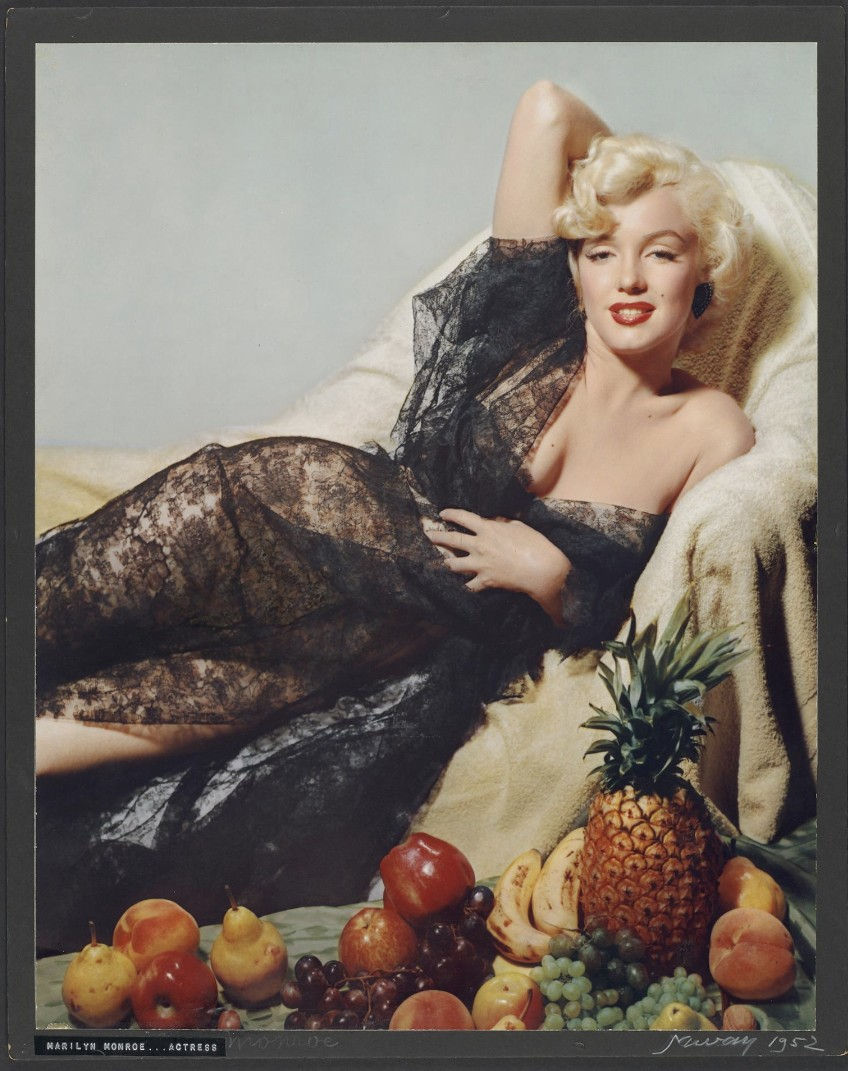
I've spent many an hour trawling through the online collection, finding hidden gems that stop you in your tracks, like this 1952 Nickolas Muray photo of Marilyn Monroe, a portrait that perfectly captures her effortless glamour and luminous beauty. Frida Kahlo's lover, before making his mark behind the camera, Muray was a world-class athlete who represented the United States at the 1928 and 1932 Summer Olympics. He shot over 10,000 portraits of the era's biggest celebrities, including Greta Garbo and Elizabeth Taylor.
Is the George Eastman Museum Worth Visiting?
If the Kodak Visitor Centre gives you the industrial history of Rochester's most famous export, the George Eastman Museum gives you its soul.
It is a beautifully balanced experience. World-class, rigorous curation sits comfortably alongside the intimate, slightly eccentric atmosphere of his historic home. It is a place that celebrates not just the technology of capturing moments, but the man who made it possible for all of us to do so.
I took several hundred photographs and videos, which seemed fitting. The joy of capturing a moment has not faded. Luckily, now I don't have to take just 36 frames and wait weeks to have them developed.
The museum is a real nostalgia hit, too. Whether you are a serious photography student, a film obsessive, or simply someone who enjoys a good nose around a grand old house with nice gardens, it is absolutely worth your time.
You could easily spend two hours here, particularly if you take a guided tour of the mansion and give yourself time to wander. Add an evening screening at the Dryden, and a visit to the Kodak Visitor Centre, and those of you, like me, who have a passion for history and technology, or geeky getaways as I now call them, will have a very fine day out indeed. Just remember to take a picture.
If you or someone you know is struggling, the Samaritans are available 24 hours a day on 116 123 (UK and Ireland). For international support, the International Association for Suicide Prevention maintains a directory of crisis centres worldwide at https://www.iasp.info/resources/Crisis_Centres/
Plan Your Visit to the George Eastman Museum
Address
900 East Avenue, Rochester, NY 14607, USA
Website: George Eastman Museum
How long was the visit?
We were there for 3 hours.
George Eastman Museum Tickets
We paid for our tickets and this was not any form of advertisement.
Adults are $23, Seniors (65+) are $21, and Students and Youth (5-17) are $9. Children 4 and under go free. Active-duty military and SNAP/EBT cardholders also receive free admission.
Opening times
It's always worth checking with the George Eastman Museum for their current opening times, as they can vary.
Tues – Sat 10 a.m. – 5 p.m.
Sun 11 a.m. – 5 p.m.
Closed Monday
Closed Juneteenth, July 4th, Indigenous Peoples' Day, Thanksgiving, Christmas Eve, Christmas Day, New Year's Day
Getting to the George Eastman
There is parking available on-site.
To reach Rochester, New York, fly directly into the Frederick Douglass - Greater Rochester International Airport (ROC), located just three miles from downtown. Alternatively, take an Amtrak train straight to the downtown Louise M. Slaughter Station via the Empire Service or Lake Shore Limited lines. For road travel, budget-friendly intercity buses like FlixBus offer regular service, while drivers, like us, can easily access the city via Interstate 90 (NYS Thruway) and I-390. We were on a 3 week road trip so based ourselves in the city for one night before moving to Ithaca for wine!
Where to stay when visiting the George Eastman
I wish I could recommend where we stayed in Rochester, but for the first time in ages, our Airbnb was terrible. The Strathallan Rochester Hotel & Spa, by Hilton is under a 15 minute walk from the museum. And if you want to save a few dollars then the Hampton Inn & Suites Rochester Downtown is right across the road from the Museum of Play and we stay in that chain quite often.
What else is there to see close to the George Eastman Museum
Rochester is home to the Strong National Museum of Play, the world's largest museum solely dedicated to the history and exploration of play. Spanning 285,000 square feet, it houses massive interactive exhibits, the National Toy Hall of Fame, and the World Video Game Hall of Fame. It will keep kids, big and small, very happy.

Rochester is also where we found the Genesee Brewing Company, with its tour followed by a rooftop deck overlooking the Genesee Falls. It should not be missed. A guide for that is coming soon.

Genesee Country Village & Museum turns 50 in 2026. It's a living history museum, 25 miles from the George Eastman Museum, with a recreated 19th-century village featuring 68 restored homes, farms, schools, and shops. Costumed interpreters and tradespeople (such as blacksmiths, tinsmiths, and potters) demonstrate daily crafts, cooking, and agricultural tasks.
The main draw in this area for most people is the Finger Lakes Wine Region, which has become one of the best-known wine regions in the United States, with vineyards stretching along the shores of long glacial lakes.

The cool climate and lake effect create ideal conditions for growing grapes, especially my absolute favourite - Riesling, which the region is particularly famous for. Alongside the wineries, visitors are drawn by the rolling countryside, lake views, and relaxed atmosphere that make the area feel both scenic and welcoming. Depending on which winery or farm you visit, they are all pretty much a 90-minute drive from Rochester.
I'll post a guide to the vineyards soon, but here are just a few that shouldn't be missed that I have visited:
Dr. Konstantin Frank, founded in 1962 by the Ukrainian-born viticulturist the winery is named after. Dr Frank played a major role in putting the Finger Lakes on the wine map after he successfully grew European grape varieties that many believed would never survive the region’s cold winters.
Barnstormer Winery, which takes its name from the travelling stunt pilots of the 1920s and has built a reputation for small-batch wines and relaxed lake views overlooking Seneca Lake.
Named after the old stone boundary markers once found on the property, Boundary Breaks Vineyard is known for its steep vineyard slopes above Seneca Lake and its strong focus on producing expressive Rieslings in a modern, sustainable setting.
Niagara Falls is a 90-minute drive away in the opposite direction. I've visited the Horseshoe Falls on the Canadian side many times, like the gardens, and the Power Station and Behind the Falls attractions, though the town above the falls leaves me cold. However, I have never done the US side. You get only lateral views on the American side, but you can get closer to the falls there. You can also do both sides in a day, crossing the Rainbow Bridge, which connects the USA and Canada, if you have an appropriate ESTA or similar, of course. Don't forget your passport!

The American side is apparently quieter and greener, and the falls are surrounded by Niagara Falls State Park, America’s oldest State Park, with a few walking paths. The best views of the falls are from Terrapin Point, Luna Island, Prospect Point and the Observation Tower. The boat boarding area is located just below the tower. Don your blue poncho and do it, if only once, as the power of the water cannot be appreciated until you're in front of it.
Further reading
If technology museums or experiences are your thing, then why not check out other guides on our site such as the one to Kodak Visitor Centre. Guides to my visits to Panasonic and Corning Museum of Glass coming soon.
Please note - I'm real
I visit every brand visitor centre and experience myself. My feedback is real, based on a single visit, but informed by years of experience designing and exploring brand experiences all over the world.
I love writing my own reflections, diving into a brand's history, doing the research and looking at spaces through the eyes of a commercial interior designer. With over 30 years of working with customers, I also enjoy watching how guests interact with guides, displays and spaces. Everything I share is honest, personal and entirely human, not AI generated.
That authenticity is important to me, and if it's important to you and you want to work with me, or share your experiences or want to suggest others, then I am happy to be contacted via this website.
Photographs: ©Julie White unless noted otherwise
Disclaimer - The views and opinions expressed are solely my own. I paid for the tours in full and any comments reflect my personal experiences on that day. Please drink responsibly. Please visit and garner your own thoughts and feel free to research the brand and the visitor centre in question.

Comments