


Checkmate - Chess is trending
How chess, the game that was once seen as just for nerds, has exploded in popularity, and how celebrities and brands are getting in on the act.

Chess is having a moment.
According to UN figures, it's estimated that a staggering 605 million adults play chess regularly. Post-pandemic, it's a trend being driven by Gen Z, celebrities and top sports stars. I am not one of them. I was in the chess club at high school for about three weeks, until the bullies got the better of me. I retreated to the art room, which, for me, was a much more natural fit. I'm too creative, generous and distracted for a game that demands you think ten steps if not more ahead. I'm not competitive enough. I want everyone to feel like a winner.
So, why am I writing about chess? Because the game I once associated with awkward school lunchtimes, is turning up everywhere, in football, Formula One, luxury advertising, on TV and also in brand heritage. And brands you can visit to find out more.
From footballers to F1
Erling Haaland thinks chess could become the next big spectator sport. The Manchester City striker became a household name thanks to the global reach of the 2026 FIFA World Cup and he was already a social media sensation. But it's not just scoring or the synchronised "boat-rowing" that the Norwegian has mastered. Off the pitch, Haaland loves his chess.

He's just invested in a new global chess tour, the Total Chess World Championship, with a prize pot of $2.7 million. The aim is to crown an overall world champion across all three disciplines: Fast Classic, Rapid, and Blitz chess.
“Chess is an incredible game. It sharpens your mind, and there are clear similarities to football. You have to think quickly, trust your instincts, and think several moves ahead. Strategy and planning are everything." (Erling Haaland, Norway Chess 2026)
Ferrari's Charles Leclerc learnt chess from his grandfather. What might have started out as a way to de-stress or kill time has turned into a paddock phenomenon. In the F1 Driver Chess Club, grid rivalries are played out across 64 squares. Grandmasters are training them. Their matches are even being live-streamed to millions.

Leclerc extols the virtues of the game, the strategy, training the mind, a moment of calm in an otherwise frenetic world, the challenge, the win. As if he, or Lewis Hamilton, also a chess devotee, needs more competition in their lives.
He's just taken on chess grandmaster Hikaru Nakamura, at the Chivas Regal Arena of Mastery, though not at chess, but a chess-inspired game he has devised called Se!ze.

Live streamed on Chivas Regal's YouTube channel, and in front of a crowd at Monza, a few days before the Italian Grand Prix, the pair played the game the Frenchman devised in conjunction with game designer James Wallis and the Chivas Regal brand. Leclerc, who became the brand's global ambassador in 2025, also worked on a signature spirit to accompany the game, Chivas Regal 16, a blend of 16 whiskies each aged for at least 16 years. You can sign up to be one of the first to play the digital version of the game via the brand's website.
Who won? The chess grandmaster. Charles didn't have a great weekend either. His 2026 Italian Grand Prix ended when he crashed out on lap two.
Chess in pop culture
Avid chess players pop up where you least expect them. Madonna, Bowie, Arnie, Kubrick, Bogart, "Che" Guevara. You can even play chess with GZA, founder of the legendary hip-hop band Wu-Tang Clan.

GZA, aka Gary Grice, has used the game as inspiration for years, with fans and peers referring to him as “The Genius of Chess.” He's been playing since the 1990s and is passionate about bringing the game to a wider audience, teaching young people to play, turning up on chess YouTube channels, and co-founding the Wu Chess Foundation with his cousin and fellow hip-hop icon The RZA, and an online chess platform, the now defunct WuChess.
“It’s a mind-worker … for strategy, critical thinking, planning two, three, four steps. I just love the game.” (GZA, The Guardian 2023)
I thoroughly enjoyed the highly acclaimed The Queen's Gambit on Netflix, based on the 1983 novel in which Beth Harmon, a child prodigy from a children's home, rises to become the greatest player in the world.

To be totally honest, I was paying more attention to Beth's costumes, the architecture and décor, than the moves on the board. No amount of practice, or substance abuse, could get me to visualise a chessboard on my ceiling. I didn't even know the squares had names until I watched it. But it got me Googling. How close was it to real-life competitions? Who were the female chess grandmasters? Did I just spot legendary grandmaster Garry Kasparov's name in the titles? Isn't that the young lad from Love Actually? I told you I was prone to distraction.
I might not know my Sicilian Defence, or what Queen to Rook 5 really means, but I did have both a full-size board and a travel chess set when I was a child. My Dad even bought an electronic Garry Kasparov chess game, convinced he could teach me and my brother a thing or two.

For a kid growing up in the 1980s this was cutting edge. I was more interested in my Duran Duran albums and backcombing my hair than worrying about the King’s Indian Defence! Needless to say, it is gathering dust in his attic.
I did, however, know all the words to the 1986 cold war themed musical Chess, written by Abba's own Benny and Björn and Tim Rice. I can still give you my rendition of Murray Head's 'One Night in Bangkok', or do my best Elaine Paige impression for 'I Know Him So Well,' and I have been known to casually belt out "1956 - Budapest is falling!" If you know, you know.
When chess becomes part of a brand's history
Watching Charles Leclerc actively sharing his chess achievements on social media got me thinking. How many brands use chess as inspiration, or have the game as part of their history. And then I remembered I had written an article on John Lewis, the UK's famous department store group. So, what does one of our oldest department store chains, the one with the famous Christmas adverts, have to do with chess?
Well, if you visit the John Lewis Heritage Centre, like I did a few years ago, you will find out that Spedan Lewis, known as the Founder, was a passionate chess player and used chess to interview prospective employees.

He said it provided him with the insight into a candidate's business acumen, the strategy needed to manage a business, see challenges off before they happen and to succeed when things get difficult. You even get to see a recreation of his office with, you guessed it, a chess set.

In 1939 he opened the UK's first National Chess Centre, on the sixth floor of his Oxford Street flagship, managed by his personal chess coach, Vera Menchik, though it was destroyed by a bomb during an air raid the following year.

Vera Menchik's story is worth a bit more time though. More than just Lewis's coach and the manager of the Chess Centre, she was the first and longest-reigning Women's World Chess Champion, until she died in 1944.
Born in Russia, her family lost everything in the Russian Revolution. Living in desperate circumstances, her Czech father taught her to play at the age of nine, and when her parents split up, Vera moved to England with her English mother.
When FIDE (the World Chess Federation) established the Women's World Chess Championship in 1927, it was Menchik's name that was first etched onto the trophy. She defended her title another seven times, and became the first woman to compete against men in master-level championships.

Vera, her sister and mother, were all tragically killed by a direct hit to her South London home during a Luftwaffe bombing raid in 1944. The Women’s Olympiad trophy is known as the Vera Menchik Cup in her honour.
She wasn't the only John Lewis employee that was a chess champion. The brand's Director of Research Conel Hugh O'Donel Alexander, a British Chess champion, worked with Alan Turing cracking the Enigma code. He's played by Matthew Goode in the Oscar winning movie the Imitation Game.

But it's not just John Lewis.
Louis Vuitton got in on the act for an ad during the 2022 FIFA World Cup, with football icons Cristiano Ronaldo and Lionel Messi playing chess on one of their monogrammed trunks. It became one of the most liked Instagram posts ever. Were they really playing? No. It was a bit of camera trickery, (they were were photographed separately), and the board shows a mockup of a game between Carlsen and Hikaru Nakamura in the third round of the Norway Chess 2017 competition. I'm sure the vast majority of the tens of millions of people who liked it didn't dig that deep.

If you're on the move and have a spare £13,000 in your pocket, then Louis Vuitton can supply you with a travel chess set, with pieces carved from maple and walnut. A full size bespoke set can also be arranged for those with even deeper pockets.

When it comes to official chess boards, the ones used for the elite FIDE events and World Championship matches, well they are made by the brand World Chess. But the global standard design, called the Staunton pattern, was originally created and sold by Jaques of London in 1849. They're one of the oldest family run businesses in the UK, founded in 1795, and they also introduced the world to croquet, ping pong, Snakes and Ladders, Ludo and Tiddlywinks. I'm not sure Tiddlywinks is trending anytime soon, though there is an International Federation, so expect a Netflix series coming soon.
And what does a historic winery have to do with chess and an AI milestone? The Mountain Winery, located in hills above Saratoga, can trace its history back to 1906, when it was founded by a pioneer of the Californian wine industry Paul Masson. Masson might have passed away in 1940, but the brand, not content with making award winning sparkling wine and throwing lavish parties, built a concert bowl at the winery, which has hosted the likes of Diana Ross, Ella Fitzgerald and Willie Nelson. It continues to host an acclaimed summer series to this day. Orson Welles voiced some of their advertising for heaven's sake. But the vineyard also became synonymous with chess. Just check out this advertisement from 1961.

In the early days of Silicon Valley the vineyard's patio became the backdrop for an annual chess championship, the Paul Masson Chess Classic, where competitors sat at picnic tables and sipped on a few vintages in between rounds. In 1976 Northwestern University arrived on the scene with a computer program called Chess 4.5, which needed a room-sized mainframe to run it. They entered it against human competitors. It won 5-0, becoming the first computer to beat a human in a tournament, and it won $700, which the programmers declined.
But it was a true turning point. The first in a long line of chess programs, two years later Chess 4.7 was beating masters. It then took until 1996 for AI to beat its first grandmaster under strict tournament rules, when IBM's Deep Blue supercomputer slayed Garry Kasparov in a tournament in Philadelphia in just 37 moves.
If you're free in January and fancy heading to the Netherlands, you can watch, or even take part in, one of the longest running sponsored chess tournaments. The prestigious TATA Steel Chess Tournament has been running for nearly 90 years.

Known as the 'Wimbledon of Chess', the event attracts Grandmasters and amateurs alike. While you're in the Netherlands, you might want to nip down to TATA's Hoogovens Museum housed in a historic old pipe foundry, or arrange a tour of their site in IJmuiden to see their casting and hot-dip steel factories.
There's even a World Chess Hall of Fame, in St Louis, Missouri. Founded by E. Stephen Doyle, the then president of the US Chess Federation, it moved from a basement in New York, to Washington DC and then Florida, before opening in 2011 in a converted historic 15,900 square-foot building, in what the United States Congress has dubbed the 'Chess Capital of America.' You can even see the world's largest chess piece out front.

I won't rush to rescue that Kasparov electronic chess game from my Dad's loft any time soon. That old tech humiliated me every time anyway, and I'm not sure I'm ready for a rematch. My strategy? I’ll stick to learning about brand history and planning my next move: deciding which brand to visit next.
Do you want to visit the brands mentioned to learn more?
The chessboard might be the common thread, but many of the brands above have visitor experiences that are as varied as the game itself.
Ferrari has two museums in Italy. They even have a factory tour, plus two theme parks in Barcelona and Abu Dhabi. You can also pick up one of their wood and carbon fibre chess sets on their online shop. It'll set you back £5,000 mind.

And F1 fans can head to the Silverstone Museum to learn about the historic track or take part in a Porsche or Ferrari experience. I'm lucky enough to be returning there soon for one of those.
Chivas has their brand home at Strathisla Distillery in Scotland. It's a lovely distillery, one of the prettiest, and I really enjoyed my tour there.
Louis Vuitton, whose historic maison, just outside Paris, served as the founder’s family home as well as his renowned trunkmaking operations, is not generally open to the public, but you can visit The Fondation Louis Vuitton, the brand's gallery to promote historic and contemporary art.
John Lewis Heritage Centre in Cookham, UK, opens on the first and third Saturdays of each month. It's small but explores the history of an iconic British retail brand.
Mountain Winery is open for tours and tastings, concerts and events. But, if you want to dig a little deeper into their history, then the brand offers historic tours behind the scenes. You even get a photo opportunity on the stage following in the footsteps of the greats in music and theatre. It has been on my bucket list for years.
TATA is a global industrial giant, running industry and media tours at several of their sites. However it is the company's architectural gem of a museum in Jamshedpur, India that I plan to visit. The general public can access The Russi Modi Centre for Excellence (CFE) and its galleries covering archive materials, art and the legacy of founder J R D Tata, learning about India's industrial heritage along the way. I'd go for the pyramid and brickwork alone.

Chess fans into their football can head, like I did, to the FIFA Museum in Switzerland, or wait a little while until late 2026, when the new, immersive Manchester City Museum Experience opens. Being designed by Ralph Appelbaum Associates (RAA), whose work on brand experiences, such as the Lavazza Museum and the London Transport Museum, I have praised for many years, I just know it's going to be great.
The 1,700-square-metre attraction will feature 10 distinct spaces combining interactive technology, historical memorabilia, and all of their major club trophies.
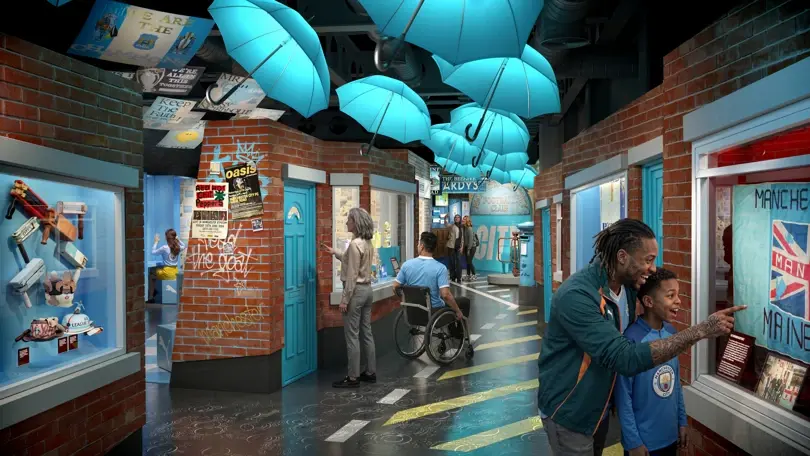
The planned Manchester City Museum Experience - Image Man City online
Please note - I'm real
I visit every brand visitor centre and experience myself. My feedback is real, based on a single visit, but informed by years of experience designing and exploring brand experiences all over the world.
I love writing my own reflections, diving into a brand's history, doing the research and looking at spaces through the eyes of a commercial interior designer. With over 30 years of working with customers, I also enjoy watching how guests interact with guides, displays and spaces. Everything I share is honest, personal and entirely human, not AI generated.
That authenticity is important to me, and if it's important to you and you want to work with me, or share your experiences or want to suggest others, then I am happy to be contacted via this website.
Photographs: ©Julie White unless noted otherwise
Disclaimer - The views and opinions expressed are solely my own. I paid for the tours in full and any comments reflect my personal experiences on that day. Please visit and garner your own thoughts and feel free to research the brand and the visitor centre in question. Please drink responsibly.

Comments