


The Visitor Centre today is ... FIFA Museum
Updated: Aug 11
The FIFA Museum in Zurich has an ambitious brief: to tell the story of a sport that unites more than four billion people. We went along to see how close it gets.

I was brought up on football - or soccer, as the Americans insist on calling it. I grew up a few miles from Liverpool, where you were either a red or a blue family. In my Dad's house, we were all about Everton and, while I never inherited quite the same level of devotion as some family members, football was always there, in the background.
These days, I tend to follow rugby more closely than football, only really tuning in for the major international tournaments. Living in Scotland has given me an added reason to pay attention, though. With Scotland qualifying for the 2026 World Cup after a long absence from the tournament, I'll have two teams to support when the competition kicks off on 11th June 2026.
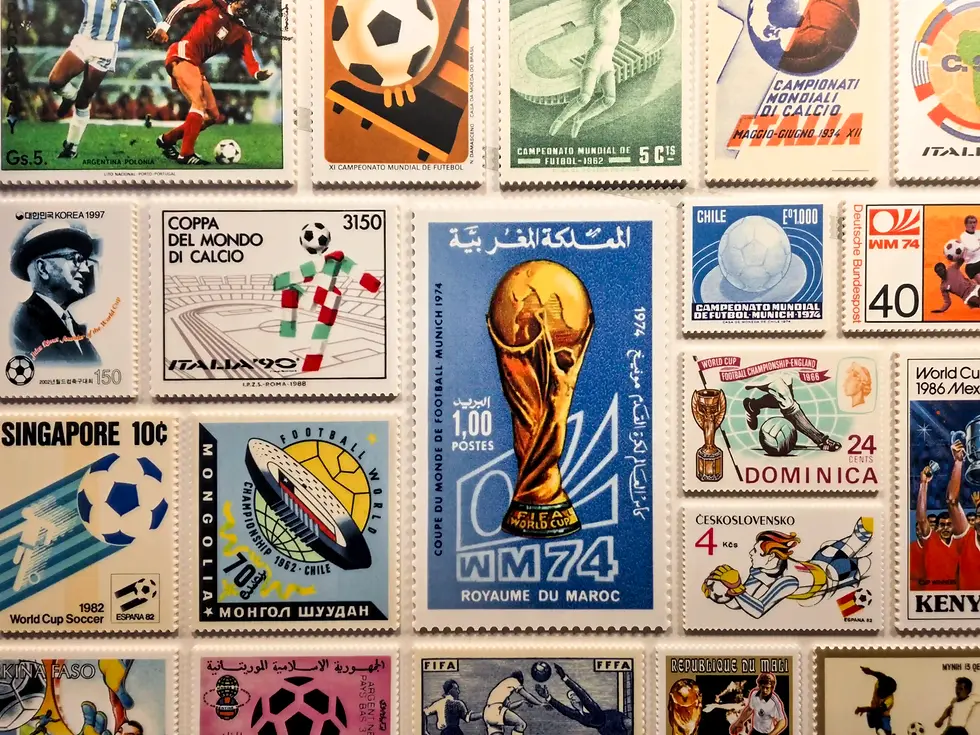
I remember watching some of the World Cup's most famous moments unfold on television, with a distinctly home-team focus: Gazza's tears at Italia '90, Maradona's infamous "Hand of God" goal, Lineker's hat-trick against Poland in '86, David Beckham's red card against Argentina in 1998, Gareth Southgate's waistcoats and, of course, the pain of penalty shoot-outs. Since moving north of the border, I've also learned a little about Scotland's footballing folklore. By the time the qualification campaign for 2026 was over, Scott McTominay's gravity-defying bicycle kick against Denmark had achieved near-mythical status. Scotland and the Tartan Army were going to their first World Cup since 1998, and he had become a national treasure.

I've never been steadfastly tribal when it comes to football. While everyone has teams they follow more closely than others, I've always been drawn to the stories behind the game as much as the results themselves. The underdogs upsetting the favourites, the managers under pressure, the volunteers, groundskeepers and backroom staff who rarely make the headlines, and the way entire communities can be united by ninety minutes on a pitch. Long after the final score has been forgotten, those are often the stories that endure.
Watched from the sofa, or even better from a sunny beer garden, these were the moments that transcended the game itself and became part of popular culture.
Six months before the 2026 World Cup started, a visit to Zurich's FIFA Museum felt particularly timely. Located just a short distance from FIFA's global headquarters, the museum tells the story not only of the world's biggest football tournament but also of the organisation that helped turn a simple game into a global obsession.
FIFA history
The Fédération Internationale de Football Association, thankfully better known as FIFA, was founded in Paris in 1904 by representatives from seven European nations. Their goal was simple enough: create a single organisation to oversee international football and make it easier for countries to play against one another.
Given football's origins in the British Isles, I was surprised to learn that neither England nor Scotland were among FIFA's founding members. England joined in 1906, and Scotland followed in 1910, although both associations would later have an on-off relationship with the organisation before rejoining permanently after the Second World War. It seems even the inventors of the game weren't entirely convinced by FIFA at first.
The organisation's defining moment arrived in 1930, when it staged the first World Cup in Uruguay.

Only thirteen teams took part, and many players and officials spent weeks crossing the Atlantic by ship. Compared with today's month-long global spectacle, it was a modest affair, but it captured the imagination of players and supporters alike.
That first tournament proved to be the start of something remarkable. Over the following decades, football spread across the globe and FIFA grew alongside it. More nations joined, new competitions were introduced, and television brought the drama of the World Cup into living rooms around the world. What had once been a small gathering of European football administrators had become the governing body for the world's most popular sport.
From those thirteen teams in Montevideo to more than 200 member associations today, it is quite a journey. Of course, FIFA's history has not been entirely smooth. Questions over governance, corruption and the awarding of tournaments have often generated as many headlines as the football itself, but there is no arguing with the scale of what it oversees.
Whether you're celebrating in a fan zone, singing in the terraces or watching from the comfort of your living room, FIFA has played a major role in turning football into the global obsession it is today.
Visiting FIFA Museum: What to Expect
The FIFA Visitor Centre design
Although FIFA itself dates back to 1904, the museum is a much more recent addition. The idea was to create a permanent home for the stories, artefacts and memories that have shaped international football over the last century. The museum keeps things celebratory rather than confrontational, which is perhaps understandable. You can make your own mind up about that.

The FIFA Museum opened in Zurich in 2016, occupying the extensively renovated Haus zur Enge building opposite Zürich Enge station. Originally designed by Swiss architect Werner Stücheli in the 1970s, the ten-storey landmark was transformed by Zurich-based SAM Architekten into a modern museum space while retaining much of its distinctive character. The museum occupies the lower floors, while offices, restaurants and apartments can be found above.
The exhibitions themselves were created by Berlin-based TRIAD, a company known for designing immersive museums, exhibitions and brand experiences around the world. Their portfolio includes projects for UEFA, Mercedes-Benz, Volkswagen and the German Football Museum, making them a natural choice for a project celebrating the world's most popular sport.

Spread across three floors, the museum explores the history of the game, the story of the World Cup and football's influence far beyond the pitch. Among the thousands of exhibits are match-worn shirts, trophies, memorabilia and personal items connected to some of the sport's most iconic players and tournaments.
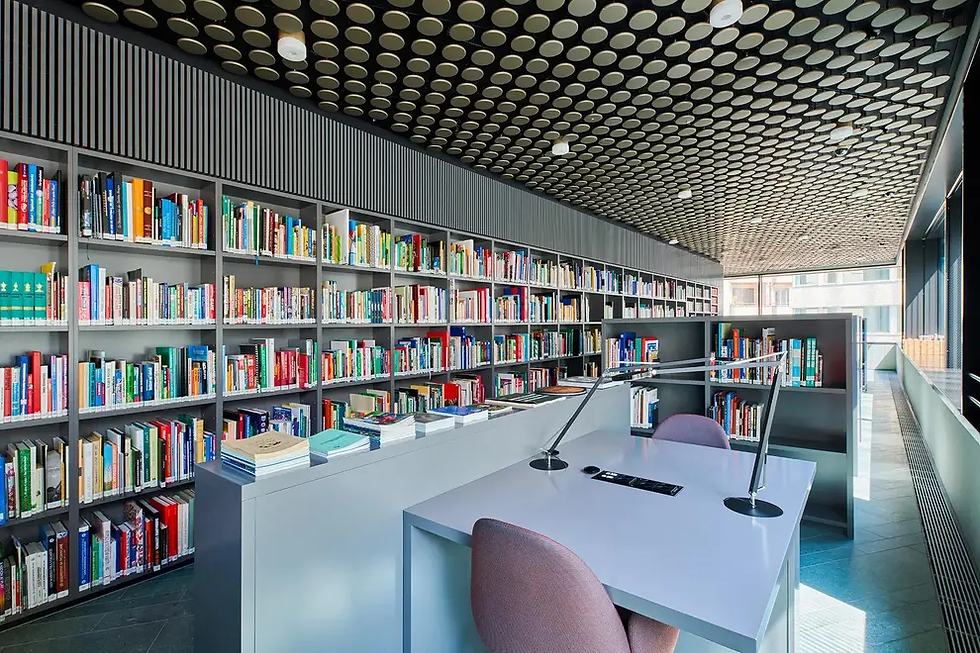
The building offers far more than museum galleries alone. Alongside the exhibitions, visitors will find the Extra Time sports bar, a bistro-style cafeteria, a museum shop and a library containing what is claimed to be the world's largest collection of football books.
The FIFA Museum celebrated a landmark year in 2025, welcoming a total of 430,594 visitors to the visitor centre in Zurich, but also the brand's satellite exhibitions, which visit different cities each year and are currently to be found in Miami, New York, Vancouver and Hong Kong. You can also find out more in their digital museum and podcasts.
Entrance
Once you've checked in, you head to dump all your belongings in the lockers. They don't allow coats, bags, backpacks or brollies, which, for a wet Swiss November day, was basically everything I had with me. It was very warm inside the museum, considering this was winter. They could save a fortune in heating if they just turned the thermostat down. The lockers, though, deserve their own moment.
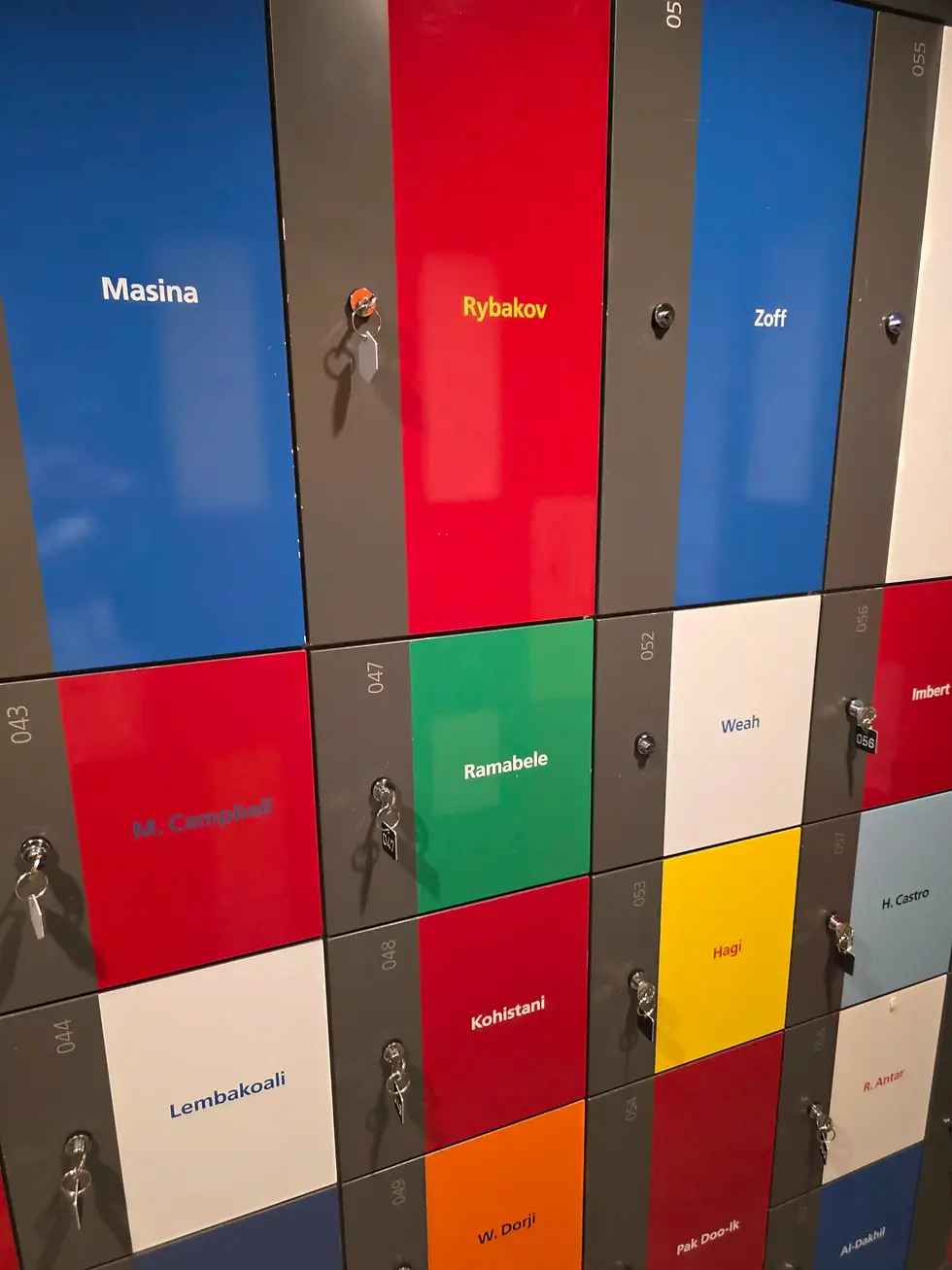
I plumped for George Best, a big locker for a big persona, and my daughter picked Beckham, off to the right, which was apt. It was just the start, but I did run around with a smile on my face, taking photos of other names I recognised.
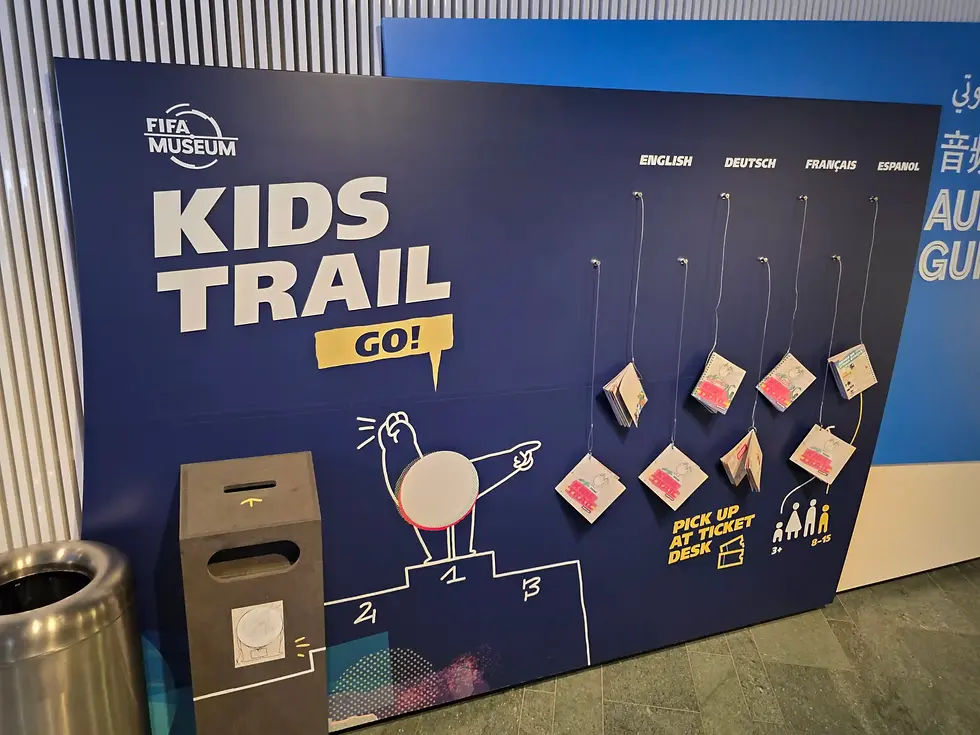
There is a free kids trail, in four languages, that my 29-year-old daughter decided would keep her out of mischief. Part of my job is to do as much of an experience as possible, and I do appreciate a treasure hunt, so I am usually the one adult hunting down a stamper, a colouring-in station or doing a word search. Don't judge. Being a big kid keeps you young.
The Rainbow
The first thing that greets visitors is The Rainbow, a spectacular 35-metre-long display featuring the shirts of all 211 FIFA member associations. Arranged by colour rather than alphabetically or by world ranking, the shirts sweep around the space in a vibrant arc that immediately highlights the truly global nature of the game. It's hard not to spend a few minutes searching for familiar teams while spotting nations you never realised were FIFA members.

Encircling the display are shirts from the 32 clubs that competed in the inaugural FIFA Club World Cup in 2025, alongside interactive screens exploring each club's history, famous players and defining moments. As introductions go, it's an impressive one, setting the tone for a museum that aims to celebrate football in all corners of the world.
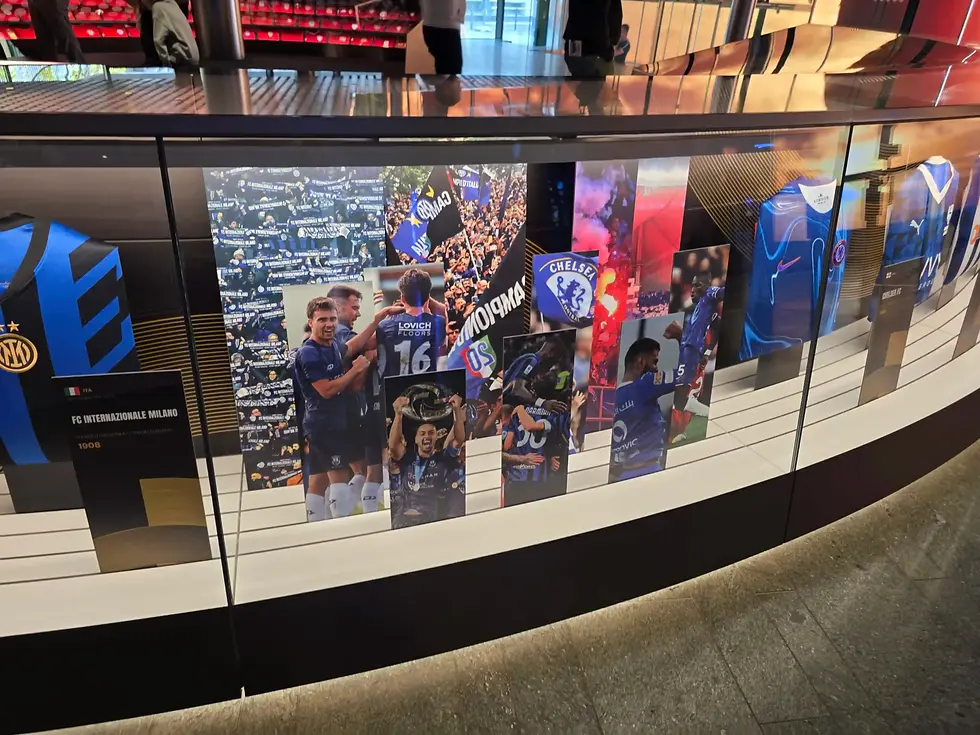
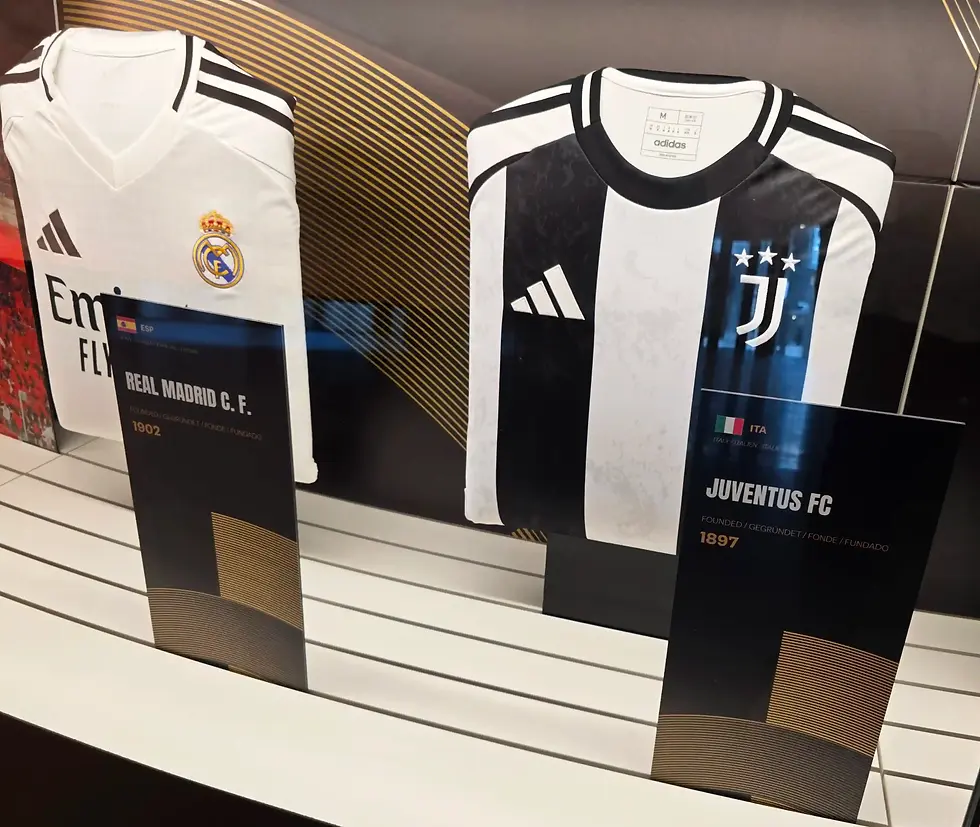
I noticed a Juventus FC shirt. I was lucky enough to visit their museum and stadium tour last year and loved it. Back in the 90s, I spent years watching Channel 4's Gazzetta Football Italia programme followed by live Serie A matches every Sunday afternoon. That was when the Italian league was the undisputed best and wealthiest league on Earth. Following Gazza's move to Lazio, I could now watch him play alongside icons like Brazil's Ronaldo, Francesco Totti and Gabriel Batistuta, and my massive crush on Roberto Baggio and his ponytail was real.
The Timeline
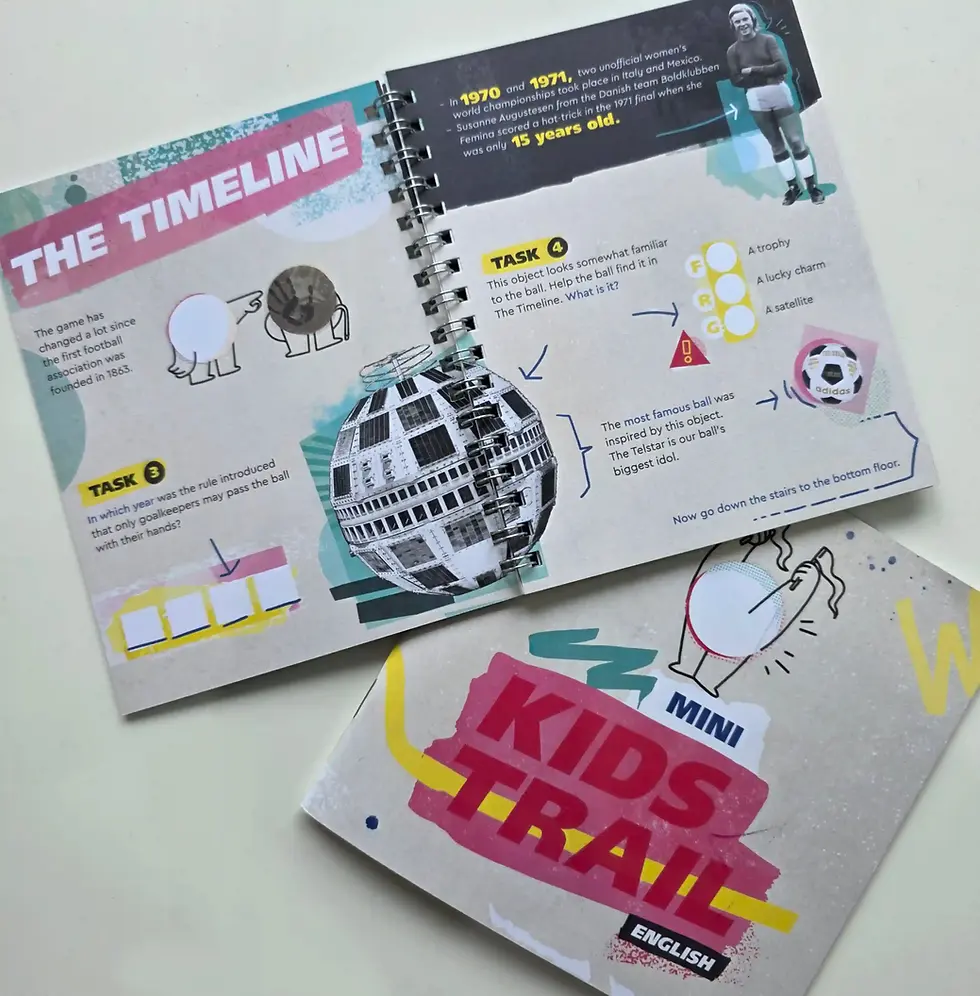
Beyond The Rainbow, a 13-metre-long timeline charts football's journey from its origins in the British Isles to the global phenomenon it has become today.

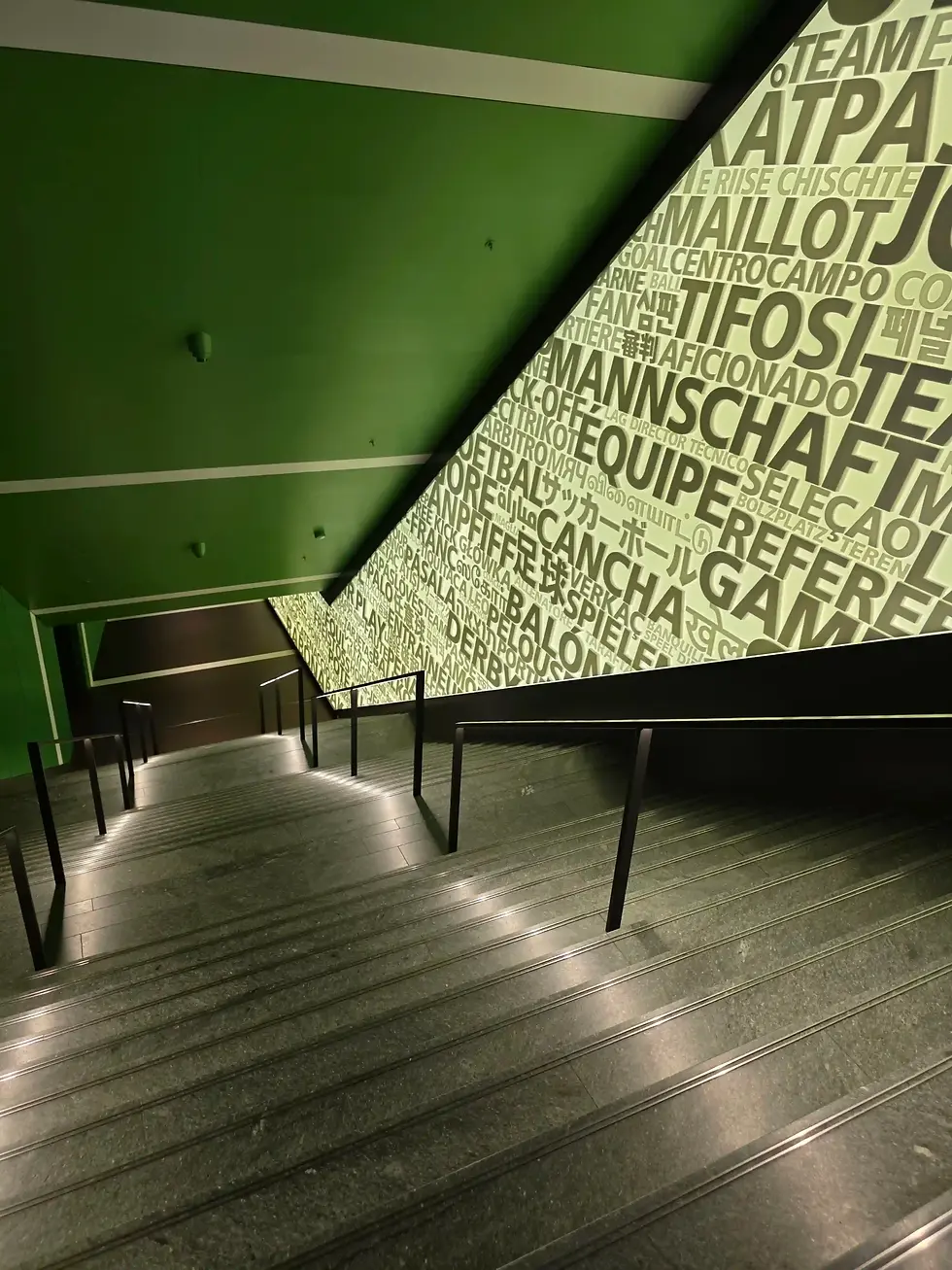
Using the dates that national associations joined FIFA, it shows how the sport spread across continents, transforming from a local pastime into the world's most popular game. Then it's down the stairs to start the next section of the museum.
The FIFA Foundations Gallery
One of the smaller spaces in the museum, The Foundations tells the story of how FIFA came to be.

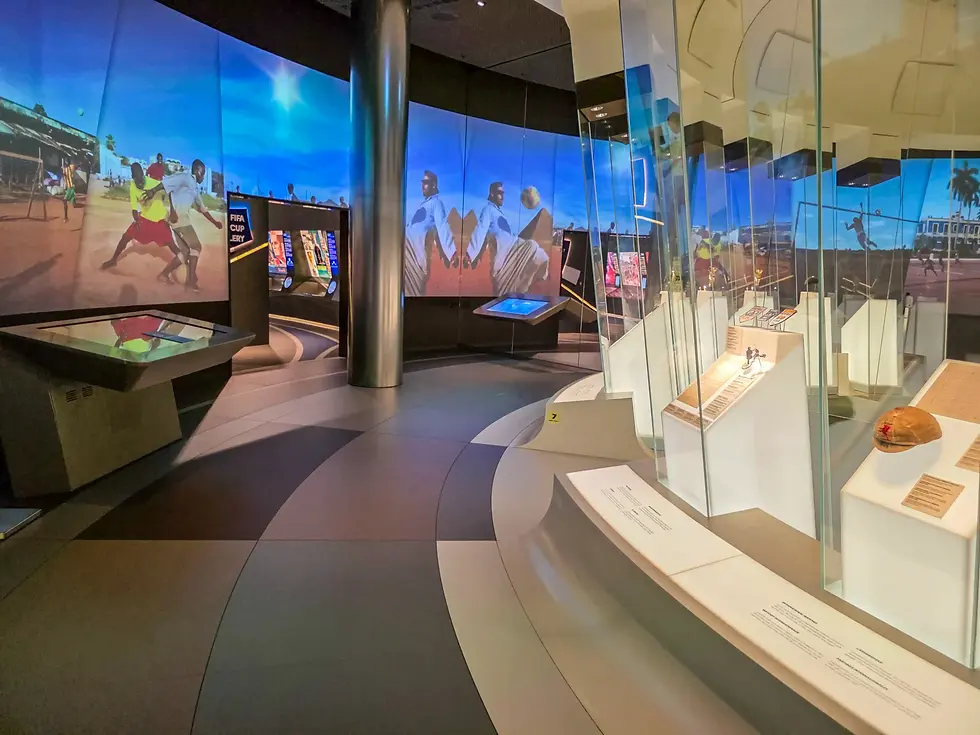
There are a few standout objects here. In one case sits a book, dusty covers, faded ink, the kind of thing you might walk straight past. Don't. Inside are the minutes from the 1913 meeting of the International Football Association Board (IFAB), the moment FIFA officially pulled up a chair. Its pages record the early wrangling over the Laws of the Game, signed by the delegates who were in the room.

IFAB had been set up back in 1886 by the four British associations, England, Scotland, Wales, and Ireland, essentially to stop everyone arguing about whose rules they were playing by. FIFA joining changed everything. Suddenly, the same rulebook applied everywhere, from a Sunday league pitch in Stoke to the Copa América.
FUN FACT - What does actor Ryan Reynolds, and my guide to Aviation Gin, have to do with any of this?
ANSWER: Wrexham AFC.
That special 1913 meeting was held in Wrexham, one of football's oldest and most storied clubs. Ryan Reynolds, of course, now co-owns Wrexham AFC alongside Rob McElhenney. Their documentary series Welcome to Wrexham put the club back on the global map in a way nobody saw coming. A dusty minute book in Zurich, a Hollywood actor in North Wales, and the beautiful game connecting them both.

This room is informative rather than immersive. There is plenty to read and take in, but it feels a little static compared to some of the more interactive spaces elsewhere. Interesting, certainly, but perhaps more for those with a particular appetite for football's administrative roots than the casual visitor wandering through.
The FIFA World Cup Gallery
The FIFA World Cup Gallery is the largest room in the museum and my favourite by far, dedicated to FIFA’s two flagship competitions: the FIFA World Cup and the FIFA Women’s World Cup. It really does feel like the beating heart of the place.
Everyone who visits will have their own allegiances, so they will be looking for content that resonates with them. I was no different. It was like a treasure hunt to find the things that mattered just to me. I count myself lucky enough to have been around for 15 tournaments. That'll age me, but it does mean I have plenty of magic moments to reminisce about. And, this is the perfect place to do that.

The gallery is split down the middle, literally a game of two halves, with the men’s tournament on one side and the women’s on the other, each presented as a kind of snapshot of football history. If, like me, you're into hidden history, graphic design, vintage poster art, old typefaces and examples of quirky marketing merch, then you'll be in heaven.
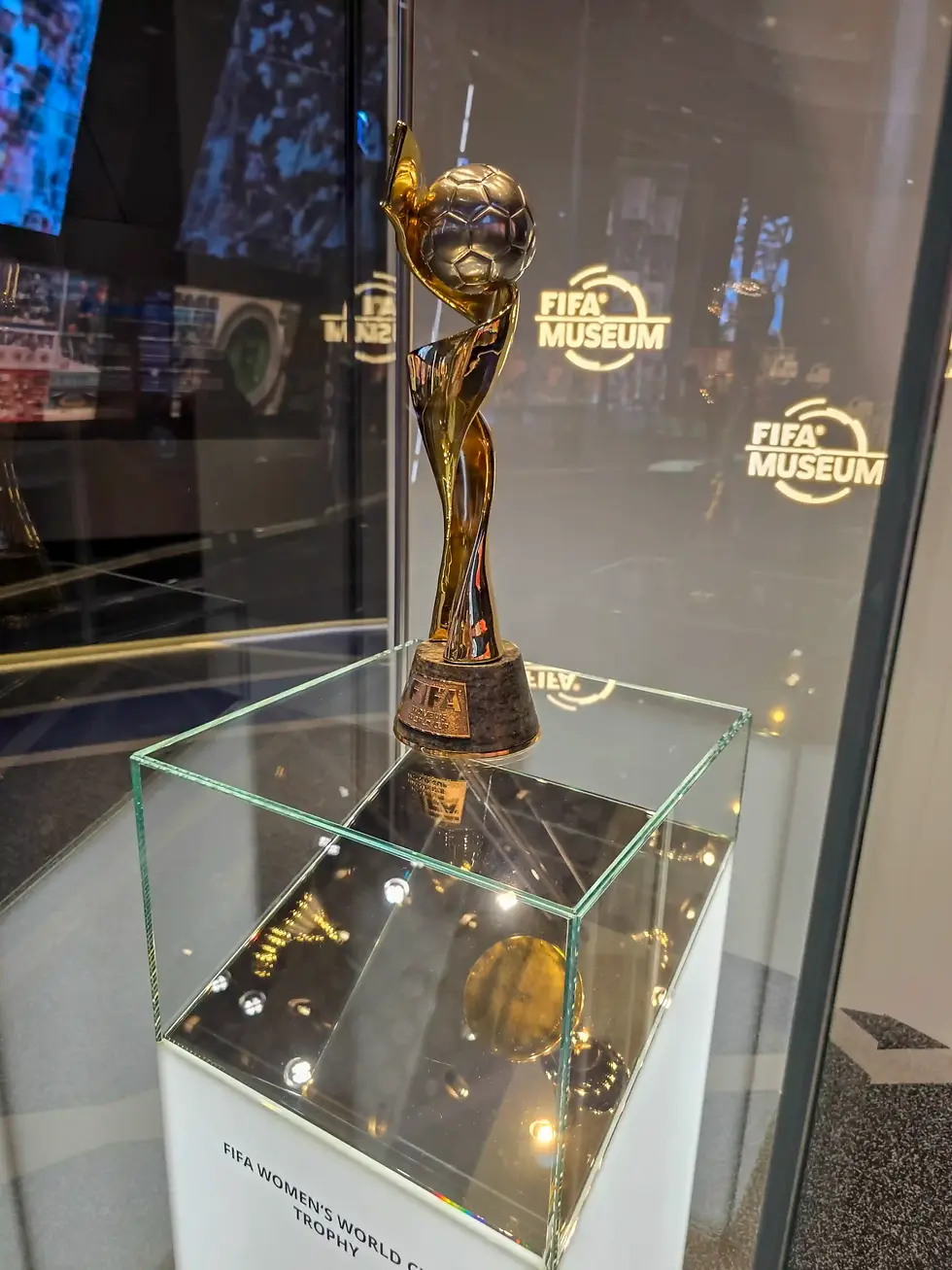
First up, and given pride of place, are the two trophies themselves, displayed as permanent centrepieces. The FIFA World Cup Trophy, introduced in 1974, sits opposite the FIFA Women’s World Cup Trophy, first awarded in 1999 at the finals in the United States.

The Jules Rimet Trophy on display today isn't the original. It was permanently awarded to Brazil after their third win in 1970 and was later stolen from the Brazilian Football Confederation headquarters in 1983. It has never been recovered.
Now for the full nostalgia hit. Each tournament gets a section, approximately 2 metres wide and the graphics are so colourful, you can't help but be pulled towards them. It is so hard to condense a tournament into one section, so inevitably there's not that much on show, but it had to be heavily curated. Not everyone will be happy. I won't show it all.
However, there were some personal standout highlights for me.
Men's Tournaments
1930 - The First World Cup

It seems strange now, but one of the biggest arguments in football during the 1920s wasn't about VAR or fixture congestion, but whether professional players should be allowed to represent their countries at all. The World Cup was FIFA's answer: a global tournament open to the best footballers, regardless of how they earned their wages. The disagreement over amateurism became so heated that the British football associations walked away from FIFA in 1928. As a result, England and Scotland weren't even present at the first three World Cups.

The first country chosen to host the new tournament was Uruguay in 1930. Today, teams fly around the world in a matter of hours, but European teams spent weeks crossing the Atlantic by ship. The then FIFA president, Jules Rimet, travelled with them, carrying the World Cup trophy in his suitcase. The 1930 final, between Uruguay and Argentina, featured an unusual disagreement. Both teams wanted to use their own football. A compromise was eventually reached, with Argentina's ball used in the first half and Uruguay's in the second. Uruguay won. Whether the change of ball made any difference remains one of football's great unanswered questions.
1950 - Maracanazo
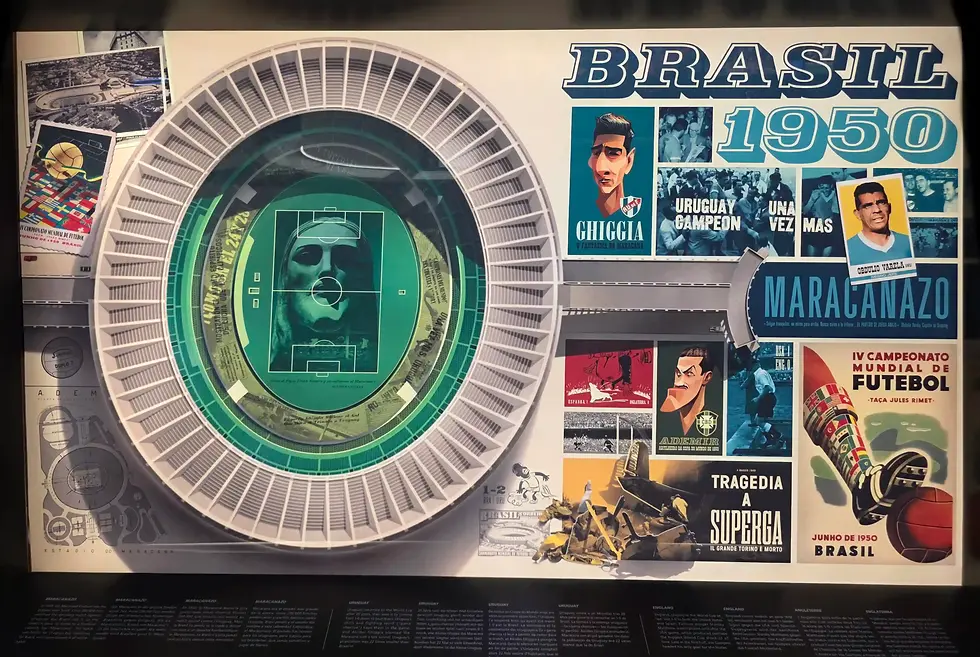
If you've ever complained about queues at a football match, spare a thought for the supporters who attended the decisive match of the 1950 World Cup. Nearly 200,000 people crammed into Rio's Maracanã Stadium to watch Brazil take on Uruguay, making it the largest crowd ever recorded at a World Cup. Most expected to witness a home victory. Instead, they saw one of the greatest shocks in football history as Uruguay won 2-1. The result was so traumatic for Brazilian fans that it became known simply as Maracanazo - "the Maracanã blow".
1966 - The year it came home
For all England fans, 1966 is etched onto our psyche, even if we weren't actually born to see it.
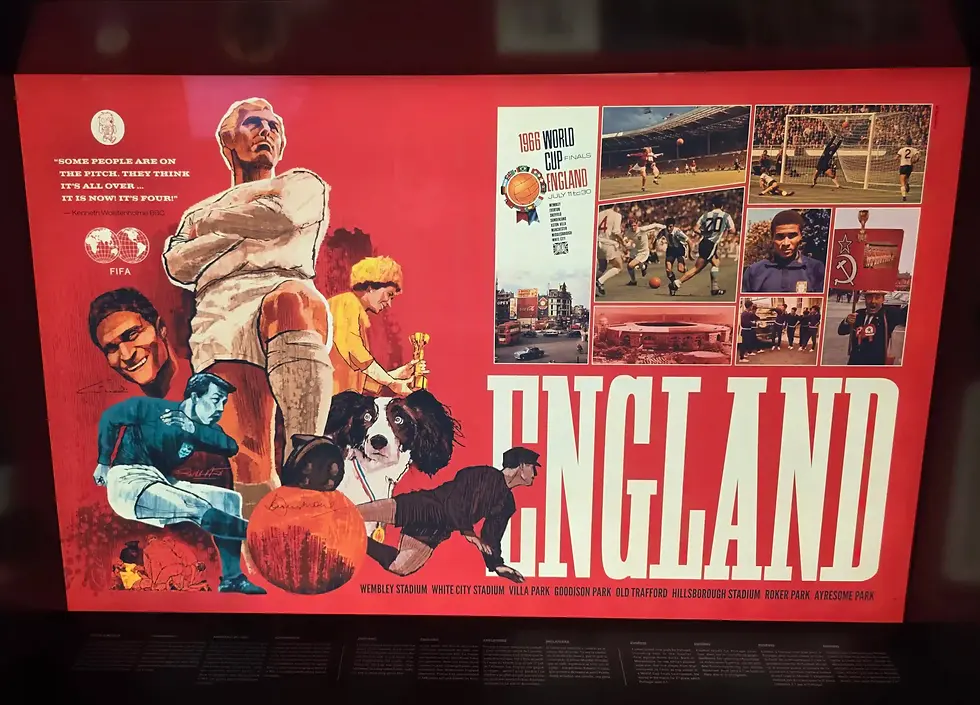
Kenneth Wolstenholme’s famous BBC commentary, "They think it's all over... it is now!" is woven into British pop culture and we're forever quoting it.

There's World Cup Willie, the official mascot, and in fact the very first official mascot for any FIFA World Cup tournament.

And the corner flag signed by England's Geoff Hurst himself, the first player to score a hat-trick in a World Cup final

The display also tells the story of the most unlikely World Cup hero that year, and it wasn't a footballer at all. A few months before the 1966 tournament in England, the Jules Rimet Trophy was stolen while on display in London. Police launched a major investigation, but it was eventually found by a dog called Pickles, who discovered it wrapped in a newspaper under a hedge during a walk. Pickles became a national celebrity overnight and was arguably more popular than some of the players taking part in the tournament. His collar and medals are kept in the UK at the National Football Museum in Manchester, which I am soon to visit.
1970 - Pele
Whenever you agree or disagree, one name is always given as the greatest of all time, and that's Pele.
The Brazilian won three World Cups, the first at 17 in Sweden in 1958 and the last in 1970 in Mexico. He scored more than 1,200 career goals and was a true sporting legend. I might not have seen him play in the World Cup, but I do remember sitting as a kid watching him dance around the pitch in the movie Escape to Victory, alongside Sylvester Stallone and half the Ipswich Town squad and Michael Caine. Happy Memories.

1986 - The Hand of God goal

1986 was a tough year. Heysel had happened the year before, and the UEFA ban on English clubs cruelly stripped Howard Kendall's legendary Everton side of their shot at the European Cup. We'd also just watched Liverpool pip us to the league title by two points and beat us in the FA Cup final. My Dad's tears that day are still with me.
But then came the World Cup. Four Everton players were in the England squad, including Gary Lineker, whose hat-trick against Poland had got us through the group stage. Then we met Argentina.

For every England fan, the rest is painful history. Watching 5'5" Maradona leap up beside the towering Peter Shilton and punch the ball into the net, so blatant, so brazen, and somehow allowed to stand. The agony barely had time to sink in before, four minutes later, he scored the Goal of the Century. Even Lineker's 81st-minute goal couldn't save us. We were out.

The shirt Maradona wore for the finals is right here in a case. It still stings.
1990 - a World in Motion
It was when I got to see Italy's Roberto Baggio, yes, him again, making his debut and scoring a legendary goal against Czechoslovakia, rightly regarded as one of the greatest in World Cup history.

It was also the year of New Order's World in Motion, often regarded as the best England football song. It featured John Barnes delivering a rap that somehow remains both gloriously dated and strangely brilliant, and I know every word.
"We ain't no hooligans, this ain't a football song. Three lions on my chest, I know we can't go wrong." Sadly, we did go wrong, in a heartbreaking semi-final defeat to West Germany after another dreaded penalty shoot-out.
I could go on. The deafening drone of vuvuzelas in South Africa 2010. Roberto Baggio's penalty sailing into the stands in 1994. David Beckham's red card against Argentina in '98. Every four years, no matter what surrounds it, the Men's World Cup gives us something to talk about for the next four years. That is the beautiful game.
Women's FIFA Tournaments Gallery
The rise of the Women’s World Cup is one of the greatest success stories in modern sports history, from forbidden pastime to global blockbuster. The first recorded women's football match was on 7 May 1881, here in Scotland, when Scotland and England played in Edinburgh. In the 1920s, matches were attracting over 50,000 spectators. And then came the unjust FA ban in 1921, which ruled the sport "quite unsuitable for females." Other countries followed suit. FIFA only officially recognised women's football in 1971.
For decades, female players had lacked official backing. The Women's World Cup’s official launch in 1991 sparked a slow-burning revolution that exploded into the mainstream during the historic 1999 edition in America.

USA's Mia Hamm wasn't just an amazing goal scorer, with her team she became the first globally recognisable icon of women's football, proving that women's football could sell, and sell big. The 1999 final averaged 18 million television viewers in the US alone, a record for a women's match at the time. It stood until 2015, when the USA vs Japan final became the most watched soccer match in American broadcast history, men's or women's. The numbers tell their own story.

She went on to co-found the Women's United Soccer Association (WUSA) in 2000, the first professional women's soccer league in US history. They even made her into a Barbie figure.

Under manager Sarina Wiegman, England's Lionesses have certainly delivered much for us to celebrate, and I remember biting my fingernails watching Mary Earps' heroic penalty save in the 2023 final. USA's Megan Rapinoe hasn't just lifted the trophy twice, but she was also instrumental in a historic equal pay lawsuit, which fought for equal prize money and in recognition of her advocacy for LGBTQIA+ rights and racial justice, she was awarded the Presidential Medal of Freedom, the highest civilian honour in the United States. When Moroccan defender Nouhaila Benzina stepped onto the pitch wearing a hijab, she paved the way for millions of female Muslim football players worldwide. And it's a woman, Marta from Brazil, who is the all-time leading goal scorer in World Cup history (male or female) with 17 goals across five tournaments. I think they prove that this sport is very much the opposite of "unsuitable for females."


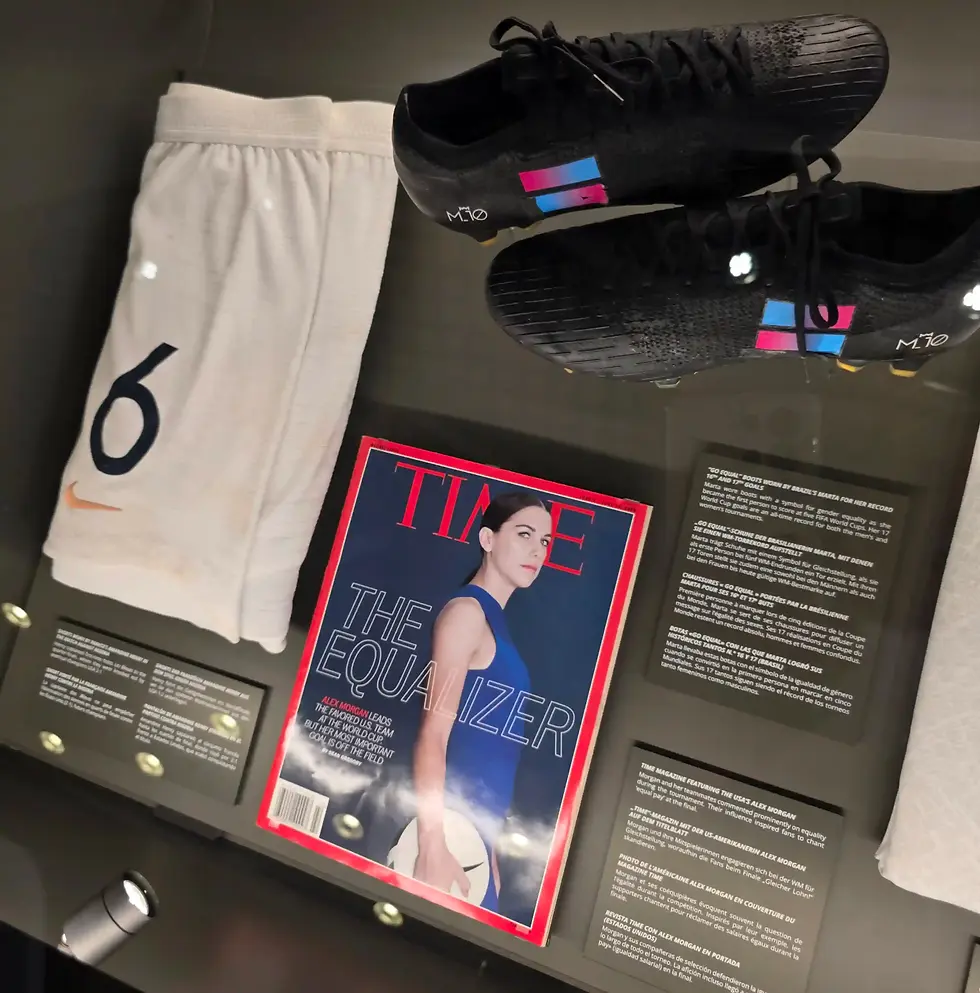
The Cinema and the seat collection
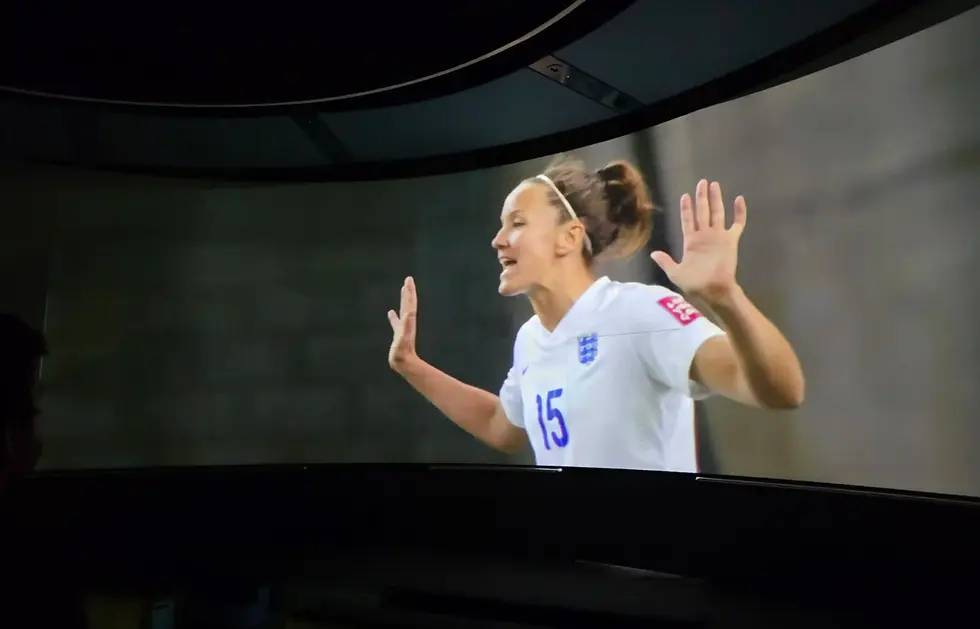
Just outside the cinema, which shows a few uplifting football short films, is the Curva Nord, a striking installation named after some of the most famous supporter stands in world football. It features seats taken from stadiums that have hosted iconic World Cup moments, including Wembley in 1966, Munich’s Olympiastadion in 1974 and Cape Town’s Green Point Stadium in 2010.
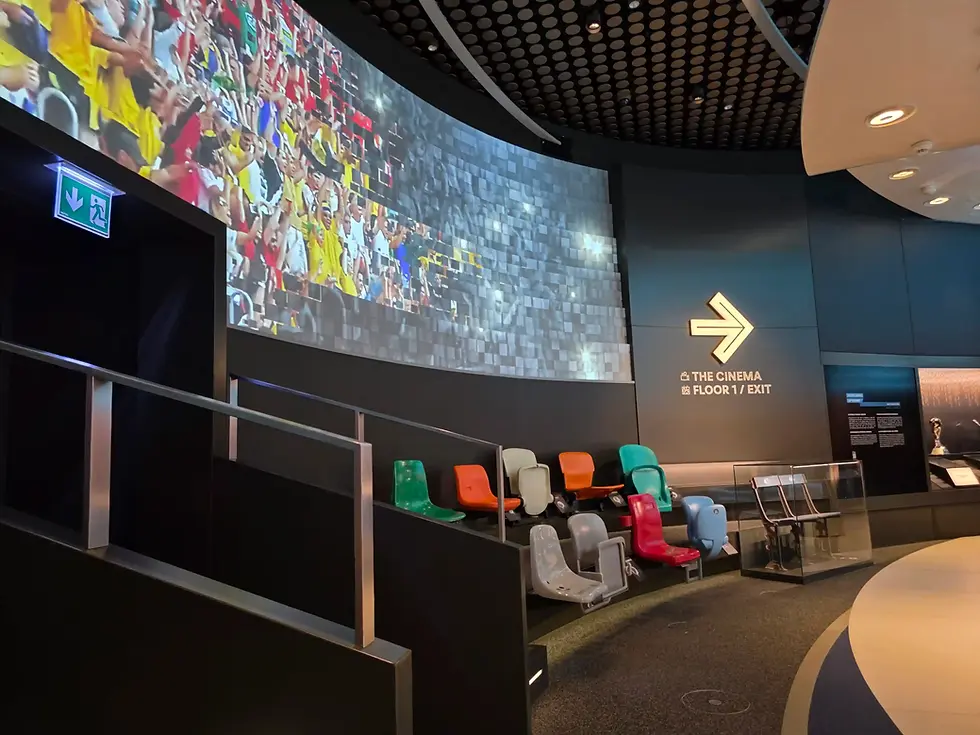
It was the first chance we had to rest our legs. The museum was stifling hot and we were getting tired and thirsty and just needed some time on the subs bench.
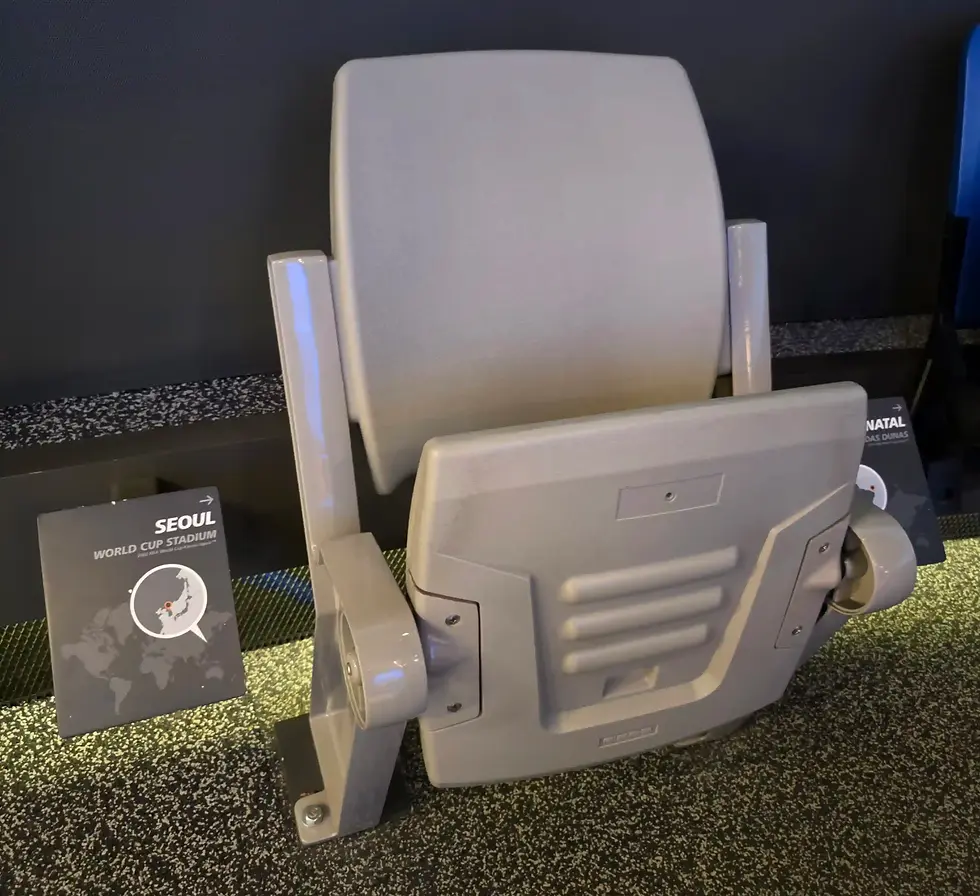
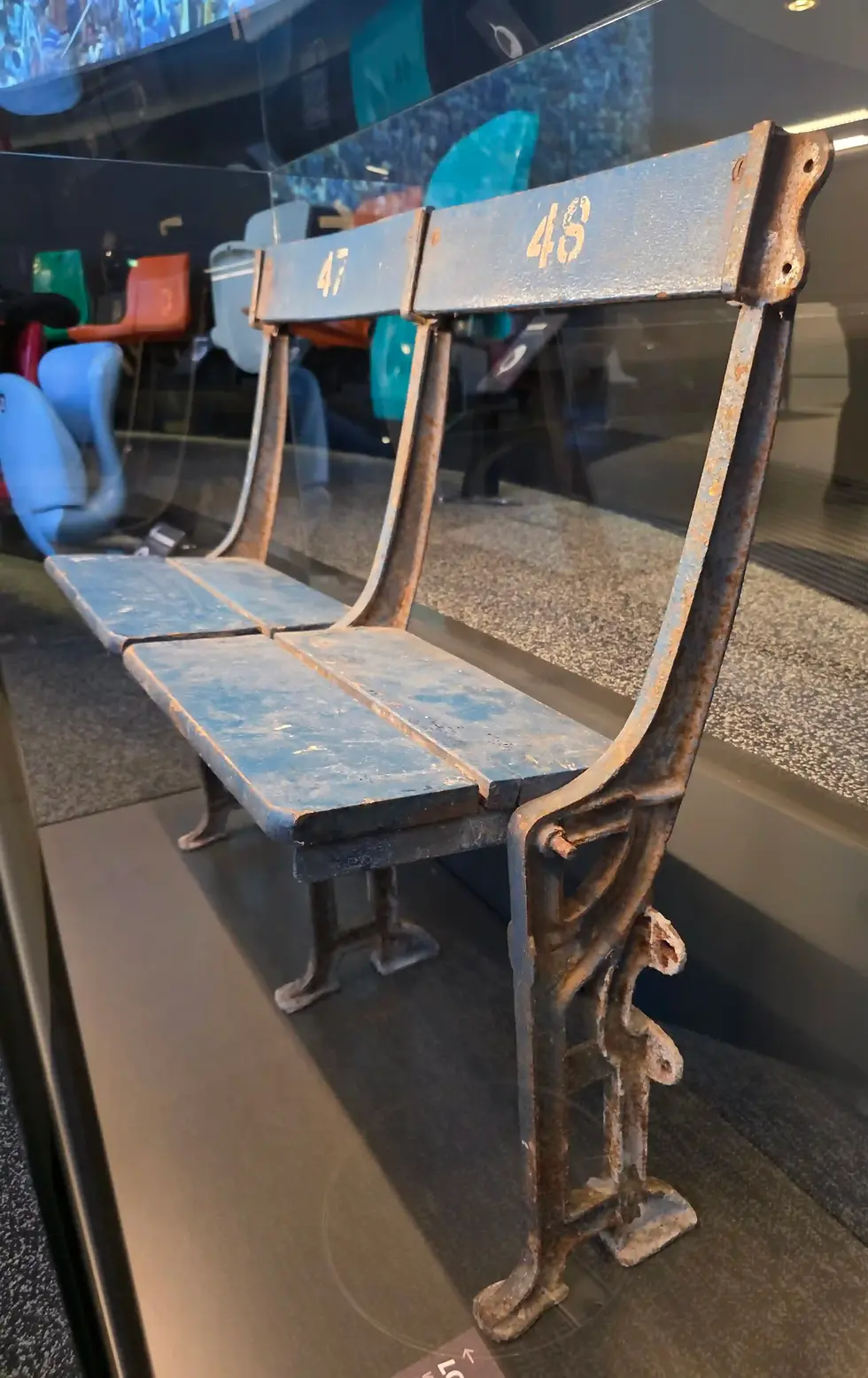
We couldn’t resist the opportunity to try them all out properly, sitting in each one in turn to see which would have been the most bearable for a full 90 minutes. Some were surprisingly comfortable, others were tiny or rock hard, and a few felt as though they were designed with very different body shapes in mind. The cherished few were behind glass, like the seats from the old Wembley Stadium. It was a simple bit of fun, but it added a nice human touch to what is otherwise a fairly symbolic display.
And we couldn't ignore the Olympic medals. Football has been an official Olympic sport since London 1908, and the women's game since Atlanta 1996. What many people don't realise is that the men's tournament has been organised directly by FIFA since 1924, making it the oldest competition FIFA has ever run.

The eFootball: The Virtual Pitch gallery
This area explores how the game has expanded far beyond the stadium and into living rooms around the world. It traces the rise of football video games from early graphics through to today’s highly detailed versions that now sit firmly within the world of esports.

First, check out the dozens of balls hanging from the ceiling in the atrium, looking like planets in the solar system.
It is very interactive in this gallery, but most of the consoles were already taken by teenagers who looked settled in for the long haul. It’s one of those sections where, without time limits, it becomes difficult to actually get a turn. However, when we finally did, boy, was it fun, transporting us back to the 90s and our old PlayStation and World Cup 98. That was the year we took our kids to France on holiday during the tournament. It was the last time Scotland qualified. We watched matches on a campsite big screen, and the whole country went wild when they won the championship.
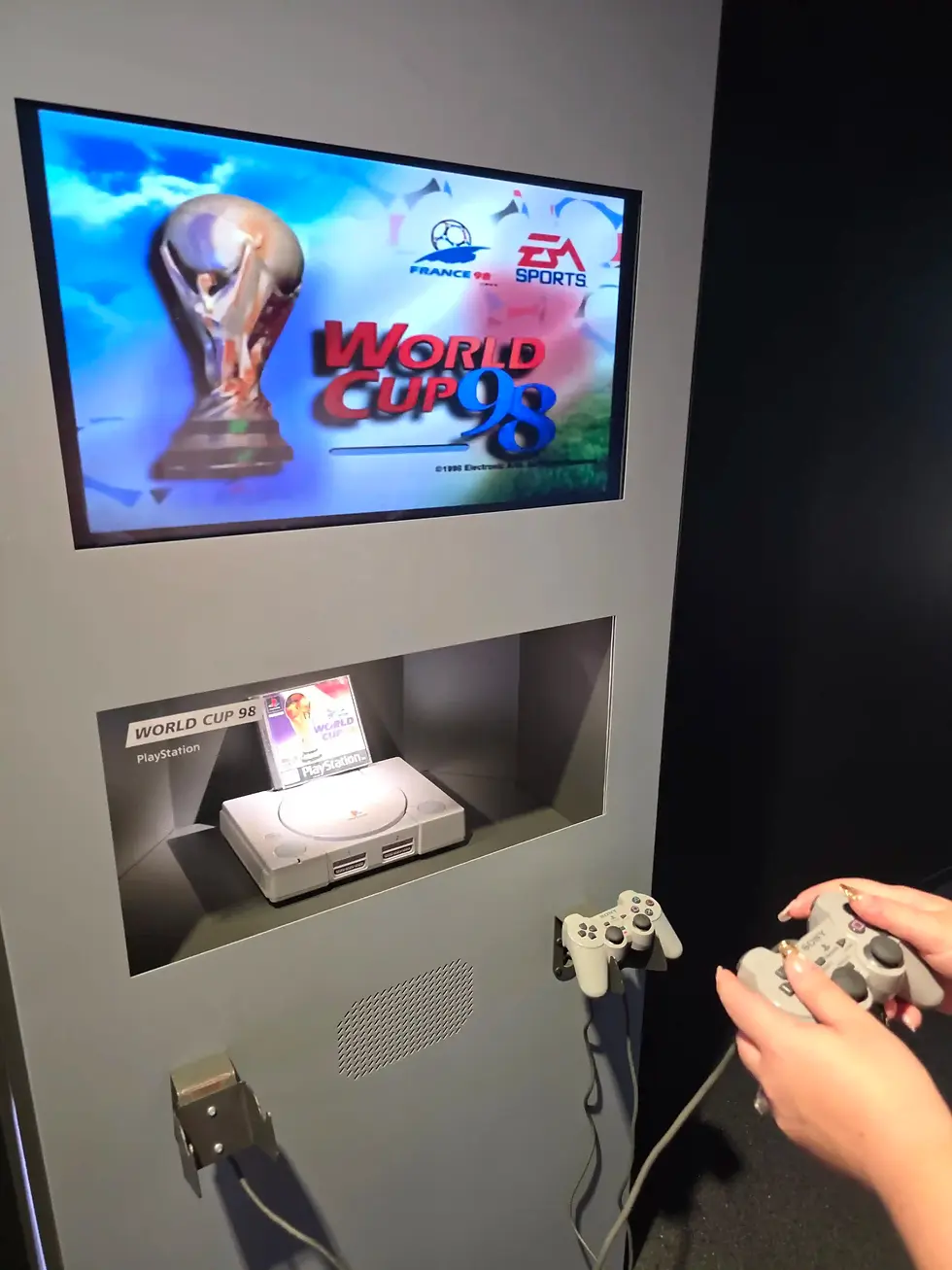
It will no doubt appeal most to those already into FIFA gaming and esports, especially with the FIFAe World Cup trophy on display, but it felt like one best experienced if you manage to catch it at a quieter moment.

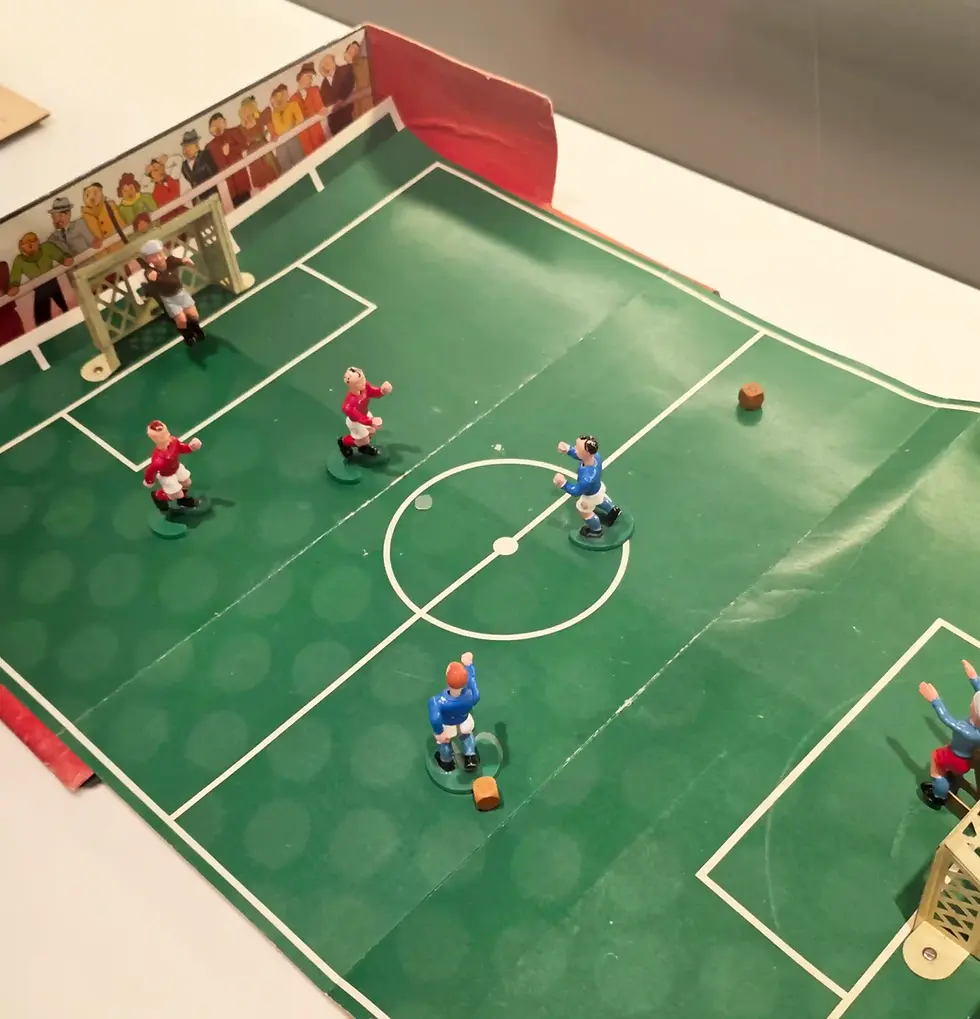
However, there are a few analogue treasures. A collection of vintage football-inspired board games caught my eye. The Trench Football game dates from the First World War and there's one at the Imperial War Museum in London too.

And I spent many years as a kid, trying to beat my brother at Subbuteo. I remember my free kicks were hampered by the creases in the green baize that my Mum refused to iron out. German children had a cardboard version called Tipp-Kick back in the 20s. They seem to have had the same issue.
The Pinball gallery
The museum visit concludes with a football skills challenge, where visitors can test themselves across a series of disciplines before seeing how they compare on the leaderboard. In theory, everyone gets a turn before moving on to the next activity. In practice, a few participants seemed determined to perfect their technique, regardless of the growing queue behind them. We've encountered similar issues at other highly interactive attractions, including World of Coca-Cola, the Home of Carlsberg and Silverstone Museum. I have a great deal of respect for the people who design these experiences and understand how difficult it is to strike the right balance between participation and throughput. Perhaps it's simply human nature, but I do sometimes wish we could all remember that everyone is there to have fun. Have your go, enjoy the moment, then let the next person step up and create their own memories.

I didn't take too many photos. I was having too much fun.

It became quite competitive between my daughter and me. We visited on a busy weekend, so there was plenty of waiting around, but overall it worked reasonably well. There is, however, something slightly unnerving about attempting to dribble, pass or shoot while a crowd of strangers watches your every mistake. It's amazing how quickly your coordination disappears when there's an audience.
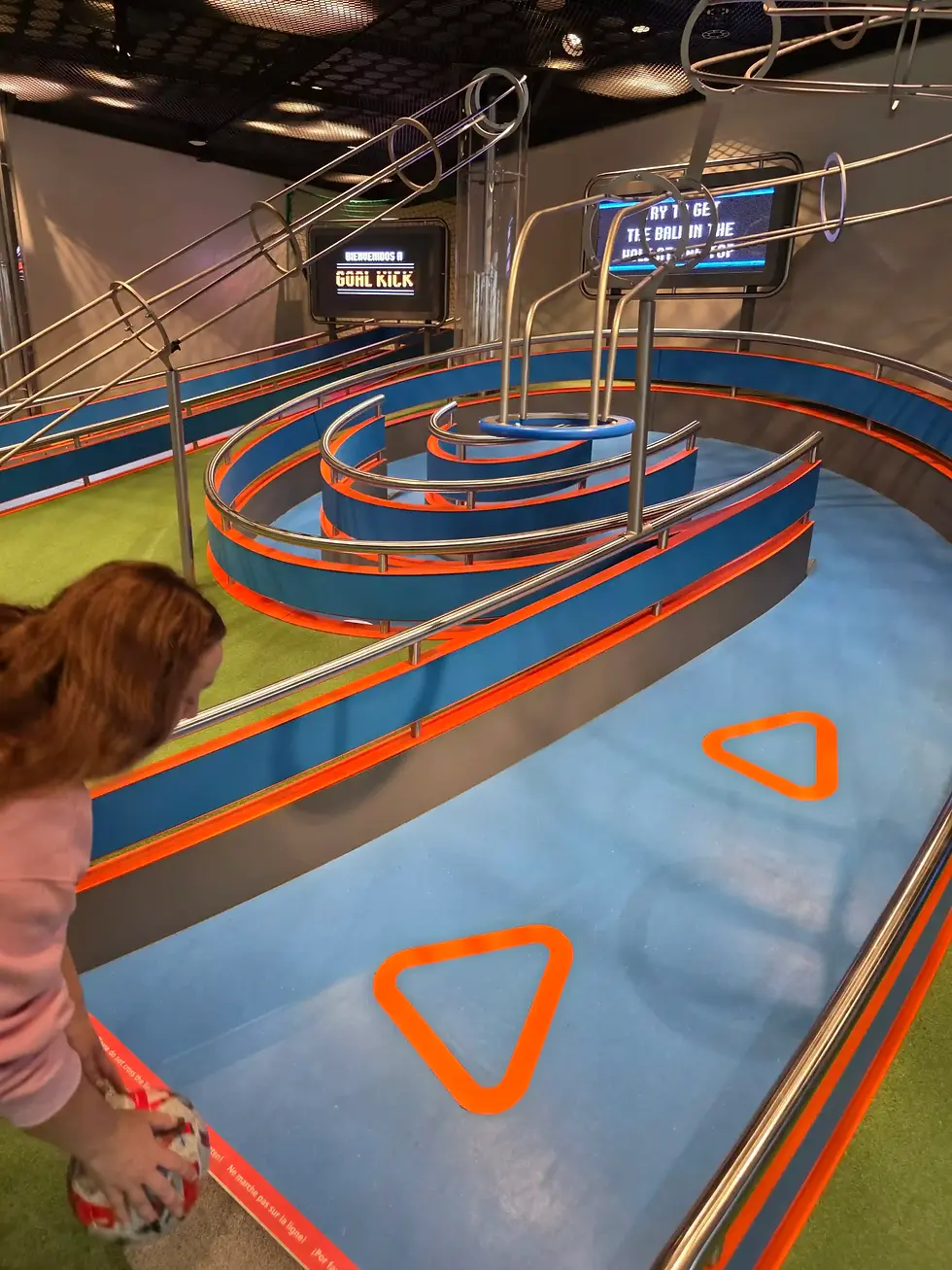
The highlight was watching a handful of particularly confident individuals loudly demonstrate how football should be played, only to be comfortably outperformed by my daughter, who has never set foot on a football pitch. My own performance was considerably less impressive. The challenge confirmed what I had long suspected: any hopes of a career in the beautiful game have long since passed me by. I'll stick to watching it on television.
Extra Time Bistro - the FIFA Museum restaurant
Given football's global appeal, we had expected the café to be something of a highlight. It was the most disappointing part of the museum experience.
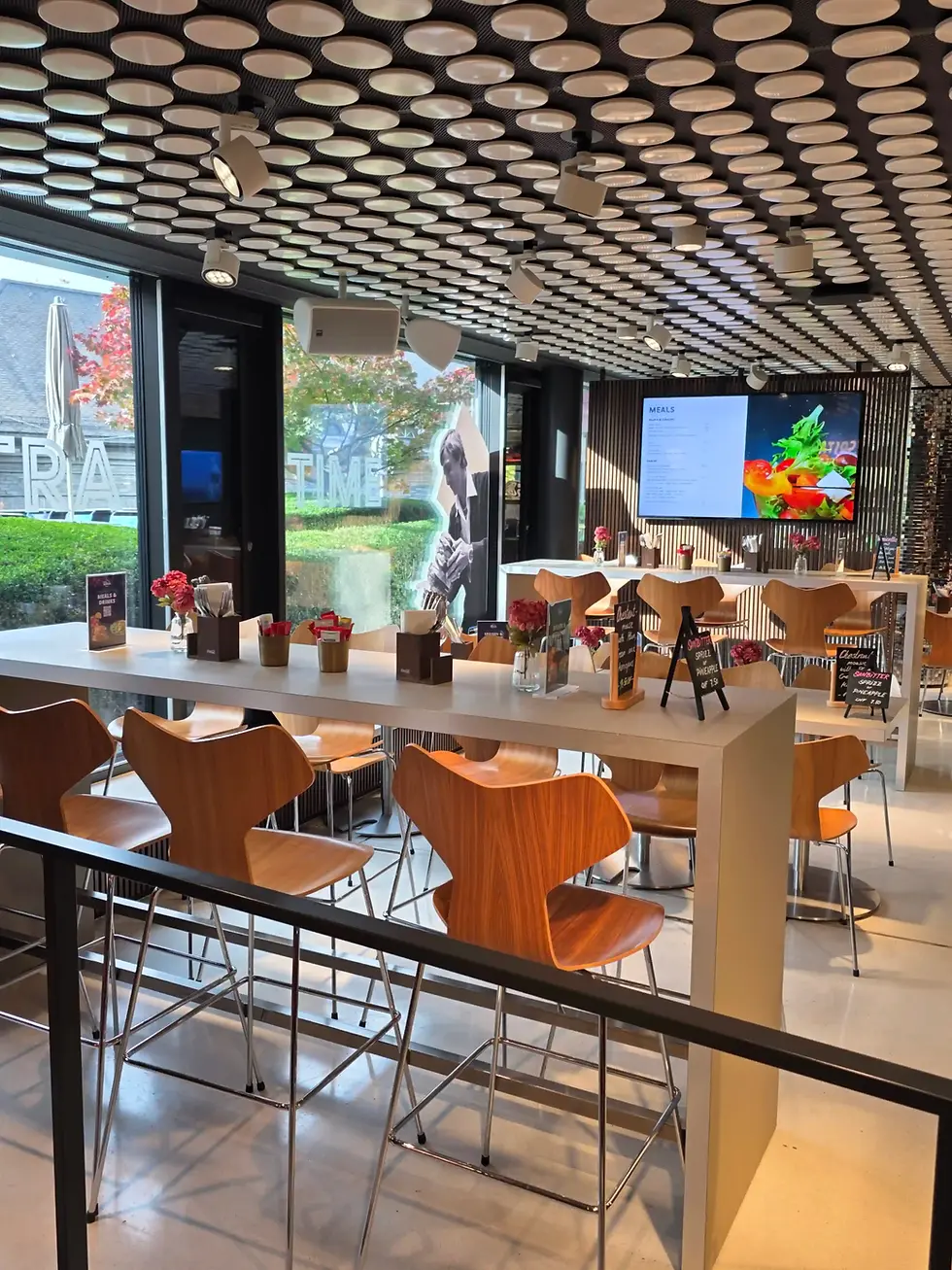
Open from 11.30 until 5pm Tuesday to Sunday, we arrived needing a half-time pick-me-up.
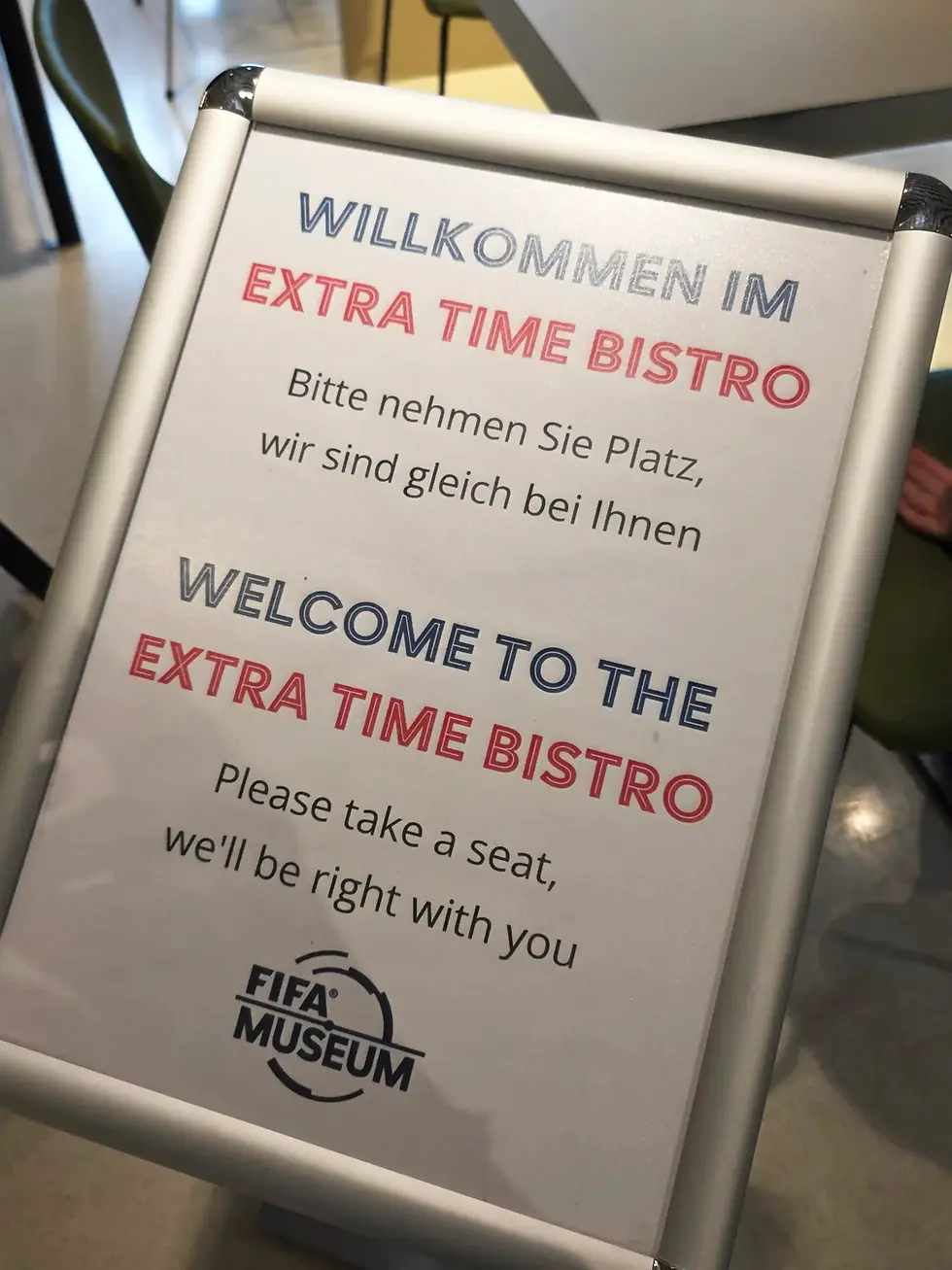
Maybe we'd get a themed menu, dishes inspired by past host nations, or simply a family-friendly space where supporters of all ages could take a break between exhibits.
Instead, the experience felt rather odd and cold. We arrived to find an empty restaurant, with no staff in sight.

After a little confusion, we discovered a QR code on the table, and Google Translate came to the rescue with a menu and instructions to wait to be served. And wait we did.

Eventually, a server appeared from behind a screen. I ordered a glass of wine and a slice of cake. It was certainly tasty, presented as if it had come out of a Michelin-starred kitchen, but at 12 CHF for the cake and 9.50 for my small wine, it was expensive for what you got. I kept telling myself it was just Swiss prices!

A family arrived and looked just as bemused as we had been. Burgers arrived for the children. I wish we had ordered them, but we had dinner plans booked. The kids had no activities given to them, no printouts to colour in, for example. Such a missed opportunity.
There was a larger dining room visible, though strictly for private functions, with another Champions Lounge also just for the corporate visitor.
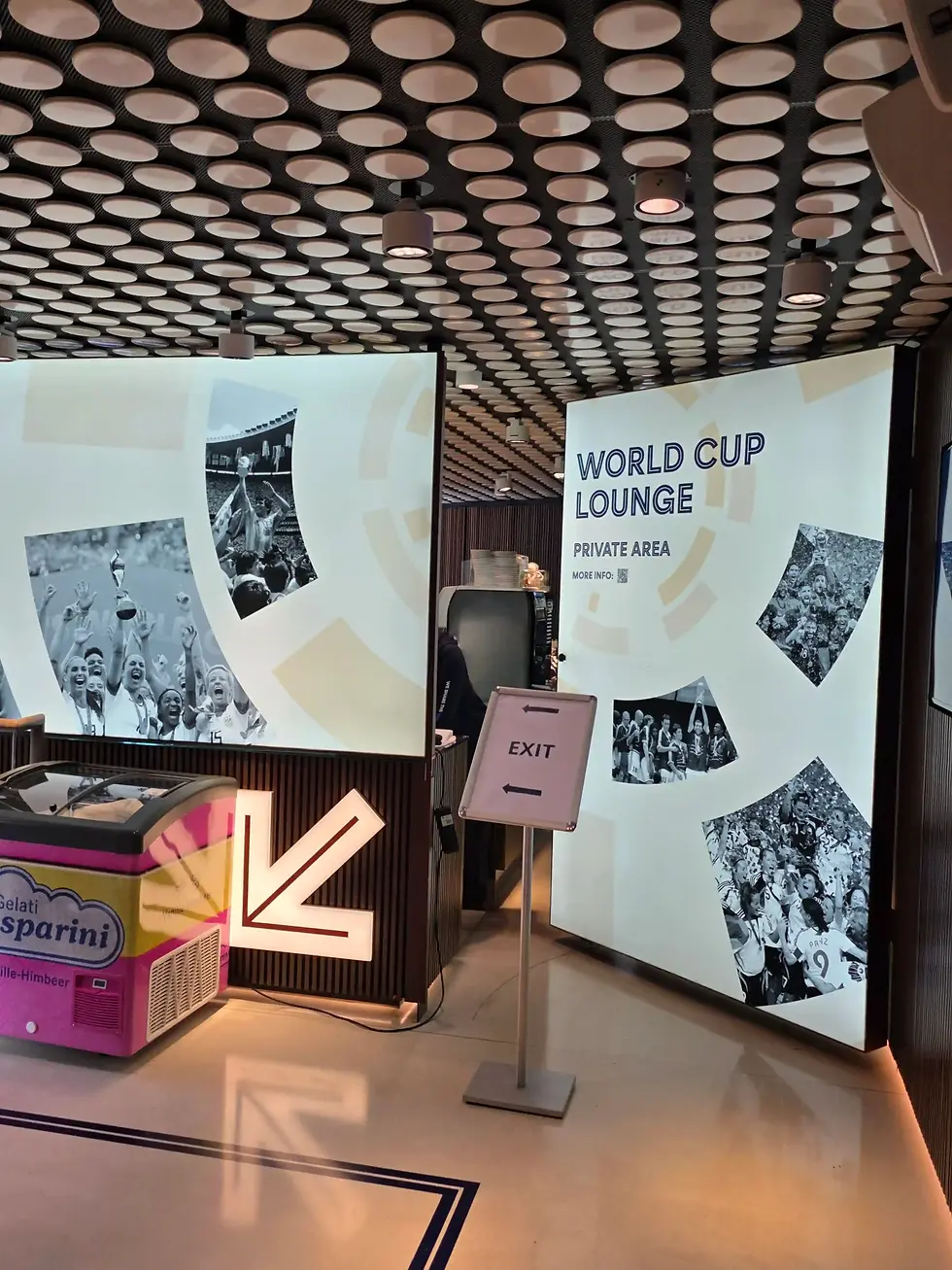
A vending machine in the corner ultimately proved more useful than the café itself when the sliver of cake failed to satisfy.

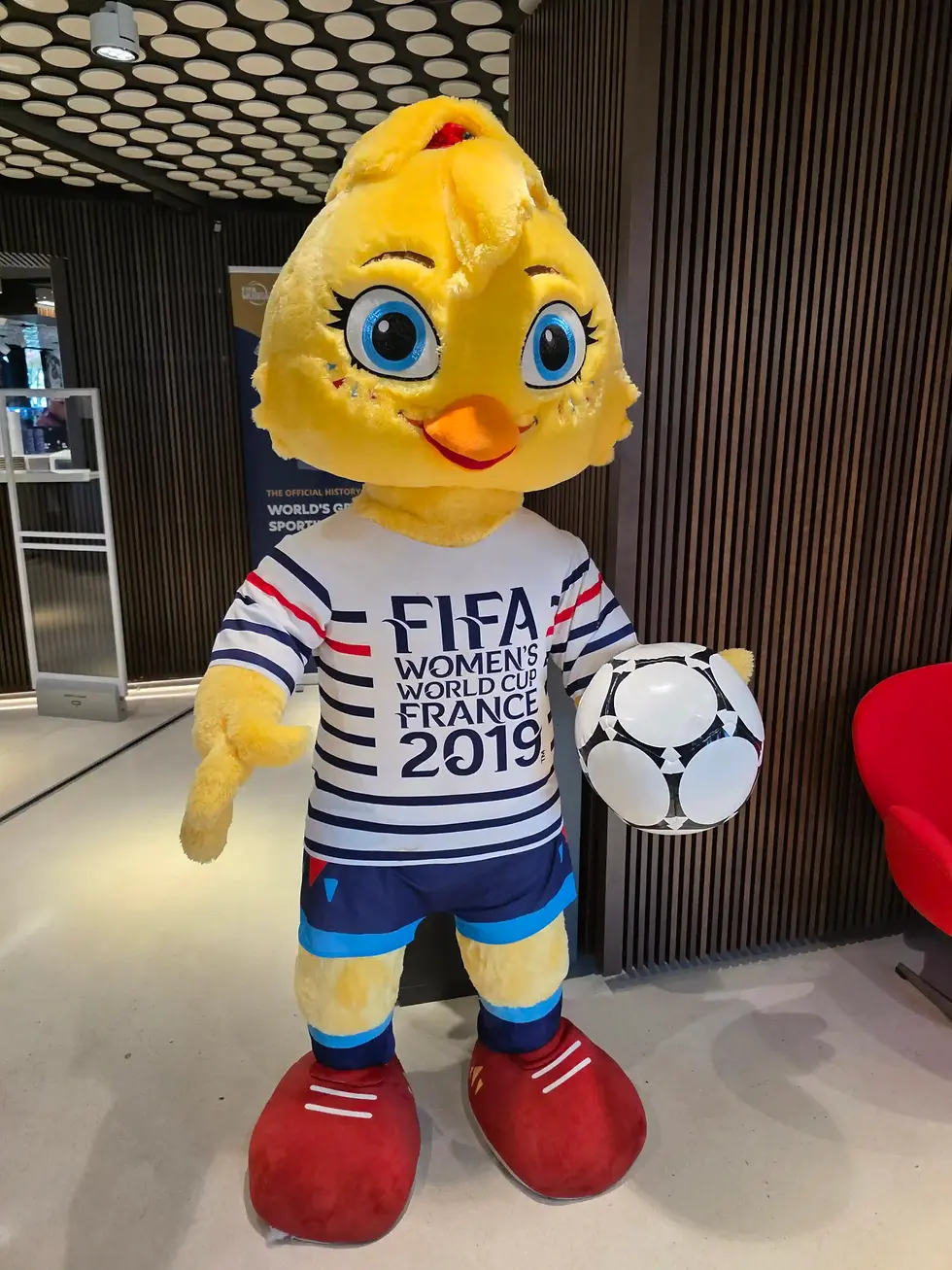
It was all a little strange. More than the prices, it was the lack of any welcome, music or atmosphere that stood out. Without anyone there to greet visitors, or to check in on us, the whole experience felt totally impersonal, which seemed at odds with a museum celebrating the world's most popular and sociable sport. It was the first yellow card for the museum. We got more conversation from the stuffed mascot!
As I said, this was our half-time snack, but we found out quickly that we couldn't retrace our steps. Barriers behind us prevented that, and we were shown the signs for the exit and arrived back at reception. We asked how we could get back to where we had been prior to our break, and were told we had to go through every gallery we'd visited again to restart where we had left off. Ridiculous and a waste of time. Another yellow card. Technically now, that should be a red!
The FIFA Museum Shop
The museum shop contains the usual mix of FIFA-branded merchandise, souvenirs and football books.

The shop stocks plenty of FIFA-branded clothing, although I'm not entirely sure who wants to wander around advertising the governing body. I'd much rather wear something connected to a team I support or a place I've visited. The new Host City Jerseys are a more interesting idea, celebrating individual World Cup host cities rather than FIFA itself. I did have a look online afterwards, right up until I noticed the price tag. At around €320 each, they'll be staying firmly on the substitutes' bench for now.

Despite having a browse, nothing quite jumped out at me. Much of it you can buy online, so that saves suitcase space. I already own FIFA Museum's own FIFA World Cup: The Official History (3rd Edition), which I'd happily recommend to any football fan. Sitting on my bookshelf at home, it explores many of the stories and characters behind the tournament in far greater depth than a museum gallery ever realistically can. Hours of fact-finding fun at your fingertips.

One unexpectedly nostalgic display featured Panini stickers, which have been part of football culture since the early 1960s and first appeared in World Cup form for the 1970 tournament in Mexico. As a child in the 1980s, I faithfully bought packet after packet, convinced that this time I would finally find the elusive stickers I needed. I never completed an album, and I don't think I knew anyone who did, before the internet made tracking down missing stickers so much easier. Half the fun was the swapping, negotiating and comparing collections in the playground, while half the frustration was discovering yet another duplicate. Seeing those familiar albums and stickers on display brought back memories of a time when completing a collection felt about as achievable as winning the World Cup itself.


How much would you pay for a signed shirt? Among the memorabilia for sale was a shirt signed by Geoff Hurst, a reminder of England's 1966 World Cup triumph and one of football's most enduring legends. Whether you're a collector or simply a fan of football history, there is something rather special about seeing the signature of the only man ever to score a hat-trick in a World Cup Final.
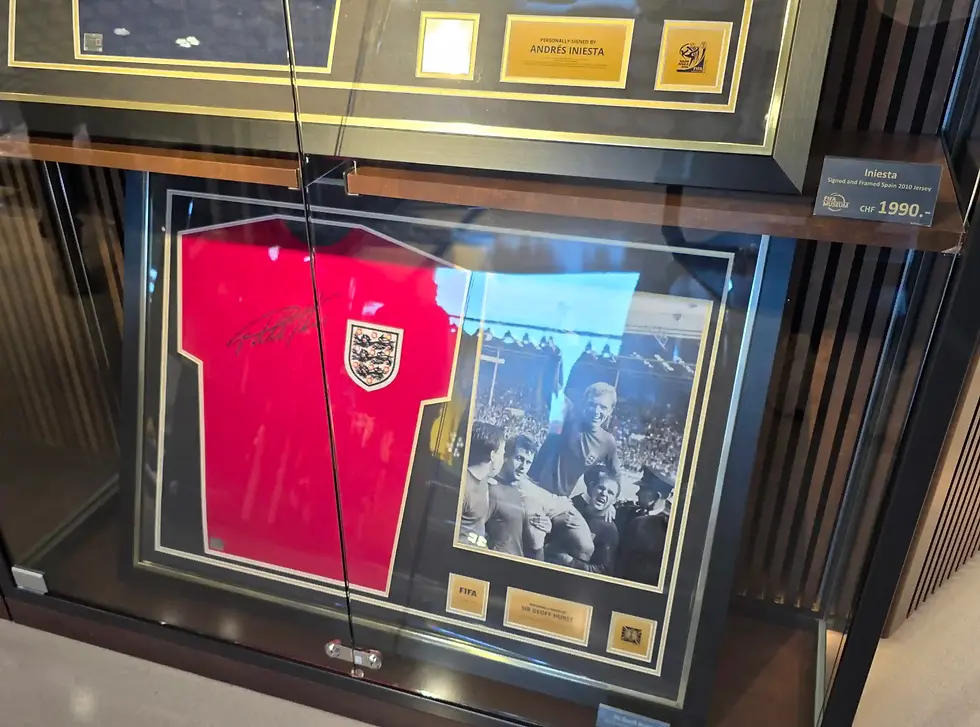
You can also get your merch personalised, which is always good to see. But a shirt was 110 CHF with 25 CHF to personalise it.

Innovation in Action

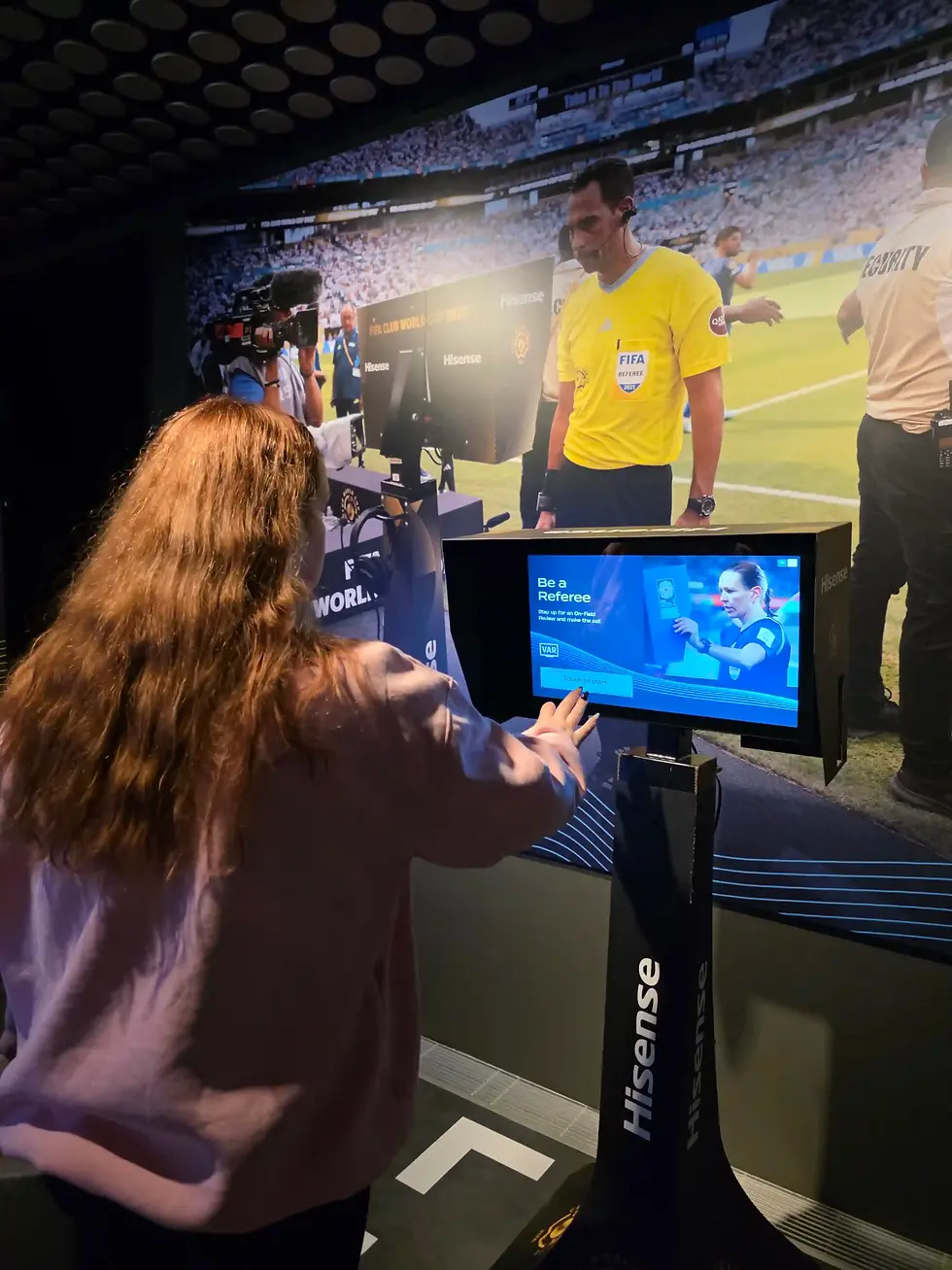
We all know football has changed, often for the better. But if you find yourself disagreeing with a referee, questioning the VAR, or getting frustrated with the TV commentary, then this is the gallery for you.

One of the newer additions when we visited was Innovation in Action: Football Technologies on and off the Pitch, a special exhibition developed with FIFA's own innovation team, which opened in October 2025. It takes you behind the scenes of the modern game through five themed areas covering broadcasting, data, refereeing, stadium management and an innovation lab, and the hands-on elements are genuinely interesting. We had a go at making refereeing decisions and at directing a live broadcast, and found out we were rubbish at both. And where else would you learn about the yarn used in hybrid pitches?
The FIFA Museum Library
The museum also houses a library, open by appointment only. You can register and book a research visit in advance. As a casual football fan rather than a nerd, I didn't bother.
New for 2026 - World Cup Fever: Skills Zone Gallery
The museum is also embracing the 2026 World Cup with its new World Cup Fever: Skills Zone exhibition. Instead of more glass cases, visitors get to test themselves, against the likes of Kylian Mbappé, Vinícius Júnior and Lionel Messi. Can you kick it like Kane, or head it like Haaland?
During the tournament itself, the museum will also host public screenings of selected matches, giving fans the chance to share in the inevitable highs, lows and last-minute drama that make the World Cup such a global spectacle. The World Cup Fever: Skills zone is an add-on to a regular museum ticket and is priced at CHF 8.
I hope that this gets incorporated into the museum as a more permanent exhibition.
Is the FIFA Museum worth visiting?
A museum of a governing body might not be the top on everyone's travel agenda, certainly not one that polarises opinion. But, FIFA represents more than 200 member associations, thousands of clubs, countless tournaments and billions of supporters, so they certainly had plenty of content to draw from.

Every visitor to the museum arrives with their own favourite team, player, match or memory. Trying to tell the story of world football in a single building is a bit like trying to explain the internet in one room. It's an ambitious task, and one that is guaranteed to leave some visitors wishing their favourite chapter had received a little more attention.
I thought the Juventus Museum in Turin gave me a stronger emotional connection, even though I wasn't a fan of theirs, perhaps because it focused on a single club and could therefore explore its history and personalities in far greater detail. FIFA, by contrast, has the impossible job of covering more than a century of football across every continent. Breadth inevitably comes at the expense of depth.

I returned with hundreds of photographs and videos to enjoy. On reflection, especially with the 2026 World Cup now in full swing, and now I am writing this, the museum did a much better job of long-term engagement than I first thought. It piqued my interest in aspects of the game I hadn't paid much attention to, and I have enjoyed finding out more, prompted by the excellent “The Official History of the FIFA World Cup™, Third Edition" that is produced by the Museum itself.

The interactive exhibits are genuinely fun, particularly for families and younger visitors, and there is enough memorabilia on display to keep most football fans interested. One aspect that deserves particular praise is the equal prominence given to both the men's and women's games. Rather than treating women's football as a footnote, the museum presents it as an integral part of the sport's story.
The museum's rigid one-way system can become frustrating, the cafe concept baffling, and on busy days, some of the interactive exhibits require a little patience. As with many modern museums, a handful of visitors can sometimes occupy an activity for far longer than intended, leaving others waiting for a turn. That's hardly FIFA's fault, but it is worth bearing in mind if you're visiting during school holidays or at weekends.
I couldn't help feeling the museum would benefit from more space for temporary exhibitions, or even special menus in the café, to really lean into themed experiences. That's why I was so pleased to see the new World Cup Fever skills challenge exhibition. Let's hope it's the first of many additions, because they're missing a trick otherwise.
All in all, the FIFA Museum is an enjoyable way to spend a few hours and gain a better understanding of how football became the global phenomenon it is today.
Plan your visit to the FIFA Museum
Address
Seestrasse 27, 8002 Zürich, Switzerland
Website: FIFA Museum
How long was the visit?
Our visit lasted five hours but I like reading a lot of history. Young kids will enjoy the interactive bits but might struggle with the rest.
Worth noting
Jackets and coats may not be worn or carried inside the exhibition areas. It is also not permitted to take items such as rucksacks, large bags (including suitcases, whether wheeled or not), umbrellas, etc., into the exhibition areas.
That meant we stored our items in the lockers located on Level -1.
You will need a CHF/EUR 1 coin for each locker – this will be refunded when you retrieve your belongings.
FIFA Museum tickets
We paid for our tickets and this was not any form of advertisement.
Category | Price |
Adults | CHF 26 |
Disabled adults | CHF 15 |
Children aged under 7 | Free |
Children aged 7-15 | CHF 15 |
Students/Seniors/Apprentices with ID | CHF 20 |
Disabled visitor companion | Free |
Check out their website for discounts for groups, families, travel card passes and season tickets. For example, there is free entry with a valid Zürich Card.
Opening times
It's always worth checking with the FIFA Museum for their current opening times, as they can vary.
Day | Opening hours |
Tuesday-Sunday | 10:00-18:00* |
Monday | Closed |
* Last admission at 17:30
Getting to the FIFA Museum
The museum is located in the heart of Zurich, opposite Bahnhof Enge, and has great public transport links. It does not have a car park.
If you have a Zurich card, which is handy for free travel in Zurich, then remember you also get free entry to the Museum.
Where to stay for the FIFA Museum
Hotels, as well as everything else in Zurich, are expensive. We stayed at the Hotel Rossli, booked through Booking.com, in a twin room as I was travelling with my daughter.
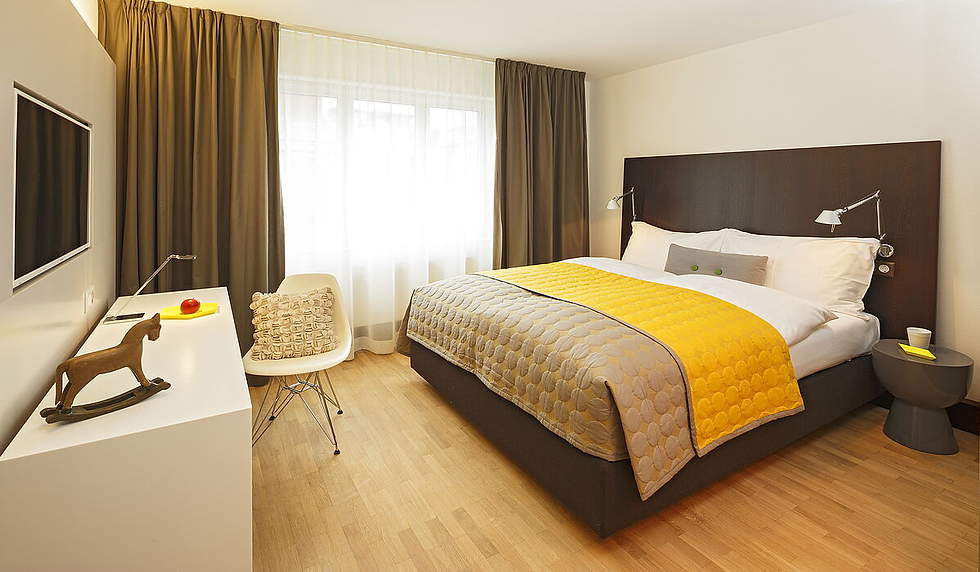
The tiny reception is across the narrow lane from the actual rooms, which did cause a little confusion when we arrived.

The staff were friendly, but we found a few times when no one was manning the reception desk, and we had to go up into the little dining room to find someone to help us. Somehow, our twin room booking wasn't flagged, so we had to stay in a double for the first night. The hotel was extremely apologetic and would have moved us at check-in, but they were fully booked. We stayed in a double for the first night and were told to leave our bags in the room and to go out sightseeing as planned. On our return, the bags were already in our new twin room with a little apology note. Couldn't ask for more.
The room was small but perfectly formed, and everything was quiet and comfortable. A great little base for exploring the city, which we will use again.
What else is there to see close to the FIFA Museum?
Zurich has a pretty enough town centre and sits on Lake Zurich. It was smaller than we expected, and we found we had done the main tourist sights, apart from the two brand experiences we had come to see, in a day.
We managed a boat trip on the lake and found the National Museum of Zurich (Landesmuseum Zürich), open for a Meet the Police family day. Entry was free that day, and, after watching endless kids clamber aboard rescue vehicles, the museum was pretty interesting, with a clever exhibition on Swiss history, juxtaposed with a confronting exhibition on psychology celebrating the 150th birthday of C. G. Jung. They refresh their exhibitions often, so you'll see something totally different. Sirens, sexuality and straightjackets were what we remembered.

Lindt Home of Chocolate is a major draw here, I think, as it was packed with tourists when we visited. Do book in advance, as tickets sell out fast at the door. We spent several hours in chocolate heaven and even made our own bars in one of their Masterpiece classes. Don't bother with the guided tour. You can get everything you need in the self-guided tour. The price of the add-on experiences does add up, on top of the cost of the entrance ticket, and they must be booked in advance. Try to do at least one, as they really add to the visit.

Switzerland is known for its impeccably designed watches, and the Beyer Clock and Watch Museum provides a broad overview of the history of timepieces, in the basement of Beyer Watches & Jewellery on Bahnhofstrasse in Zurich, the oldest watch shop in the world, founded in 1760.
We took a train ride to spend the day in Lucerne, a very pretty town with beautiful timber buildings and bags of history, located just over 30 miles away. The train cost us a whopping £45 return each, so do book in advance to get cheaper rates.

Further reading
If sport museums or experiences are your thing, then check out our other Sport brand experiences, such as The Indianapolis Motor Speedway Museum, Silverstone Museum, Jockey Club Rooms or the excellent Louisville Slugger Museum and factory tour.
Please note - I'm real
I visit every brand visitor centre and experience myself. My feedback is real, based on a single visit, but informed by years of experience designing and exploring brand experiences all over the world.
I love writing my own reflections, diving into a brand's history, doing the research and looking at spaces through the eyes of a commercial interior designer. With over 30 years of working with customers, I also enjoy watching how guests interact with guides, displays and spaces. Everything I share is honest, personal and entirely human, not AI generated.
That authenticity is important to me, and if it's important to you and you want to work with me, or share your experiences or want to suggest others, then I am happy to be contacted via this website.
Photographs: ©Julie White unless noted otherwise
Disclaimer - The views and opinions expressed are solely my own. I paid for the tours in full and any comments reflect my personal experiences on that day. Please drink responsibly. Please visit and garner your own thoughts and feel free to research the brand and the visitor centre in question.


https://betao.br.com/betao-bonus/ deixa bem preto no branco logo no começo que não tem bônus de boas-vindas e que isso rola por causa de lei desde 2025, então já corta aquela enrolação de ficar caçando “oferta escondida” que no fim nunca aparece, e eu curto quando a página é honesta assim e vai direto ao ponto sem dramatizar nem tentar empurrar nada. Aí, em vez de ficar só no “não tem”, eles mencionam o que dá pra considerar de verdade, tipo o cashback ligado a perdas líquidas, e isso fica fácil de achar sem precisar garimpar. O texto é bem picado. Os títulos ajudam. E tem uma tabelinha do “o que existe e o que não existe” bem na cara, com blocos…