


The Visitor Centre today is ... Samuel Adams Boston Brewery
Updated: Aug 11
From a recipe found in an attic to craft beer pioneers, we visit the Samuel Adams Brewery in Boston, still fiercely independent and still brewing up a revolution. All men are created equal - but not all beers are.

I've got a bit of a rebellious streak, and have a soft spot for an underdog story. If you have been following my travels for a while, you will also know that I have a deep penchant for heritage, craft and genuine connection. I love uncovering those rich layers of company history and story that permeate through the best brand experiences.
On a recent jaunt across the pond, I found a brand with a truly rebellious soul, residing in a handsome cluster of historic red-brick buildings in Boston’s Jamaica Plain: the Boston Beer Company's Samuel Adams brewery. There is so much I admire about this brand and what they stand for, that a trip to Sam Adams was always going to be part of my New England itinerary.

As much as I appreciate a great backstory, founder Jim Koch's father once offered him a brilliant piece of advice: "People don't drink the story, or the marketing, they drink the beer. So, start with a great beer." Luckily for us, the beer is exceptional, and that is coming from someone who doesn't usually drink the stuff. (Don't judge me too harshly. My other half certainly makes up for it.)
While the craft beer scene has exploded over the last few decades, the current landscape is a complicated one. In 2024 there were nearly 10,000 craft breweries operating across the USA, an all-time high, but the industry is facing some stiff headwinds. For the first time in twenty years, we're seeing more breweries closing their doors than opening in the US and more and more are being swallowed up by international conglomerates.
It’s a tough environment for the independents. Competition is fierce, and the costs of everything from malt and hops to energy and packaging have spiralled. We’re also drinking differently. Per capita beer consumption has dropped significantly over the last decade. We’re drinking less, but when we do, we’re still looking for quality, as well as something seasonal, more storied or out of the ordinary. There’s also a huge shift towards non-alcoholic options, which have moved from a niche afterthought to a mainstream must-have, often led by the same craft producers who redefined the industry forty years ago.
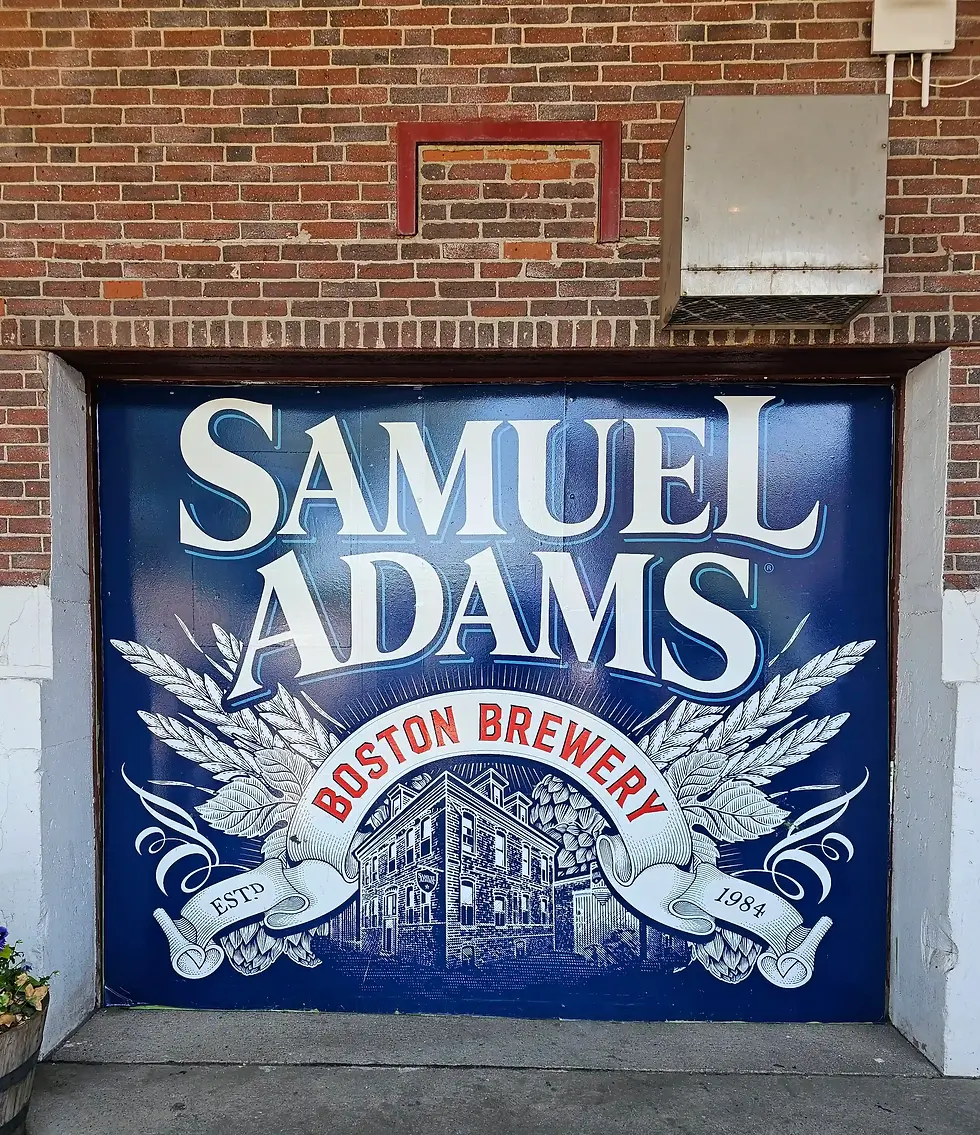
Despite these shifts, the Boston Beer Company remains a titan of the "small and independent" world, currently ranked as the third largest craft brewer in the US by sales volume by the Brewers Association. (For those following my travels, Deschutes in Oregon and Tröegs in Pennsylvania, both of which I’ve visited recently, sit at 10th and 22nd respectively - guides coming soon)
“Born and brewed in Boston, Sam Adams has always been more than just a beer – it’s a reflection of the city’s bold character, rich history, and unwavering pride.” (Lauren True, head of brand, Sam Adams)
2026 could also be the perfect year for a visit to Boston and the surrounding state. Massachusetts, home to many of the famous battles that led to America’s independence, is celebrating America's 250th birthday with the Celebrate Massachusetts 250 campaign, which brings together events and special exhibitions all across the state.
And, if that's not enough, then don't forget that football fever will grip the city when the FIFA World Cup 26™ arrives in town. The enormous Boston Stadium is hosting seven matches, with two of those matches featuring Scotland and its Tartan Army. Like those fans making the trip to this fabulous city, I will be toasting my team's victory, or, more likely, drowning my sorrows, with a Sam Adams.
Samuel Adams Boston Brewery history
The story of Samuel Adams Boston Brewery (often just called Sam Adams) is one of those classic tales of persistence, heritage, career tangents and a stroke of luck. It is a multi-billion-dollar company that started from the humblest of beginnings - on this occasion, with a dusty trunk in a Cincinnati attic.

76 year old, affable billionaire, Jim Koch, is a sixth-generation brewer. But, in 1984, he was a 34 year old Harvard-educated management consultant, and doing rather well at that. He'd gained three degrees, including an MBA and a JD, and was working in finance. He liked it, but it wasn't making him happy. Happiness is important to Jim. After all, this is the man that dropped out of Harvard for a while to run wilderness courses. Beer made him happy. Beer makes a lot of people happy!
Growing up in Ohio, Jim's father, Charles, a fifth-generation brewmaster, had seen the family business in St Louis crushed by the rise of industrial big beer. When Jim told his Dad about his plans to start a brewery, the response was blunt, "Jim, you’ve done some stupid things in your life, but this is the stupidest."
Despite the skepticism, his father eventually climbed the attic stairs of their family home in Cincinnati, dusted off an old trunk, and unearthed a recipe from the 1860s. It was the formula for Louis Koch Lager, Jim's great-great-grandfather’s brew. That recipe only included four ingredients: water, yeast, barley or wheat and hops. It would be fresh, rich and complex, and nothing like the mass market beers with their additives and preservatives. But, it did require learning a few nearly forgotten brewing techniques, some with names I'd never heard of: krausening, decoction mashing and dry hopping. He rushed home and brewed it up a batch on his stove, and after a bit of refining, it became the blueprint for Samuel Adams Boston Lager.
Now, to understand why this brewery was so revolutionary, you have to look at the state of beer in Boston back then. In the early 1900’s there were thirty one breweries, within a two-mile stretch of Jamaica Plain alone. That was more breweries per capita than St. Louis, New York, or Philadelphia at the time. Across the wider Boston area, the figure was higher still.

But, by the 1960s, the local brewing scene had almost completely vanished. When the Haffenreffer brewery closed its doors in 1965, followed by Carling in Natick in 1975, it felt like the end of an era. Boston, a city with such deep colonial ties to brewing, was virtually a beer desert. By 1983, the domestic heavyweights, Anheuser-Busch, Miller, and Coors, were methodically squeezing independent breweries out of existence, armed with superior distribution networks and marketing budgets that the little guys simply could not match. The top six beer companies controlled 92 per cent of all US production. It was time for Jim Koch to start a revolution.
He had good beer, but he knew he also needed good people.
Enter Dr. Joseph L. Owades, the famed American biochemist and master brewer, widely hailed as the guru of the microbrewing industry, and the inventor of low calorie beer.

Having trained virtually every brewer of note in the country, and developed the formulas for many of the nation's leading beers, including both Miller Lite (who I shall be visiting in July) and Budweiser, Jim brought him in as a consultant. Learning from the beer Yoda, Jim further developed his Samuel Adams Boston Lager and gave him 2% of the company as way of thanks.
So, who else do you start a brewery with? One of your fellow Harvard grads, or a big business leader from your time as a consultant? Nope, Jim chose Rhonda Kallman, his admin assistant. I've worked as one of them longer than I've been a designer!

She was organised, a great listener, smart as a whip, great with people and, as Jim said, “Rhonda knew bars.” She had, as Jim described it, a knack for making people feel comfortable, so that they did what she wanted without actually realising it. Woman after my own heart. (She has since left to focus on her first love, whiskey, as CEO and Founder of Boston Harbor Distillery, who also offer tours. Yet another excuse for me to return to Boston. I love writing about women in business.)
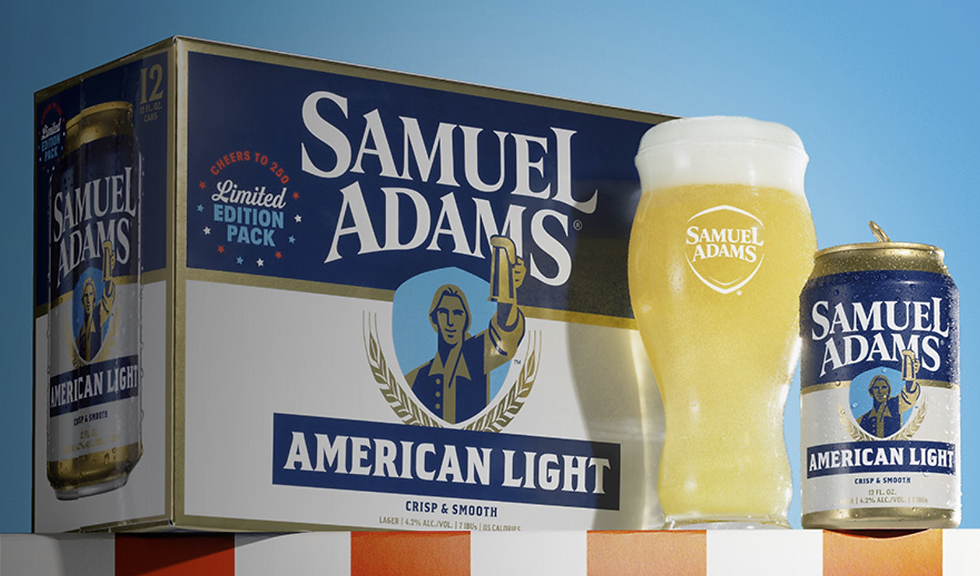
Then there was the small matter of a name. From a list of nearly 800 possibilities (including Sacred Cod - thank goodness he ignored that marketer's pitch!), he landed on Samuel Adams. It was a stroke of pure genius. Tying his beer to one of America's founding fathers was the kind of move that no amount of advertising budget could replicate. Suddenly, here was a beer with history in its bones, a sense of heritage so convincing you'd swear it had been brewed since the Revolution.
But still, starting an independent brewery is never easy. Jim would walk from bar to bar in Boston, hauling a suitcase containing seven beers, two ice packs and a pair of tasting cups.
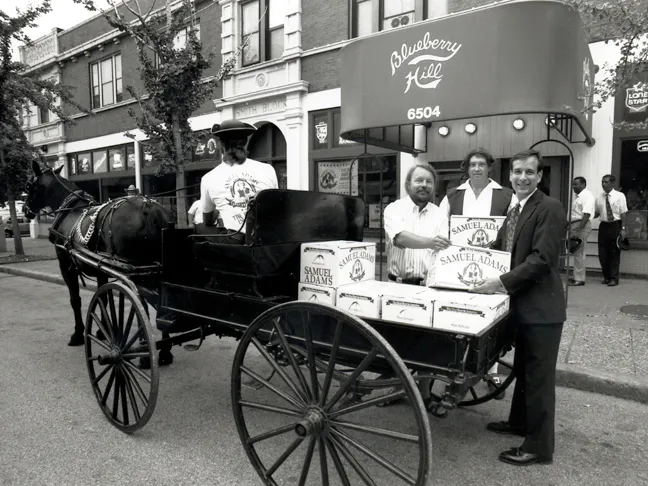
On 15th April 1984, Patriots' Day, a public holiday in Massachusetts and a date Koch chose with characteristic intent, he made his first sale of Samuel Adams Boston Lager. Just a few weeks later it went on to win Best Beer in America at the Great American Beer Festival. By that November it became the first American craft beer to be legally imported and sold in West Germany, after passing the country's famously strict Reinheitsgebot, the German Beer Purity Law dating back to 1516, which stipulates that beer can only be brewed using water, barley, and hops. That's some start.
Jim’s deep knowledge of the craft, his generations of beer geekery, was his secret weapon. His beer was voted best in the country the following year, and the one after that. People loved it.
Now, he needed a brewery, and what could be better than returning brewing to the historic but now abandoned Haffenreffer site?

It's not just about a great story, it's about doubling down on heritage. Though the Jamaica Plain location makes only a small fraction of the company’s beer now, it’s home to the brand's R&D department and more than 250,000 visitors tour the brewery every year.
From very early on demand had already meant that Jim needed more production space, so he acquired a brewery in his hometown of Cincinnati, Ohio and one in the Lehigh Valley in Pennsylvania, an area I know really well. This has given the brand the needed capacity and allowed the Boston site to concentrate on the hyper local and experimental.

Massachusetts had found itself the testing ground for a new kind of beer culture. Today, the state is home to over 200 craft breweries, from the pioneers like Sam Adams and Harpoon to the new cult favourites like Tree House and Trillium. The scene is more vibrant than ever, but it all traces back to those early, gritty days in Jamaica Plain.
Koch turned a niche into an empire. Once a small-batch brewery, Boston Beer Company shipped approximately 7.1 million barrels in 2025 across all their brands.
Not someone who wants to have anyone else boss him around, when the Boston Beer Company went public, Koch made sure that he kept all the voting rights. I can't imagine him retiring, as he'll always want to be learning more, meeting people and seeing them interact with his product, and quite frankly, brewing is his life and it's what makes him happy.
"If your ambition is to become a billionaire, good f***ing luck. People who aren't happy want to get rich. What would you rather be, rich or happy? (Jim Koch, speaking to the School of Hard Knocks)
But here's what I really love about Samuel Adams. Their Brewing the American Dream programme has quietly been doing something rather wonderful, coaching small food and beverage businesses, facilitating over $2 million in loans, and generally being the kind of big brand that actually gives something back. When hops were in short supply, they shared theirs with fellow brewers and they've championed new talent through their LongShot American Homebrew Competition for years. It's not flashy, and they don't shout about it nearly enough, but it makes a difference.
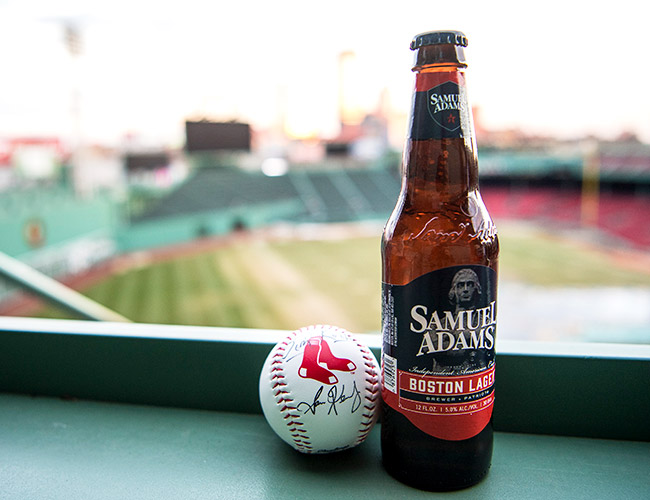
It's a brand that has infiltrated pop and sports culture too. From 2018, Samuel Adams has been the official beer of the Boston Red Sox in a deal that will last through the 2035 season. When Martin Scorsese needed a beer to anchor The Departed in the gritty, proud streets of Boston, it was a Sam Adams that ended up in the characters' hands.
The brand knows about pivoting too. Since 2011, with beer sales beginning to soften, Koch quietly started diversifying, branching out into alcoholic cider and flavoured malt beverages under the Angry Orchard and Twisted Tea labels.

It turned out to be a very shrewd move. Angry Orchard alone now commands more than 50% of the American cider market, and both brands have grown to such a size that they make up a significant chunk of Boston Beer's overall business.
In 2019 Boston Beer Company merged with fellow independent craft brewer, Delaware-based Dogfish Head, in a $300m deal.

Husband and wife team Sam and Mariah Calagione, co founders of Dog Head, had been friends with Jim Koch for years, and the partnership has led to joint projects in order to compete with the international beer conglomerates. I am hopefully heading to Delaware soon, on yet another field trip, and will swing by for one of Dog Head's tours and post a guide for you.
As for getting their brews back home here in the UK, well that's been a challenge. Shepherd Neame, Britain’s oldest brewer, had the contract to brew Sam Adams Boston lager over here under license from 2012. That beer has since been discontinued. But all hail Beerhunter, the UK-based independent online retailer, who specialises in craft beers and lagers from around the world, as they now stock imports of our favourite Boston brew. My order has arrived!
Jim's book, Quench Your Own Thirst, which I've been reading over the last few weeks, gives you a little snapshot of the character of the man, alongside barrels of inspiration, especially for us small business owners. It's a lesson in patience, perseverance and pivoting.
"If we're too certain, too stuck in our ways, too invested in the way things are done, we run the risk of missing out on all the fun of creating a better world, or at least one with better beer." (Jim Koch)
Who was the real Samuel Adams?
Before we get to the beer tour, we must talk about the man whose name is on the label. In the 1760s and early 1770s, many Americans were fighting for political, economic, social, and religious freedoms, think Benjamin Franklin, Thomas Jefferson, and John Adams. Yet, the name of the person who arguably played the most significant role in the colonists’ decision to declare independence from Britain, is often overlooked. Plenty of Americans, and most of us outside the US, know his name only in connection with this brand of beer - Samuel Adams.

Samuel Adams was a Harvard-educated revolutionary, a master of propaganda, and a pivotal American Founding Father. A tireless political campaigner for colonial independence, he orchestrated the Boston Tea Party in 1773, that famously bold act of defiance where colonists dumped British tea into the harbour to protest "taxation without representation."

Jim Koch asked permission from Samuel Adams's descendants to use his name. There was one stipulation. The Boston Beer Company would contribute to the upkeep of the Granary Burial Ground in downtown Boston, where Samuel Adams rests alongside Paul Revere, Peter Faneuil (benefactor of the famous Faneuil Hall), and two other signers of the Declaration of Independence, among many others. To this day, Boston Beer employees carry out an annual clean-up of the site, and a share of brewery tour proceeds goes towards its maintenance. It is a quiet but rather fitting tribute.
There's a beer connection too. Before he signed the Declaration of Independence, Sam actually ran his family’s business, and bankrupted it. While often described as a brewer, he was technically a maltster, inheriting his father’s malt house, only to see it crumble as his focus shifted from grain to grievance. This forgotten revolutionary, a background operator who always stood up to the elite, embodies the very spirit of defiance that this brand champions today.
Visiting Samuel Adams Boston Brewery: What to Expect
The Samuel Adams Boston Brewery design
Some of my earliest memories are of visiting my grandfather at the brewery he ran, a great old Victorian, red brick building, home to the Birkenhead Brewery on the Wirral. The smell of it, the scale of it, the sheer size of it, with walls that if they could talk, would recount generations of stories. It's why I've always had a soft spot for buildings like these, and why I love nothing more than seeing them find a new purpose.
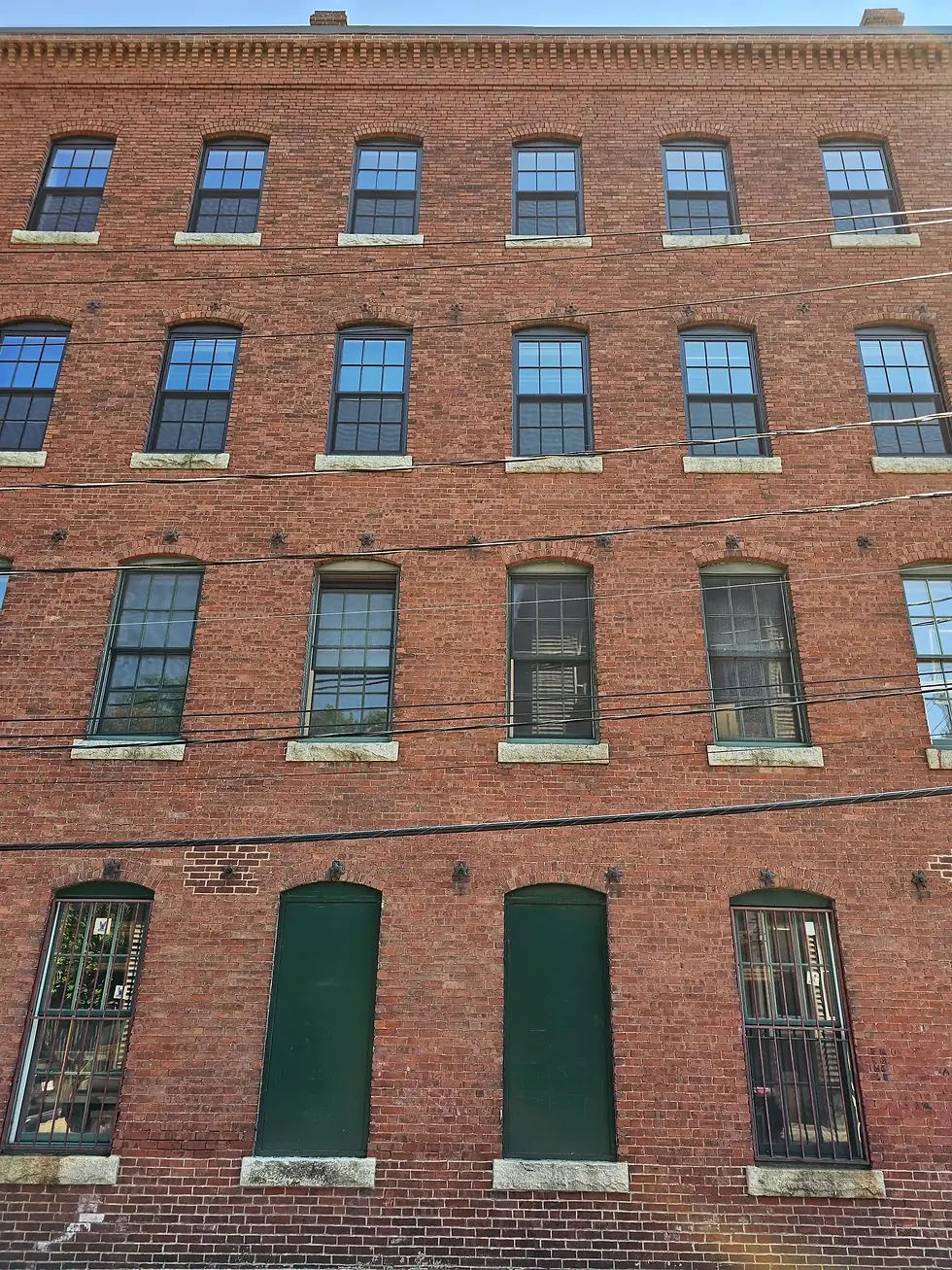
Haffenreffer & Co Brewery, with its trademark smokestack, was a pre-Prohibition brewery originally built in Boston in 1871 by German immigrant Rudolf Haffenreffer.
When it closed in 1965, the site lay empty for nearly two decades. That was until the JPNDC (Jamaica Plain Neighborhood Development Corporation) acquired it in 1984 and set about transforming parts of the site into a variety of community based projects, housing and small businesses.
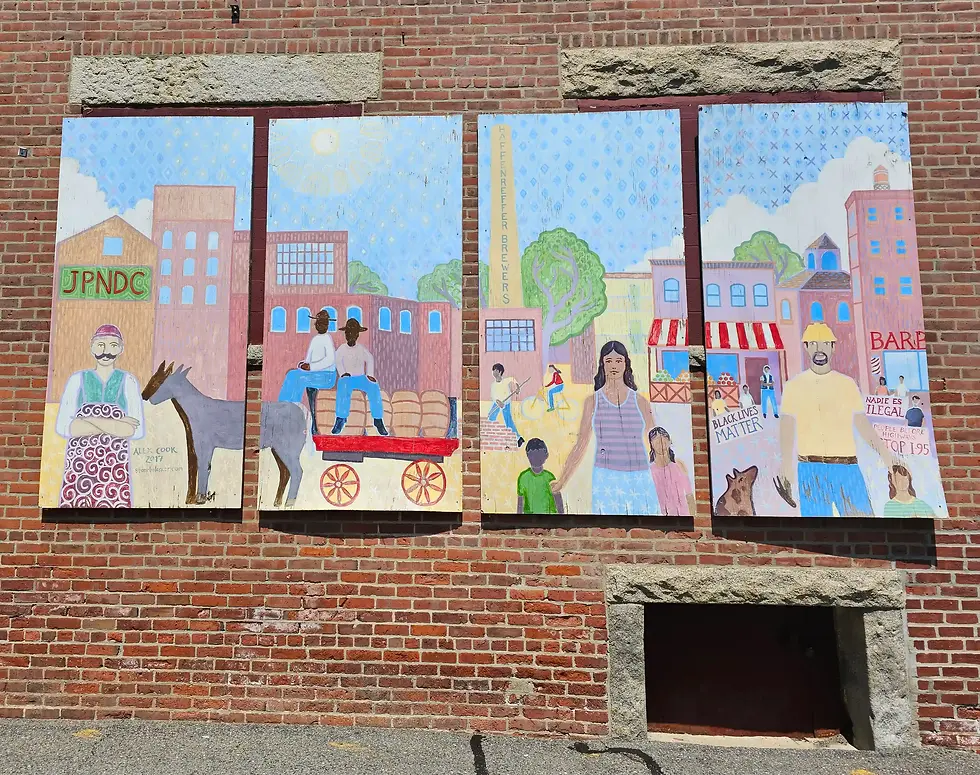
Situated, handily, just blocks from the Stony Brook MBTA station, the Boston Beer Company has been a tenant from the beginning, when the complex was very much a work in progress. Gentrification came along much later.

The main brewery building has been on the National Register of Historic Places since 1982, and, if you have time to kill, it's worth wandering around the area to take a look at the transformation.

The Samuel Adams Boston Brewery tour
We couldn't have asked for a better day for our tour. With 90-degree heat forecast, we gladly headed inside for some air-conditioned relief.

After checking in and receiving our trusty tour hand stamps, we waited in the Samuel Adams foyer and Perfect Pint Pub room, a comfortable, unflashy space with walls lined by Boston Beer ephemera. I am a sucker for old advertising posters. There are so many forgotten names to discover.


It was good to see the giving back initiatives on show.

We were a group of twelve. A few guests were late, victims of Boston's apparently dreadful public transit system, which had turned a simple trip from downtown into an hour-long ordeal. We couldn't possibly comment, having taken an $18 Uber out there, arriving in plenty of time with an entire afternoon dedicated to drinking.
Once everyone had gathered, we were guided through the tunnel and into the brewhouse. (I could have done without the cardboard cutouts, if I'm honest. A welcome video from Jim would have landed much better.)

We started with a plastic glass of Summer Ale, a splendid way to start any tour. Erin, sipping on a glass of Boston Lager, was our guide. She was fun, making jokes along the way and rattled through the founder's story. We laughed when she mentioned that Jim was manufacturing consultant, which Erin described as a vague and generic job title. I wish she'd have left a little pause in her script, to ask us why we laughed, as that is exactly what my husband does for a living. He's never been described as vague or generic before!
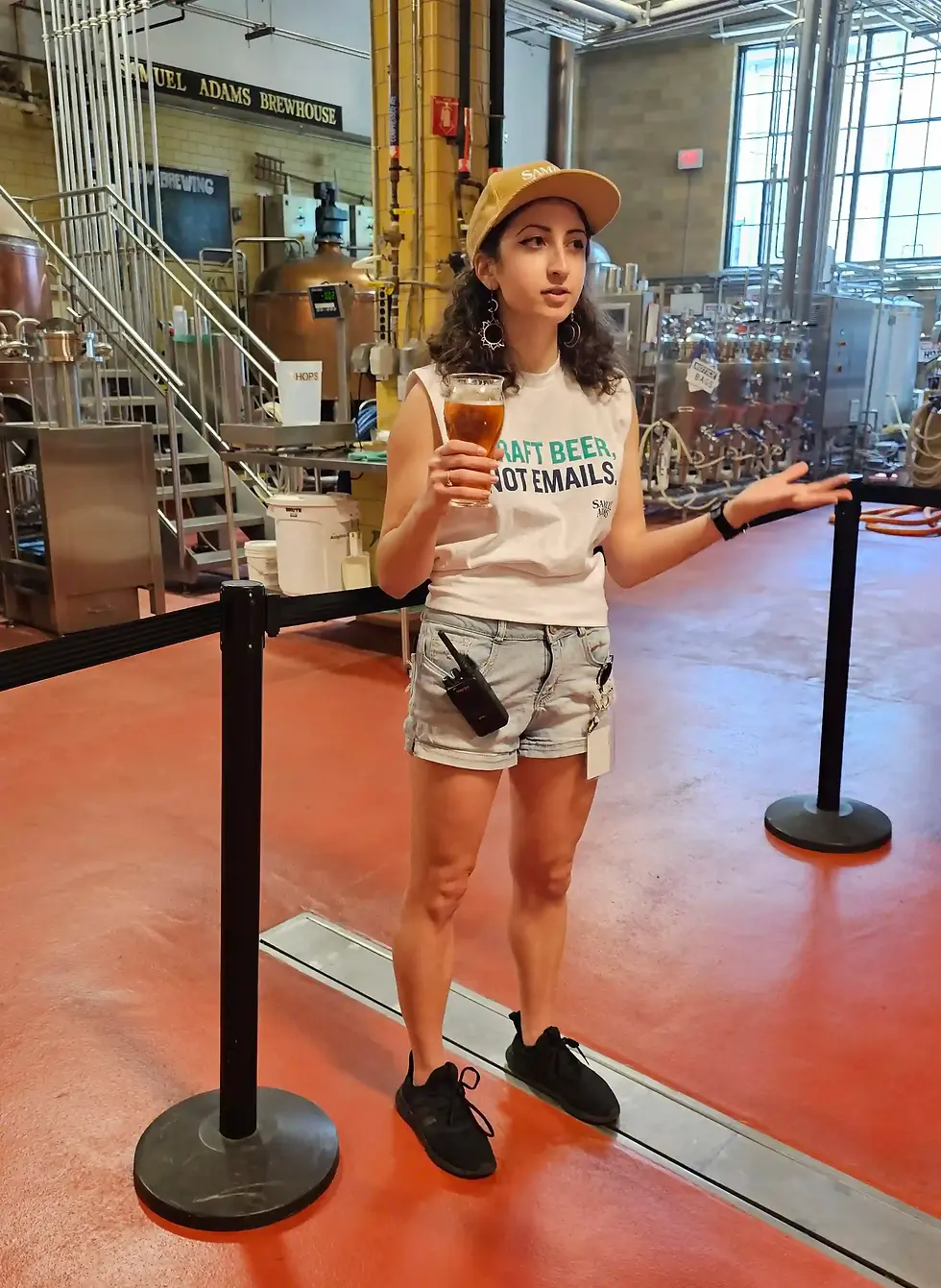
It turned out to be a non-production day, which was a shame. There's nothing better than the sensory treat of a brewery in operation. We were standing in one spot for half an hour here, being told about the process and history. (Tip for Sam Adams - maybe a few stools for those with mobility issues)

All beer must start with water, and here the source is good old Boston tap water. The brewery sends samples of their local water to their larger production breweries in Ohio and Pennsylvania, so the teams there can filter and analyse it, recreating the mineral content and pH levels to keep every batch consistent across all sites. And just to make absolutely sure, Jim receives a six-pack of every batch brewed elsewhere, for his own quality control. Apparently he is often found in and around the Jamaica Plain brewery, and has even been known to turn up unannounced on tours.
It reminded me of meeting Jack Teeling (the father of the Irish whiskey revolution) on the Teeling Distillery tour in Dublin. That sense of a founder who genuinely cannot keep away from the thing they have built, even if, in Jack's case, it was his son's. It says everything about what drives people like this. The beer, the craft, the connection with the people who make the journey to see it. That is the real quality control.

It was nice to see big chunks of copper and I spotted another Vendome kettle in action. It reminded me of my trip to Kentucky and all those delightful distilleries on the Bourbon Trail, with their stills made by the Louisville stalwart. The bulbous beauty here is helping to create the brand's barrel aged beer known as Utopias, which can reach an eye-watering 30% ABV. Since 1993 the Utopia range has been aged in decades old, charred whiskey barrels. However, since 2025 the range of casks now includes Irish Whiskey, Amarone, White Port, Ruby Port, Carcavelos, Cognac, and even good old Scotch barrels. That's quite the palette to play with for any brewmaster.

Next came the grain, selected, milled into grist, and pipe-fed into the mash tun, where it is combined with that hot Boston tap water to produce what Erin described as an oatmeal-like mixture. This process converts starches into fermentable sugars, yielding a sweet liquid called wort, which is then separated from the spent grain. The spent grain goes to animal feed, as we have heard at practically every brewery or distillery we have ever visited. But Sam Adams goes a step further: they also use it to make cookies, pizza dough and dog treats, some of which you can pick up in the tap room.
After a bit more about the beer making process, it was time for a pop quiz. Erin asked us, "How many types of beer are there?" One of our group said two. "Yes, " Erin said, "Sam Adams and all the other s**t you drink."
It was welcome light relief, because by this point the tour had got a little information-heavy, and a few well-placed infographics beside each piece of equipment would have helped everything land. None of this was Erin's fault. She clearly knew her subject inside out and had a genuine love for the product. She simply needed to be given a little more time in her tour to let the detail sink in and to feed off the reactions of the group.
We're told this is where this experimental brewery goes a little funky. The brewmasters are free to add ingredients to infuse with the beer, such as cacao nibs, oak chips, vanilla beans, even pickles. One of the beers in the gift shop on our trip was a brewery exclusive, infused with cranberry puree, spruce tips, juniper berries, and honey.
I told Erin I was in desperate need of inspiration for the glut of rhubarb currently taking over my garden at home, having already worked my way through rhubarb jam, chutney, marmalade and crumble. A rhubarb beer, she said, would be a bit ordinary. But a rhubarb crumble beer? Now that sounded like exactly the sort of thing they would try. It reminded me of the Cheetos spirit we sampled when visiting the flavour punks at Empirical. Some ideas sound mad until they are delicious.
Once kegged, the beer from this brewery heads to festivals, local draught accounts around Boston, or simply stays on site for visitors to enjoy in the beer hall and tap room.
Erin rounded things off with a nod to the beer's namesake. Just across the street from the Granary Burying Ground, where Samuel Adams himself is interred, stands the Beantown pub, whose slogan reads: "The only pub in the world where you can drink a cold Sam Adams while viewing a cold Sam Adams." Way to end - on a dad joke!
Samuel Adams Boston Brewery Tasting Room
After thirty minutes in the brewhouse, we were guided to the tasting area to sit down and enjoy more beer. It's a hard life. This is where Erin's humour and knowledge truly shone. She was a natural storyteller, introducing us to the ingredients, the proper way to taste, and the concept of the Perfect Pint glass.

In March 2005, after years of quietly obsessing over every curve and angle, Sam Adams unveiled something rather unexpected, a glass. Not just any glass, mind you, but one designed from scratch by brewers and sensory scientists working together to make sure Samuel Adams Boston Lager tasted exactly as it was meant to.

Think of it as the Glencairn of the beer world, the first glass ever created specifically to enhance the experience of a single beer. It became known simply as the Perfect Pint. And the name stuck, because honestly, it's hard to argue with it. Did we get one for our tasting? Sadly no, just the cute little glass that we all could take home. Mine survived the flight back to Scotland hidden in a shoe!

The room was a very simple affair, okay for beer sloshing around, but not overly comfy.

We laughed at a sign asking us what we thought of the stage lights. We didn't have time to click the link, but as we were talking about lighting in this space (bet you weren't), we agreed it was way too bright. Save a fortune on the electricity Sam Adams, and turn down the overhead lights a bit. It's not cosy.

A couple of pitchers landed on our table for us all to share. Erin regaled us with a list of horrifying things previous tours had done with the glasses and pitchers (beer pong and spitting back into the pitcher after tasting being the worst), but her rules were deftly delivered with humour. We were firmly reminded that this was a "no chug zone."
When Erin asked how far people had travelled for the visit, guests from Pittsburgh, Philadelphia, and South Carolina proudly chimed in. But we easily won the prize for furthest travelled. Go Scotland!
They use a two-row pale malt blend, 90% pale malt blended with 10% Caramel 60 malt, and to emphasise this, two glass jars containing grains were passed around for us look at and touch and taste. It did smell delicious.

A glass jar of hops was handed round too, even though the brand use hops pellets now. They generally use two types of German Noble hop varieties: Hallertau Mittelfrüh and Tettnang Tettnanger. I had to look up the spelling for those later!

After a discussion on the different hops varieties from across the US and beyond, we got to the matter of finally tasting.
We were given clear guidelines on the tasting process, how to engage all our senses, and how to account for the differences in our palates. It did not feel rushed, which is not something you can always say of a brewery tour. We were also told to chew our first sip, much like the Kentucky chew we had learned on the Bourbon Trail, a technique we now apply to every tasting, whatever the drink. Chewing that first sip coats the palate and wakes it up, so that the second sip can open up fully and reveal everything the beer has to offer.
I will be honest, beer is not usually my drink of choice. But sipping Samuel Adams Boston Lager in the place it was born, guided through every note by someone who clearly loves it, I found myself genuinely converted.
Our second tasting pitcher was a research and development session beer which had been made in the Nano brewery. They use the feedback from these tour tastings to help decide if the beer should be tweaked, or rolled out as is. Way to run a focus group.
We had heard about the Utopias beer earlier and an empty bottle was passed around. It smelt like a beery pancake, with syrup sweetness notes, which Erin told us was because the beer was aged in Buffalo Trace whiskey barrels. (I loved my trip to Buffalo Trace). They needed to create a new strain of proprietary yeast to make it. 20,000 or so are made for each release. The first goes to Jim. The second goes to the head brewer, and then all full time employees get them, before it goes out to be sold in liquor stores.

Utopias is therefore extraordinarily rare, aged for sixteen years, and consistently ranked among the most coveted beers in the world. The bottle alone is a collector's piece: a hand-crafted ceramic miniature of a copper brewing kettle, complete with tiny sliding doors that open to reveal a portrait of good old Sam himself. Having made miniature stills as props for brands in the past, I have a particular appreciation for this kind of functional artistry. Apparently it drinks more like a cognac than a beer: uncarbonated, warming, designed to be sipped slowly. So, I should love it. Utopias 2025 is one of the strongest beers ever brewed, and it is illegal in fifteen states. What a story. As for whether it is worth the $240 price tag, we cannot get it over here, so I am in no position to judge. I'm intrigued though.
Just a quick note, there was enough beer in the pitchers to fill up our glasses a few times over, so we were not restricted to two small tastings. I guess it would depend on how many people do the tour with you, but at least the brand didn't come across as tight.
Samuel Adams Boston Brewery Barrel Room/Bier Keller
Off limits to us on our tour, I sneaked a peek inside the brand's barrel cellar.
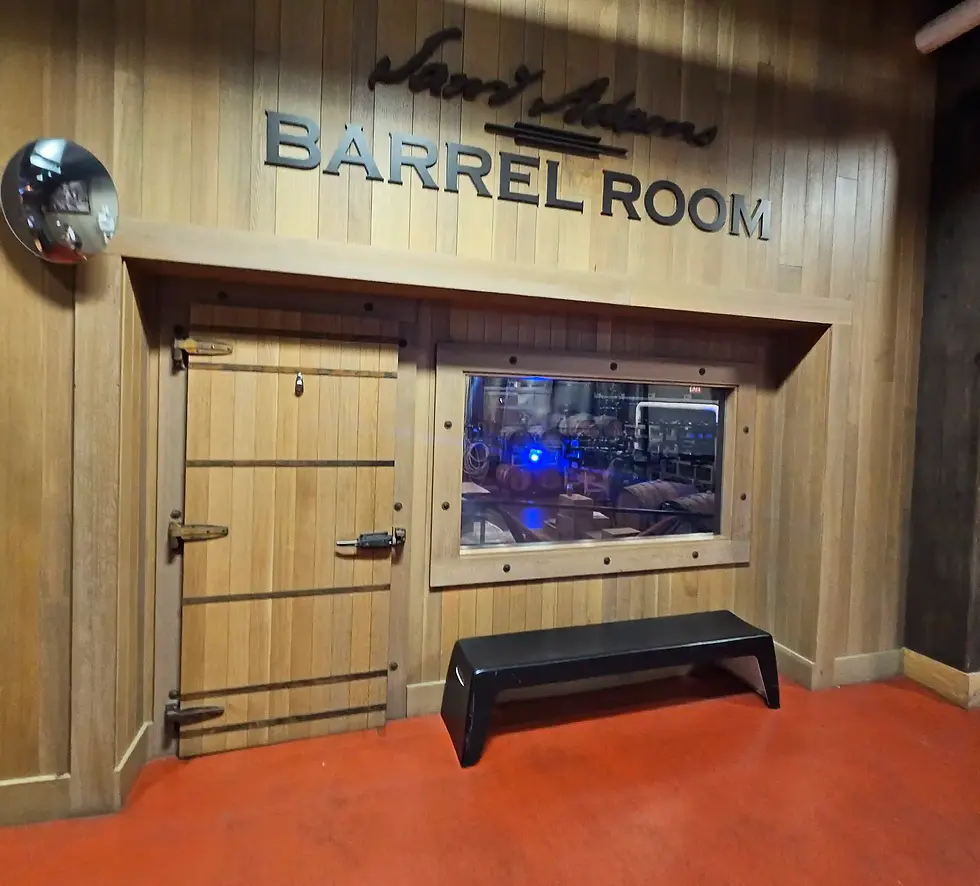
The expanded Bier Keller is where they age their experimental barrel-aged beers, with ingredients referred to on site as "Kosmic Mother Funk" or "KMF" for short.

The space was redesigned by Boston based Studio Troika.

Nano Brewery at Samuel Adams
So, what else is behind the curtain you might ask? You're not going to see the Nano Brewery on the tour. It's where they have over 20 experimental beers on tap, and barrels containing their most secret stuff.
Shop at Samuel Adams Boston Brewery

Our tour ended in the generous sized shop.

There's certainly plenty to tempt you, though a lot of it was not suitcase friendly!

The clothing was good quality and I managed to pick up a zipped hoodie that my husband has envied ever since. It's a bit far to go back for another one, though I am sure the air miles would be handy.

Tasting packs and glassware really doesn't travel well, as we have found to our cost. I don't travel light enough to have room for six packs.

I'm always on the hunt for souvenirs that do travel well, and picked up a few ceramic coasters, but was really on the hunt for a Christmas bauble, or something I could use as such for my travel themed Christmas tree back home. Sadly no luck this time.
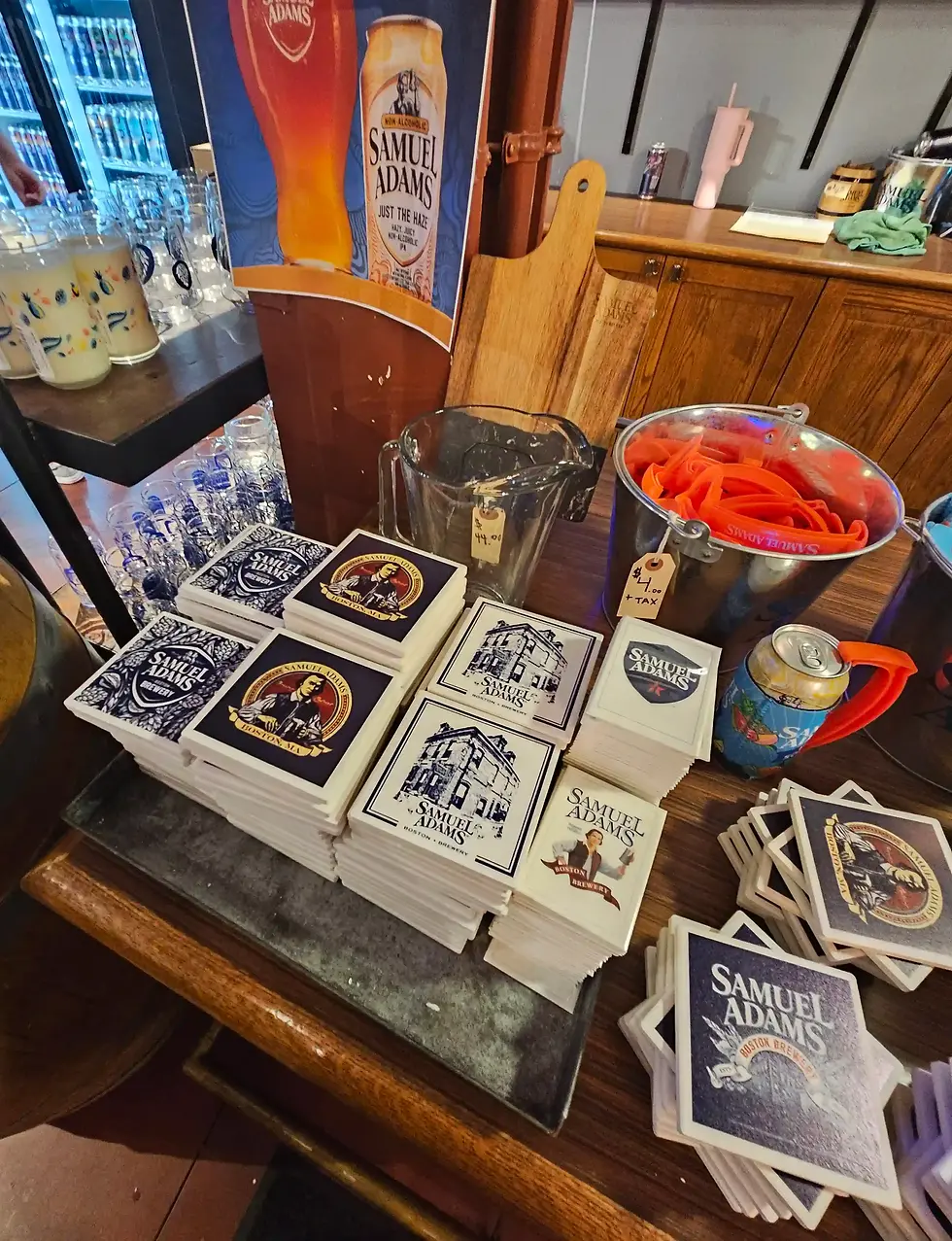
I could have bought endless hats and t-shirts, or paddle board racket covers, or a throw for my sofa, or dog leads. The choice was impressive.

I appreciated the simple donations barrel, especially when it's for such a good cause. Good to see the brand shouting about their programmes that support others.

And who can resist a sale rail?

The Tap Room at Samuel Adams Boston Brewery
The Tap Room opened in 2017, again designed by Studio Troika. It was a space repurposed from a staff training area. The education center shifted across the complex to a building that now also holds the Bier Keller, and it is where the beer and cheese tastings take place.

Of the people that did our tour with us, most of us bought something in the shop. But all of the tour guests bought a beer flight in the Tap Room and sat in the beer garden.

The Tap Room is open to everyone, so not restricted to those on tours. I always appreciate food and drinks being served up at a brand experience, providing the dwell time that is so important for building brand advocacy.

It was time to get our thinking caps on and to design our flight.

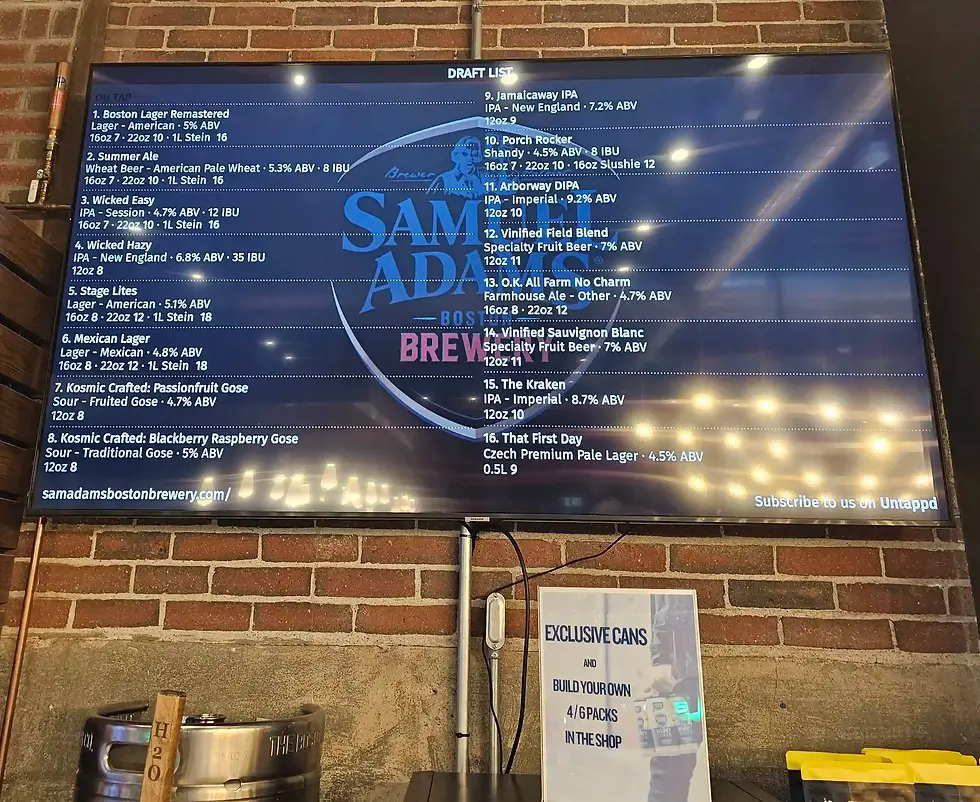
I would have appreciated something other than beer on the menu, a soft drink, a coffee, a wine, something for the designated drivers and the non-converts among us. Sacrilege, I know, at a brewery. But it is worth saying.
What I did love, though, was the chalkboard guide to local spots nearby. It lured us straight to Ula Café (Black-Owned, Woman-Owned, Veteran-Owned) for a post-tour coffee, which turned out to be a very good decision.

Say it loud and say it proud, it was great to see diversity on show too in the signage. My differences certainly make me stronger.

Even the beer mats agree that love does conquer all, or in this case, ale! This brand initiative, originally just to support Pride, has since spawned a limited release ale, brewed by LGBTQ+ coworkers at the Boston Brewery with 100% of proceeds supporting LGBTQ+ organisations.

As the tours were all booked up, visitors were filling up the spaces quickly.

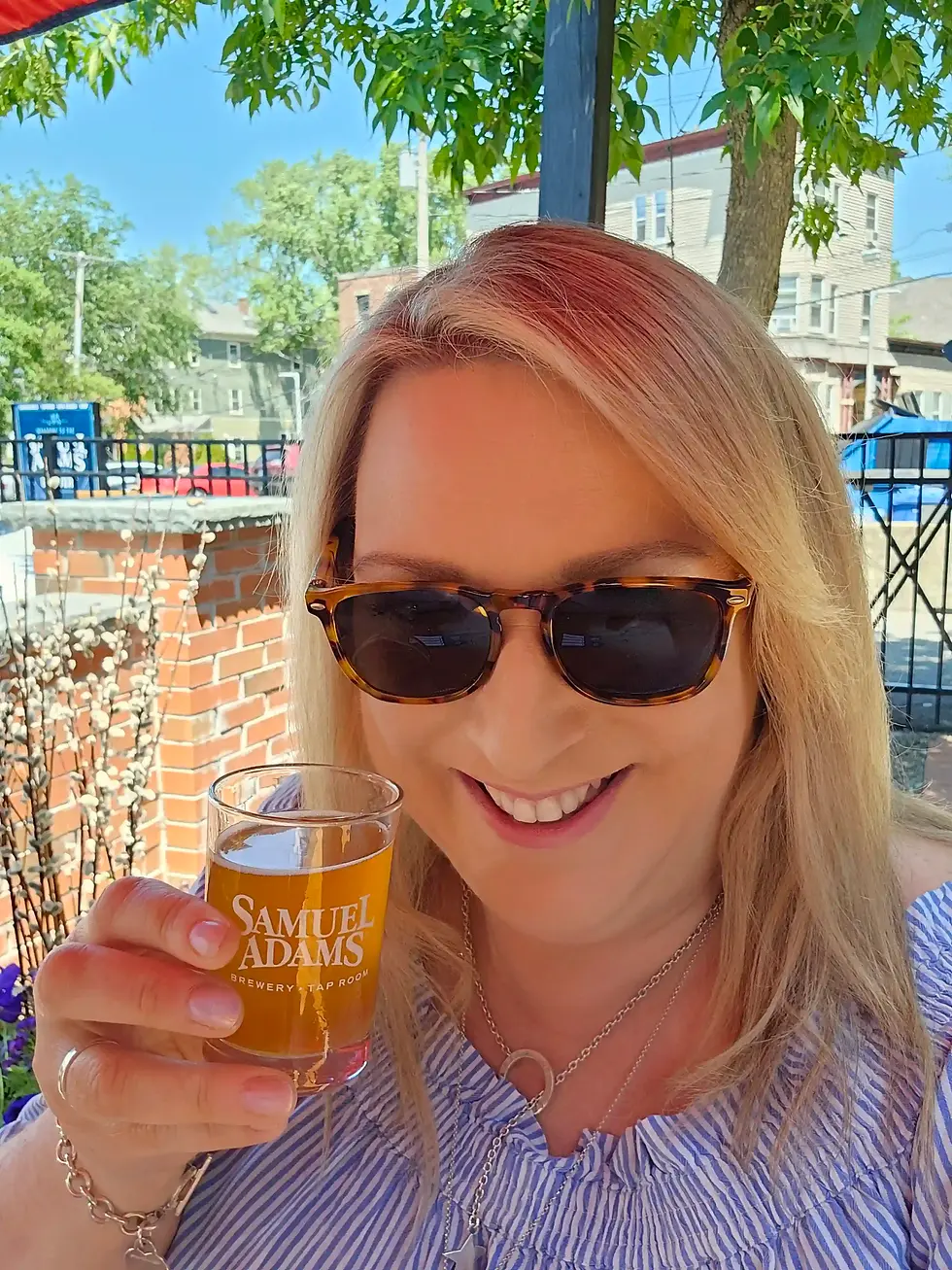
It was too hot to be indoors, so we plumped for seats on the patio to enjoy our brews.

We were addicted to pretzels, beer cheese and mustard dip, which we had found served at multiple breweries throughout our trip. This lot cost us $14. They also do pizzas, chicken tenders, sharing plates and sandwiches.

This is the life!

What is better than Boston in the sunshine? Not much.
Sam Adams Downtown Boston Taproom

If you're in downtown Boston, then you can also head to the brand's 14,000 square foot, 3 storey Taproom near Faneuil Hall, which opened in 2020. Their rooftop patio is a great place to enjoy the warm weather. Designed by Bergmeyer, the multi disciplinary design team behind several visitor experiences I have toured, such as Jim Beam in Kentucky, and the downtown location brings the brewery to a wider audience, or certainly those too lazy or time poor to visit the brewery itself.

There's another taproom in Cincinnati, Ohio which also does tours. There's another field trip for me.
Is the Samuel Adams Boston Brewery worth a visit?
Looking at my haul from the visit and my post-tour acquisitions, you would know I left a committed Samuel Adams convert.

I wear my hoodie with pride, and am regularly stopped by people who recognise the brand or want to talk about Boston. I am more than happy to oblige. Boston is a city I will absolutely return to. Turning the pages of Jim Koch's book Quench Your Own Thirst, has made me appreciate the brand even more, and I will be sipping on their beers and working through some of the recipes from the American Dream cookbook this summer.

Our tour was delivered at pace, with bags of enthusiasm and knowledge, and packed with humour, much like the tour we had at Aviation Gin. There's a lot to cram in though on a 45 minute tour, and we left wanting more than our commemorative glass. In hindsight we could have booked a more in depth experience, like the Beyond the Brewhouse tour. The standard tours are really popular, so fill up fast and they run back to back all day. We just felt as if our guide needed maybe fifteen more minutes, so she could go off script a bit more, and to give her time to feed off the reactions of not just us, but our other tour companions. Those little nuanced remarks that tour guests make can really open up a conversation, and make each guest feel heard and truly part of the family. It can make the tours even more memorable and, if I'm putting my hard marketing head on, they can also drive sales in the bar or shop.
A few infographics around the brewing equipment would help everyone know what we were looking at. It's a common piece of feedback I give to brands, as you'll read in my other guides. As production wasn't going on, we could hear everything well, but things like hearing loops or mics help to make everyone's experience accessible. Maybe a printout for those without English as their first language too on the key points.
With so much story, there's actually not a lot to see on the tour. But there is a welcoming patio and Tap room, so you can linger for hours here, as we did, soaking up the atmosphere and the sunshine.
The historic buildings are not being fully utilised, and there is certainly scope for a deeper neighbourhood history tour, which I've enjoyed at places like Buffalo Trace and Carlsberg.
A few more local connections in the shop wouldn't hurt either. I am sure there are some local artisans that could whip up Boston-themed merch, such as apparel and homewares, the sort of stuff the Starbucks Reserve Roasteries and the RHS Garden Bridgewater do so well.
I wonder if they'd serve up a supper club event, or seasonal bar food menu, maybe using some of the recipes in the American Dream cookbook (which I picked up on Amazon over here), or just invite some of those brands to have their goods on sale in the shop or have food trucks in the yard - there's community connections that could work in everyone's favour. (No doubt there's some crazy US legislation that'll prevent it!)
Samuel Adams and Boston are so intertwined that it's almost impossible to think of one without the other. The real Cheers bar on Beacon Street serves it on tap. The sports teams drink it. The city breathes it. For a brand that started in a kitchen in 1984, that's quite the legacy.
Plan your visit to the Samuel Adams Boston Brewery
Address
30 Germania Street, Boston, MA 02130
Website: Samuel Adams Boston Brewery
How long was the visit?
We were there for 3 hours, with 45 minutes spent on the tour and the rest soaking up the sunshine, drinking and chatting to locals.
How much are tickets?
Tickets for tours are from $15, and, as usual, we paid for our tickets and this was not part of any advertising.
There are 3 standard tours to choose from.
The Sam Signature Experience at $15, is a 45 minute classic brewhouse tour showing you the brewing process and R&D program with a few tasters on the way and upgrades are available too.
Beyond the Brewhouse costs $30 and lasts about an hour. It's a slightly deeper dive into the Brewhouse, Bier Keller and Sour Barrel aging facilities, and you get to sample three fresh beers.
Keller Crafted: Artisan Beer & Cheese Experience is $40 and takes you underground to the Bier Keller to taste some of their rarest beers paired with locally-sourced cheeses.
If you want a private tour then they can accommodate this with prior notice. And if you rock up and want to know a bit more, then they even offer abbreviated Lager tours, if they're not too busy.
Opening times
It's always worth checking with Samuel Adams for their current opening times, as they can vary.
The Brewery, Taproom and event space is open Monday to Thursday from 12:00 - 9:00 PM, Friday and Saturday from 11:00 AM - 9:00 PM and Sunday from 11:00 AM - 7:00 PM.
Tours are scheduled throughout the day and should be booked online to avoid disappointment, though they do have a few spaces for walk ins.
Kitchen closes 1 hour before closing time.
Last Bar Call is 15 minutes prior to closing.
Remember - you will need ID to prove you are over 21, even if, like me, 21 was a long time ago.
Getting to the Samuel Adams Boston Brewery
We had a hire car in Boston, as we were on a 3 week road trip, but we left this in our hotel car park and either walked or grabbed an Uber so that we could both enjoy the beers, the buzz and the banter. On site parking is very limited, so do like us, or take the MBTA Orange Line to Stony Brook station, and the brewery is just a short walk away.
Where we stayed for our visit to the Samuel Adams Boston Brewery
We were based in Boston for 3 nights, and our base was the Omni Boston Hotel at the Seaport, booked through Booking.com. We splashed out on one of their Artist Tower Studio King Rooms with a view and got lucky with a corner room which gave us plenty of space and a really comfortable stay. We liked being on the water, with views of the harbour, and found it super handy, but never got to use the heated rooftop pool. Maybe next time?

What to see near the Samuel Adams Boston Brewery
This was my first time in Boston, and I'd always wanted to visit. There is lots to do and is very walkable, though you will notice that you'll have beaten your step count at the end of the day.
This city is, in most people's minds, linked to one event, so do make the time to do the Boston Tea Party Ships & Museum.

It is cheesy, but we came out having had a thoroughly fun time, thanks, in no small part, to some very theatrical costumed guides and some clever storytelling. The one hour tour gave us an immersive reenactment, and we laughed and learned along the way. The only small down side was the disappointing tea and food options at the end.

But, if you like audience participation, and a smattering of fun facts, then this is a tour for you. If you want something serious and historically accurate, then head to one of the city's excellent museums.
We enjoyed a self-guided walking tour of the Freedom Trail, following a red brick line that meanders through the city for 2.5 miles. Along the route are 23 historic buildings and locations that help to tell the story of the city.

Now, you don't have to do them all in depth, as many visitors, like us, won't know all the ins and outs of American history and legislation.

What we did find however, is that it gave us a route to follow at our own pace, and something we could come back to, after we wandered off on a tangent in search of sustenance, sightseeing or shopping.
The Boston Public Garden is beautiful. The first public botanical garden in America, it was a riot of colour on a hot, sunny day and a great place for people watching.
We visited on Memorial Day and found a whole hillside on Boston Common covered in 37,000 flags to represent the fallen. It was so moving.

Don't bother with the historic swan boat trip on the lake. It's a tourist trap, lasts just 15 minutes and only has you going round in a circle under a bridge, and the queues were horrendous. Just wander along and enjoy sitting under a tree to take in the skyline and scenery.

Acorn Street in Beacon Hill is apparently the most photographed street in the United States, and it certainly came up on every guide to the city we found. Now the 19th-century cobblestoned lane, flanked by Federal-style, brick row houses and their gas lanterns is undeniably pretty, but it was also rammed with tourists (which we did our best to leave out of our photo below). We were underwhelmed and left to go for a Guinness. It must be a nightmare to live there. It's just a street folks!

You are never far from an Irish bar in Boston, and we found Emmets to be one of the most authentic. It served a fine pint of the black stuff and a welcome chilled Riesling, that we paired with a trio of Irish delicacies called the Taste of Ireland. You can't beat a good pie or stew when it's 99 degrees Fahrenheit outside! After an hour or so of chatting to the locals, we stayed for live music from an expat Scouser with a guitar. Made me feel right at home. Sam Adams is on draft too.

As for other brand experiences you can visit, then there are a few I will return for.
I really want to do a tour of Harvard. They have a visitor centre, which opened in the 1960s. Yes, it's a brand! And, if you need more beer, there is the Harpoon Brewery & Beer Hall, that offers tours just a stroll from the hotel we stayed in at the Seaport. They even have a beer garden in Boston Common if you're passing. And there's so many beer halls and even a cidery for you to find around town. For spirit fans, then a trip to the aforementioned Boston Harbor Distillery is a must. For those with a sweet tooth, you can tour the pioneering, ethical brand Taza Chocolates, making unrefined, stone ground chocolate from bean to bar. And, for fitness fans, New Balance's Global Flagship at Boston Landing has displays drawn from their archive, plus there's a whole lot more to do in their retail and community hub.
And with a few extra days, you can take trips out of the city to places like Salem and Marblehead, like we did. A brilliant mix of history, innovation, learning, landscapes and culture, Massachusetts is just marvellous.
Further reading
Drink fans, if you liked this article then check out our guides to Aviation Gin, Jack Daniel's, The Black Sheep Brewery, Craft Co, Campari, Johnnie Walker Princes Street, Evan Williams, Buffalo Trace, Llanerch Vineyard, Empirical and White Castle Vineyard. More drink related visitor guides coming soon.
Please note - I'm real
I visit every brand visitor centre and experience myself. My feedback is real, based on a single visit, but informed by years of experience designing and exploring brand experiences all over the world.
I love writing my own reflections, diving into a brand's history, doing the research and looking at spaces through the eyes of a commercial interior designer. With over 30 years of working with customers, I also enjoy watching how guests interact with guides, displays and spaces. Everything I share is honest, personal and entirely human, not AI generated.
That authenticity is important to me, and if it's important to you and you want to work with me, or share your experiences or want to suggest others, then I am happy to be contacted via this website.
Photographs: ©Julie White unless noted otherwise
Disclaimer - The views and opinions expressed are solely my own. I paid for the tours in full and any comments reflect my personal experiences on that day. Please drink responsibly. Please visit and garner your own thoughts and feel free to research the brand and the visitor centre in question.


Comments