


The Visitor Centre today is ... Sapporo Olympic Museum
Updated: Aug 11
We visit the Sapporo Olympic Museum, home of the Winter Games of 1974, where history and legacy sit side by side, and where everyone is "YOKOSO" ("Welcome!" in English).

With the Milano Cortina 2026 Winter Olympics in full swing, and the Paralympic Winter Games waiting in the wings, billions of fans across the world are glued to their screens. Some brave souls will know some of the sports first hand. But many, like me, will question why anyone would think of hurtling down a sheet of ice on what suspiciously resembles a tea tray, or will suddenly morph into experts on the scoring of a Cab, Double Cork 1440 or the dreaded Quadruple Axel.
I don't ski. I've designed multi-million pound ski chalets, and every client looked utterly perplexed when I confessed that I had never set foot in a ski resort, let alone taken on a black run. If you had ever seen my attempts and curling or ice skating, you will be under no illusion that I live vicariously through the utterly terrifying exploits of others.
However, I adore the Winter Olympics. It is a spectacle not just of sport, but of nature. Snow capped mountains, forests of firs, flood lit ramps, near vertical downhills. The visuals alone are cinematic. Athletes now hail from around ninety countries, a far cry from the first games, when only sixteen countries attended. How times have changed.
I'm of the vintage that remembers legends such as Robin Cousins, Katarina Witt, Franz Klammer and Alberto Tomba. Torvill and Dean's gold medal winning Boléro, at Sarajevo 1984, had our whole nation in tears. I became obsessed with extreme sports athletes, such as Shaun White, thanks to playing SSX Tricky on Playstation. We bit our fingernails watching Rhona Martin throw her stone of destiny to win gold in Salt Lake City in 2002, though, thanks to Scotland, we thankfully have several more Olympic curling heroes. And some, like Japan's "Ice Prince," Yuzuru Hanyu, reach a level of fandome equal to that for Harry Styles or Taylor Swift.
Pop culture has also embraced the Winter Olympics. You have the feelgood underdog stories, such as those of the Jamaican bobsleigh team in Cool Runnings (1993), or Margot Robbie's portrayal of notorious American figure skater Tonya Harding, in I, Tonya (2017). Even the spoof Blades of Glory (2007) gets us in the mood for the nerve-wracking, winter spectacle that rolls around every four years.
There is one sport in particular that is a firm favourite of mine, the ski jump. It is thanks to one man, Britain's Michael Edwards, better known as "Eddie the Eagle", the plasterer turned ski jumper, who won our hearts, even though he came last in both his Olympic events. I once sat next to Eddie on an international flight, just after his legendary jumps at Calgary in 1988. He was generous and charming, and unforgettable. So, the chance to get up close to an Olympic ski jump was irresistible, when I found out there was one next to an Olympic museum in Sapporo.

The 1972 Sapporo Games were the first Winter Olympiad to be hosted in Asia, and they transformed this northern city. Winter is not endured here, it is celebrated. Best known internationally for its annual Sapporo Snow Festival, which attracts over 2 million visitors every February, Hokkaido, Japan’s northernmost island, is too often skipped on the tourist trail. Most travellers head for Tokyo, Kyoto, Osaka and maybe Hiroshima. But Japan is so much more. Sapporo, with its heavy snowfall in winter, has cooler, less humid summers, a blessed relief from the sweat box that is summer in Honshu. A trip north delivers surprising delights, such as fabulous seafood and rice, wild, unspoilt landscapes, fascinating indigenous culture, plus a beer, whisky and wine industry that benefits from the cool climate, crystal clear waters and volcanic soil.
While the main Olympic Museum is in Lausanne, Switzerland, there are now 37 satellite Olympic museums around the world, all stitched together under the banner of the Olympic Museums Network (OMN). Japan has three, two of which I have been lucky enough to visit, in Tokyo and here in Sapporo.
Sapporo's games did more than re-shape a city. They inspired a continent, and left a legacy that you can still feel today.
The Sapporo Olympics history
The Sapporo Winter Olympics ran from February 3 to 13, 1972. But Japan's Olympic story started much earlier, with plans that never got to the starting line. The country was set to host the 1940 Summer Olympiad, and the Winter Games in the same year in Sapporo, but both were postponed due to World War II and the Sino-Japanese War. And so Japan waited. Nearly a quarter of a century passed before the torch was lit on the Summer Games of Tokyo 1964, followed a few years later by Sapporo 1972. The success of Sapporo's Winter Games paved the way for Nagano 1998, then Tokyo 2020, delayed until 2021 due to the Covid pandemic, and held without spectators. A bitter blow, softened only by resilience.

Sapporo's Winter Olympic bid was spearheaded by key local and national figures, most notably Mayor Harada of Sapporo, and Shingoro Takaishi, an International Olympic Committee (IOC) member and influential business leader, president of Mainichi Newspapers, who famously campaigned for the Games from his sickbed in 1966. This passionate bid lead to their success. In the six years before the games opened, around 200 billion Japanese Yen (around ¥600 million today) was poured into upgrading the city's infrastructure and utilities. In a city often hit by heavy snow, a new subway system and underground shopping complex was built. Main roads, railways and the airport all received significant upgrades, ready for the influx of visitors. Fourteen new sports facilities were designed by leading architects, and proved so popular and efficient that many are still in use today. The investment turned Sapporo into a hub for winter sports in Asia, and opened the door for Nagano 1998, PyeongChang 2018 and Beijing 2022.
The Sapporo Games had the motto, "YOKOSO" ("Welcome!" in English), a fitting tribute to a city known for its friendliness, simplicity, and warm-heartedness. One lasting legacy of the games is the Sapporo Olympic Museum, built into the Mt. Okura Ski Jump Stadium.

Sapporo dropped its bid to host the 2026 Winter Olympics, when in 2018 a devastating earthquake hit Hokkaido. Officials decided they should focus on disaster recovery and set their sights on winning the bid for 2030. But the fall out of the Tokyo 2020 games, and its postponement, had the nation wary of costs, and a corruption scandal didn't help either. The final reported bill for hosting the Tokyo Games was around 1.4 trillion yen (about $13.6–$15 billion), twice as much as forecast. It was too much for Sapporo, so, on the 6 October 2023, Sapporo pulled out from bidding for 2030 altogether.
Climate change is also looming large. Rising winter temperatures even has the International Olympic Committee (IOC) considering moving the Winter Olympics and Paralympics earlier, to protect snow conditions, something that is already affecting competition snow sport seasons and wider winter tourism.
Visiting Sapporo Olympic Museum: What to Expect
The Ōkurayama Ski Jump
You cannot miss the Ōkurayama Ski Jump. Ride up the escalator from the car park, and you are greeted with the awe inspiring vista of the famous jump, towering over the Olympic Museum next door.

Ski jumping has featured at every Winter Olympics since their inception in 1924. The Sapporo ski jump was completed in 1931, thanks to funding from one man, Baron Kishichiro Okura (1882–1963), the Japanese entrepreneur and hotelier, who studied at Trinity College, Cambridge, raced in England's first motor race, and became a major patron of sport and the arts.

To get to the observation deck, I first had to summon up all my courage. Now, remember I mentioned I had never set foot in a ski resort? Well, I'll confess that I've never ridden a chair lift either. This was painfully obvious, when I approached the serious looking uniformed attendant, who was puzzled by my hesitation, followed by my hysterical laughter, as I attempted, in a display of undignified clumsiness, to launch myself onto the moving target. It took three attempts. The Japanese are, of course, too polite to make a comment. But I swear I saw his eyebrows lift in alarm. No doubt I had been assessed as a liability. I was carried upwards, legs dangling, still slightly terrified, with my dignity somewhere back on the ground. With the fear ebbing away, I was fascinated by the steepness of the hill itself and its construction. You get a close up view of the ceramic tracks of the in run, and the edge they jump off, and gain a whole new respect for anyone brave (or mad) enough to launch themselves down it.

Since hosting the 90-metre (now large hill) competition at the 72 games, the jump has been modernised, to cater for year round jumping, and it remains a world-class venue for national and international competitions.

Up top, and I had some time to regroup. The view down is terrifying and spectacular at the same time. Well worth the journey up.

The summit has an enclosed viewing platform with a little cafe, that thankfully served up hot drinks and ice cream, which gave us something to snack on as we enjoyed the panorama.
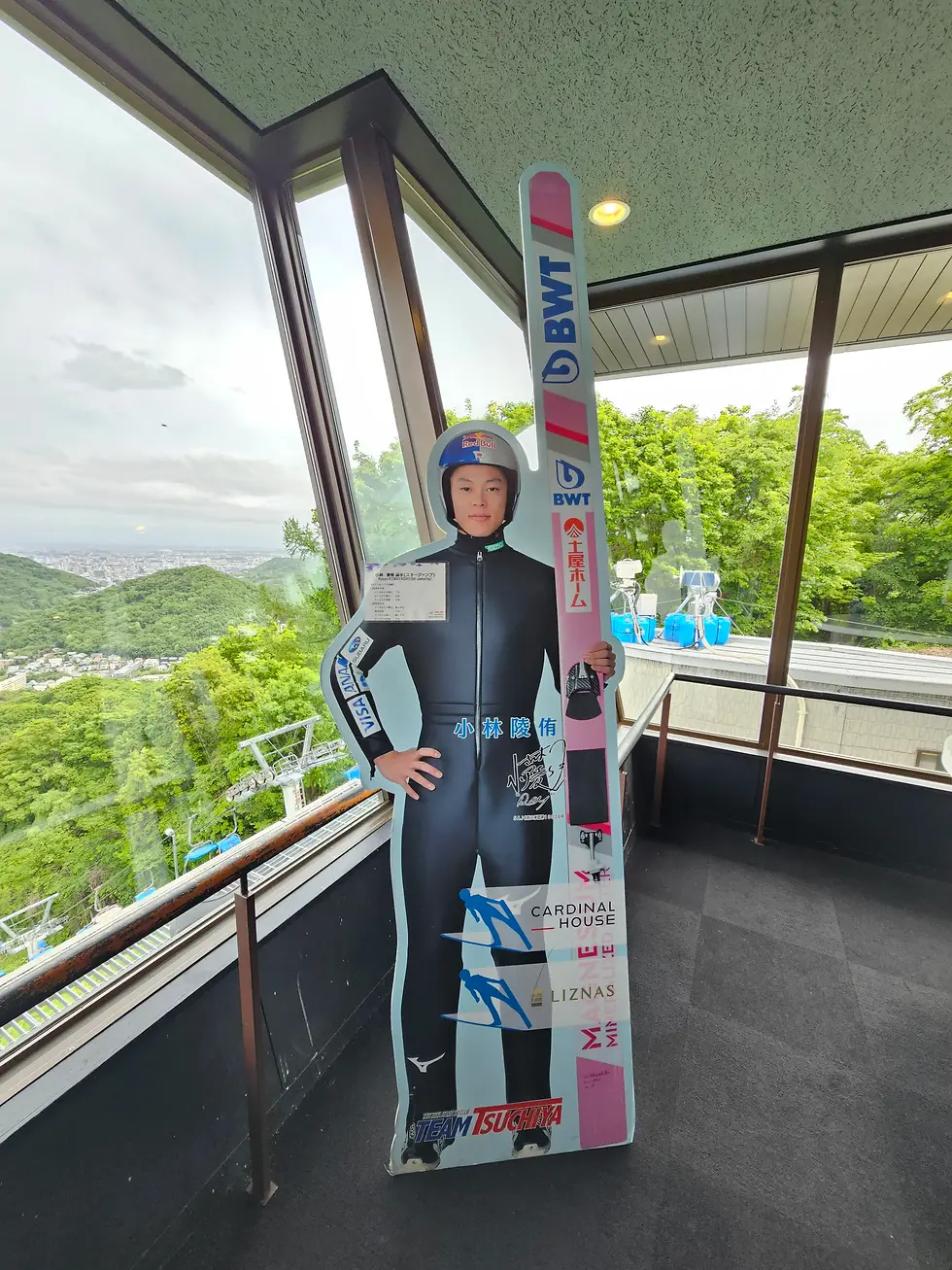
The night time view is extremely popular with tourists and locals alike.

You cannot help but think of Japan's first Winter Olympic Gold medalist, Yukio Kasaya (1943 – 2024), a native of Yoichi (home to the famous Nikka whisky distillery), not far from Sapporo. He won the 70m normal hill ski jump in 1972, with his team mates Akitsugu Konno and Seiji Aochi taking silver and bronze respectively. The trio was nicknamed Hinomaru Hikōtai (the Rising Sun Squadron) and they became national heroes and showed that Asian winter sports athletes could compete with the best from Europe and North America.

Kasaya was a long term employee of the Yoichi Distillery, which I have had the pleasure in visiting (guide coming soon), and the ski jump on which he trained, was built by the Nikka company.
Inside the Sapporo Olympic Museum
The Sapporo Olympic Museum first opened its doors in 2000, and was given a refresh in 2017. In 2016, the museum joined the Olympic Museum Network (OMN) and it is one of the biggest attractions in the city.

The museum spans two exhibition floors with a further floor dedicated to the gift shop.


Inside you will find a treasure trove of memories from the Sapporo Games, exhibits on the evolution Olympics, from the ancient games to the modern Olympics, the rise of the Winter Paralympics, plus displays charting the successes of the Japanese team.

The simulators that were installed here proved so popular that they have been used as a blueprint for similar exhibits in other Olympic Museums across the world. We all need a little competition.
We started off with a short film in the Panorama Theatre, to get us in the mood, before we wandered through the Olympic Spirit galleries.

Displays trace the history from Pierre de Coubertin, the founder of the modern Olympic Movement and Japan's own Jigoro Kano. Kano was introduced to jujutsu to beat the bullies, became a trailblazer for the sport and was the first Asian member of the International Olympic Committee in 1909. His legacy is the modern day sport of judo.

Some of what we saw we knew from our visit to the Olympic Museum in Tokyo, but none of the displays were exact duplicates, so we learned something new.

One whole wall was filled with gold medals from each of the previous Winter Olympics, and it was fun to see how the designs had changed over the years.

We reminisced over the one from 1984, remembering trailblazing British Ice Dancing duo Torvill and Dean. Held in high regard among figure skaters all over the world, and especially in Japan, the pair's 2025/2026 farewell tour ("Our Last Dance") features several modern Japanese skating stars, including 2022 Beijing Olympic silver medallists Misato Komatsubara and Tim Koleto.

I'm a huge fan of Yuzuru Hanyu, the first Japanese male skater to win Olympic gold when he performed at Sochi 2014. Hanyu went on to win back-to-back Olympic gold medals and was the first skater to perform a quadruple loop in competition, way back in 2016.
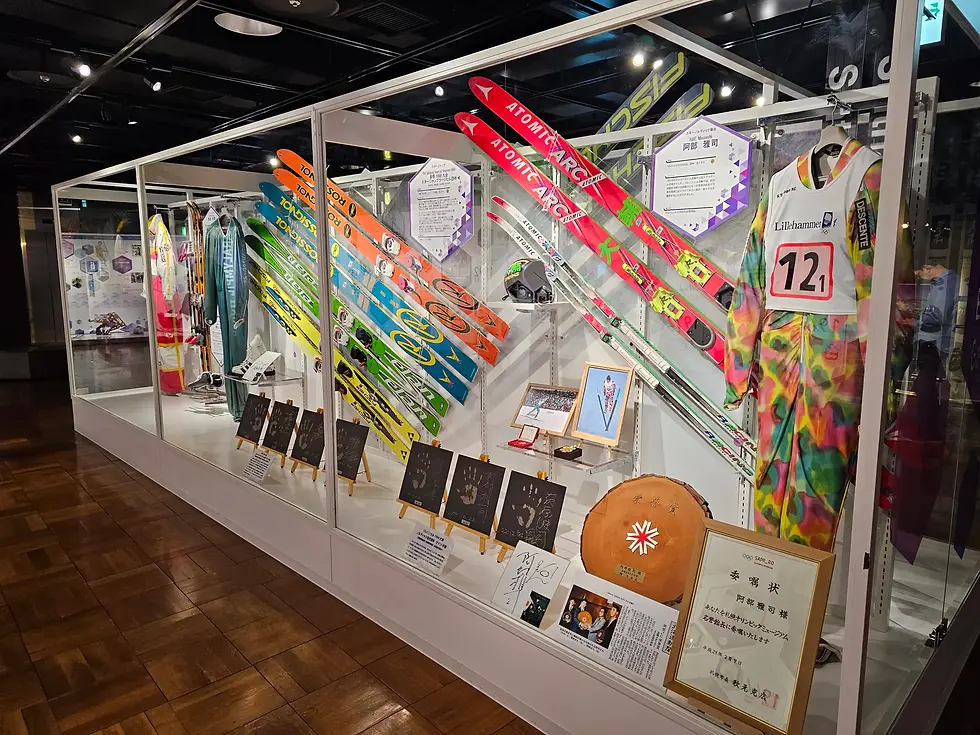
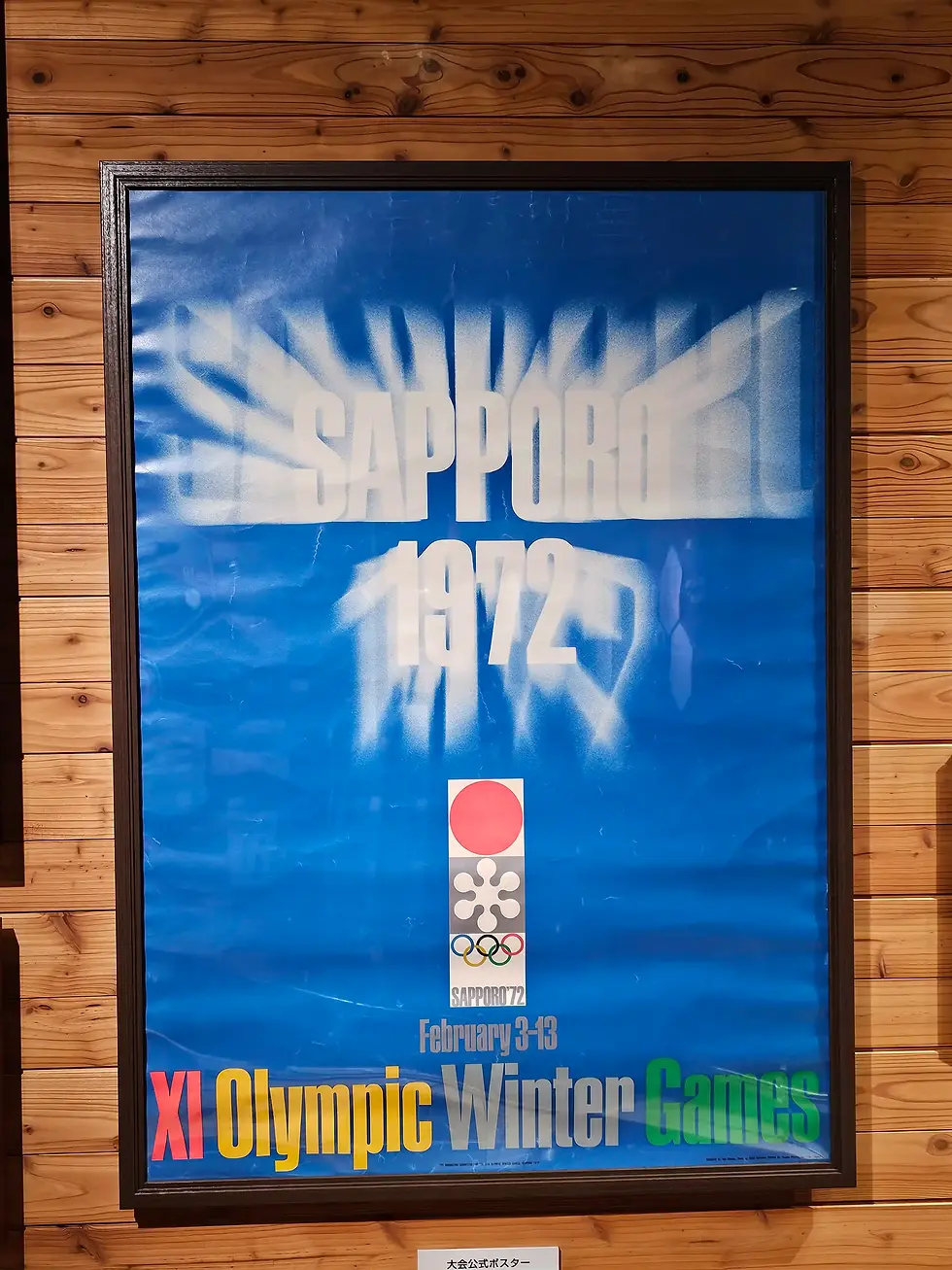
With colourful displays of sports equipment through the ages, we were grateful that nearly everything had an English translation. As a designer, I always gravitate to the historic print designs, such as posters and guide books, a treasure trove of archive material to draw inspiration from.


The next gallery is dedicated to the legacy of the Sapporo Winter Olympics, with its Olympic torch, artefacts and costumes from the games, plus a recreation of the Paradise Hütte.

The Paradise Hütte (or Helvetia Hütte), was built in 1926 as a mountain lodge for the Hokkaido University Skiing Club. Japan's first western style ski lodge, it was designed by a Swiss architect. After Imperial Prince Chichibu stayed there, he pushed for Sapporo to hold the Winter Olympics. It can still be rented by students.

Inside the recreation you find more displays on the highlights of the games.


The Imperial Family and Dr. Seishichi Ohno Ski Collection, is a culturally important archive of documents and equipment.

HIH Prince Takamatsu of Japan (1905-1987), the brother of Emperor Hirohito, invited Hannes Schneider, the Austrian ski instructor, known as the 'father of modern day skiing', to Japan in 1930, to popularise modern skiing techniques.

Founded in 1930, the International Miyasama Ski Games in Sapporo still has Japanese royal family members in attendance, and the champion of the cross-country skiing event takes home the Prince Takamatsu Cup. The skis on show are from the Prince's own collection, and it is fascinating to see how ski technology has come on.

Another highlight is the Japanese Medal-Winning Athletes gallery, where you can see uniforms, kit and medals up close. Japan first competed in the Winter games in 1928 and has since missed only 1948, when it was not invited. There are some famous names in there: Kokomo Murase, Joji Kato, Noriaki Kasai (the oldest ski jumper ever to take a medal at the winter Olympics), Takanori Kono, Kazuyoshi Funaki etc, and no doubt Kira Kimura and his compatriots will get added to the gallery after their medal winning exploits in Milan Cortina.


The Japanese team won 18 medals at the 2022 Winter Olympics in Beijing. Who knows how well they will do this year, but they do have rising stars across many disciplines.

The short but explosive, Hokkaido native, Hiroyasu Shimizu, is a legend in Japan. He is the former Olympic champion over the 500m in speed skating when he made history at the Nagano Olympics, and he is the current world record holder over the 100m, and you can see his skates here.

Among the 120 athletes representing Japan at the 2026 Winter Games, most come from Hokkaido, primarily due to it's long, snowy winters, historic and well supported winter sports clubs and year-round training facilities.


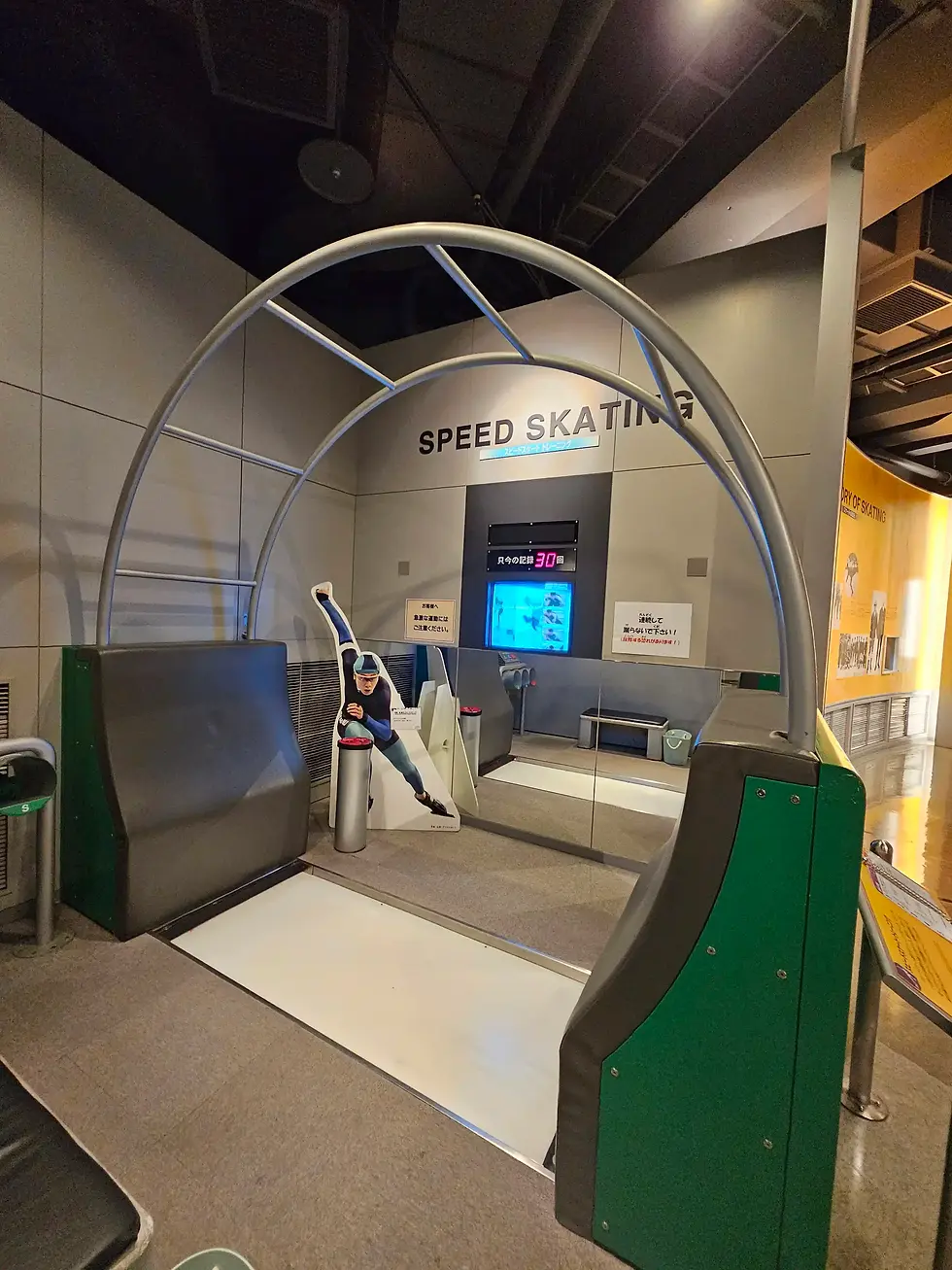
Then comes the big interactive hall, home to displays on each winter Olympic discipline, with simulators for ski jumping, ice hockey, speed skating, cross country skiing, biathlon shooting, and the bobsled.

Suffice to say, I was utterly rubbish, but everyone was giving it a go, from suited businessmen to coach trip grannies.

And some big kids, like me, just can't resist being silly. I channelled my inner Midori Ito, one of Japan's most beloved skaters, the 1992 Olympic silver medalist and first woman to land a triple Axel in competition. I wish my leg did reach that far up!


I found the speed skating simulator simply exhausting. Hokkaido's own Miho Takagi has won eight Olympic medals, including two golds in speed skating, and is the most decorated Japanese female athlete. She is competing in Milan too and already adding to her haul.


We finished off with the gallery called Paralympic World, marking 50 years of adaptive Winter Olympic sport, though I did feel that this area could do with some tactile models and accessible simulators, to allow everyone to get into the spirit of the games.

The Sapporo Olympic Museum restaurant - Nouvelle Pousse Okurayama
What we did not get chance to experience was the restaurant Nouvelle Pousse Okurayama next to the stadium, just above the escalator, where they serve Hokkaido-French cuisine. We had dinner plans elsewhere, but can imagine that the views over Sapporo would be fabulous.

Shop at the Sapporo Olympic Museum
There's plenty of fun things to buy in the shop, especially if you like cute teddies and Team Japan merch.


Is the Sapporo Olympic Museum worth a visit?
If, like me, you enjoy your Winter Olympics packed with mogul mayhem, half pipe heroics, lunatic lugers, bruising biathlons, slopestyle slip ups, ice dance darlings and short track shenanigans, then any Olympic museum will be right up your street.
The Sapporo Olympic Museum has the bonus of the jaw-dropping Okurayama ski jump and its popular viewpoint right next door. Visiting in the winter season adds extra magic, with real snow on the hill making the whole experience feel like a real Olympic moment. Spring, when we visited, and autumn will offer crisp, clear views from the ski lift and milder temperatures for outdoor exploring, while in summer you can escape the heat with some air-conditioned fun indoors, with longer days where you can enjoy the ski jump views into the evening.
Inside, the Museum is unflashy and easy going, and every guest is left to wander at their own pace. That's generally the Japanese way. The simulators are fun. Who doesn't want to feel the adrenalin rush of a bobsleigh run? But, for many visitors, the joy is the nostalgia hit and the stories behind the medals. Yes, perhaps there's too much reliance on text heavy wall displays, and much of the content is sadly static, but there is much here to enjoy.
That said, the museum could benefit from rotating exhibitions to appeal to more visitors. The Lake Placid Olympic Museum just installed a new permanent interactive exhibit all about snow, real or man made, that key ingredient for winter sports. A pop up exhibition, at the Fondazione Luigi Rovati in Milan’s historic centre, “The Olympic Games. A 3,000-Year History” was opened to coincide with the 2026 Winter Olympics, curated by the Olympic Museum in Lausanne, to target visitors to the games. And even simple ideas such as a treasure hunt, tactile 3D models, or an Eki stamp route (they do love to collect stamps in Japan), would broaden its appeal.
All in all, the Sapporo Olympic Museum does a fine job of celebrating Olympic history, values and culture, and offers a thoughtful stop in a city that deserves more attention than it gets.
Plan your trip to the Sapporo Olympic Museum
Address
1274 Miyanomori, Chuo Ward, Sapporo, Hokkaido 064-0958, Japan
Website: Sapporo Olympic Museum
Getting here:
We took a taxi (Uber) from the nearby Shinto shrine Hokkaido Jingu, which we visited that morning.
If coming from downtown Sapporo, take the Tozai Line to Maruyama Koen Subway Station. From the No.2 exit, make your way to the Maruyama Bus Terminal. Take the No.14 bus (Araiyama Line) to Okurayama Kyogijyo Iriguchi Bus Stop (approx. 10 mins), or jump in a cab. The Sapporo Olympic Museum is approximately 10 minutes walk from the bus stop but is up hill.
We flew up from Osaka to Sapporo on one of the multiple internal flights run by Japan's budget airlines. The flights were extremely low cost (just £60 each), punctual, friendly and comfortable. We then flew back to Tokyo to get our return flights to the UK with KLM.
How long was the visit?
We were there for 3 hours with some of this time being spent up at the observation deck and riding the ski lift.
How much are tickets?
We paid for our tickets, and this was not part of any advertising.
Tickets are 670 yen for adults, and children go free. We paid on the day.
Opening times
It's always worth checking with Sapporo Olympic Museum for their current opening times, as they can vary.
May 1 - October 31 : 9:00 am to 6:00 pm
November 1 - April 30 : 9:30 am to 5:00 pm
Last admission 30 minutes before closing.
Where we stayed for our visit to the Sapporo Olympic Museum
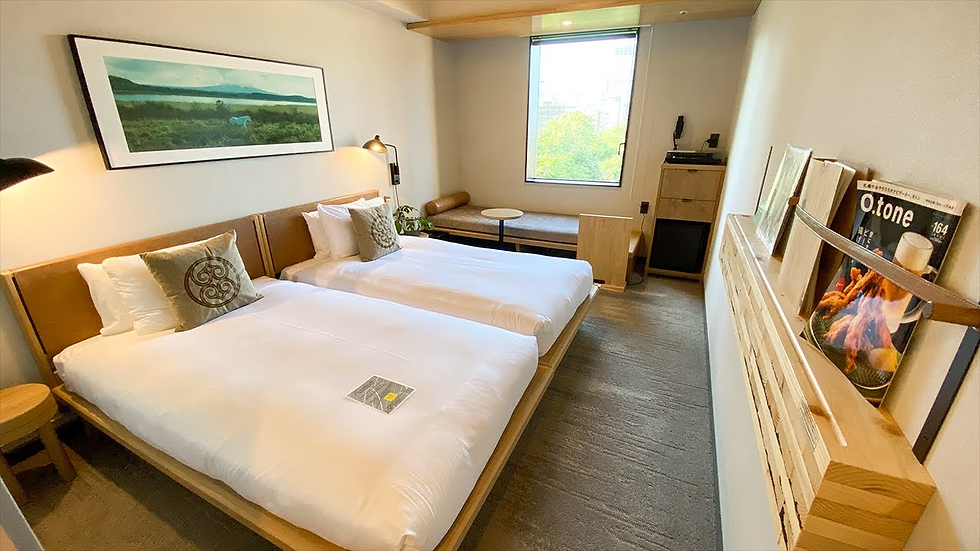
We had 5 days in Sapporo, staying at the Royal Park Canvas Sapporo Odori Park, booked through Booking.com, with terrific views onto the Sapporo Tower. The lovely hotel had a rooftop bar, was steps away from public transport and overlooked the park, which had the remnants of the annual lilac festival in place.
What to see near to the Sapporo Olympic Museum
We came to Sapporo so I could visit two drinks brand visitor experiences. Guides to both are coming soon. The Sapporo Beer Museum was fascinating, a mix of old brick buildings and modern production facilities, and a beer hall restaurant that served the famous Sapporo delicacy Genghis Khan (Mongolian Barbeque), which we cooked ourselves over a sizzling domed platter in their restaurant.

The Nikka Yoichi Whisky Distillery, 56km from our hotel in downtown Sapporo, is one of my favourite distillery tours in the world. It was worth navigating the nearly 2 hour public bus journey, as it delivered wonderful whisky, a warm welcome and the backstory of the founder Masataka Taketsuru, the father of Japanese whisky, and his Scottish wife Rita, and a love that conquered all. Utterly fabulous.

Get out into the countryside and there is a wine region to discover, home to over 60 Hokkaido wineries, from small scale enterprises to larger, more design led architectural gems offering tours and restaurants. With a climate comparable to Champagne and Alsace, you can taste that cool climate in every glass, and passionate Japanese winemakers are producing high-end wine that is now winning international recognition. I can't wait to go back and visit some of them.
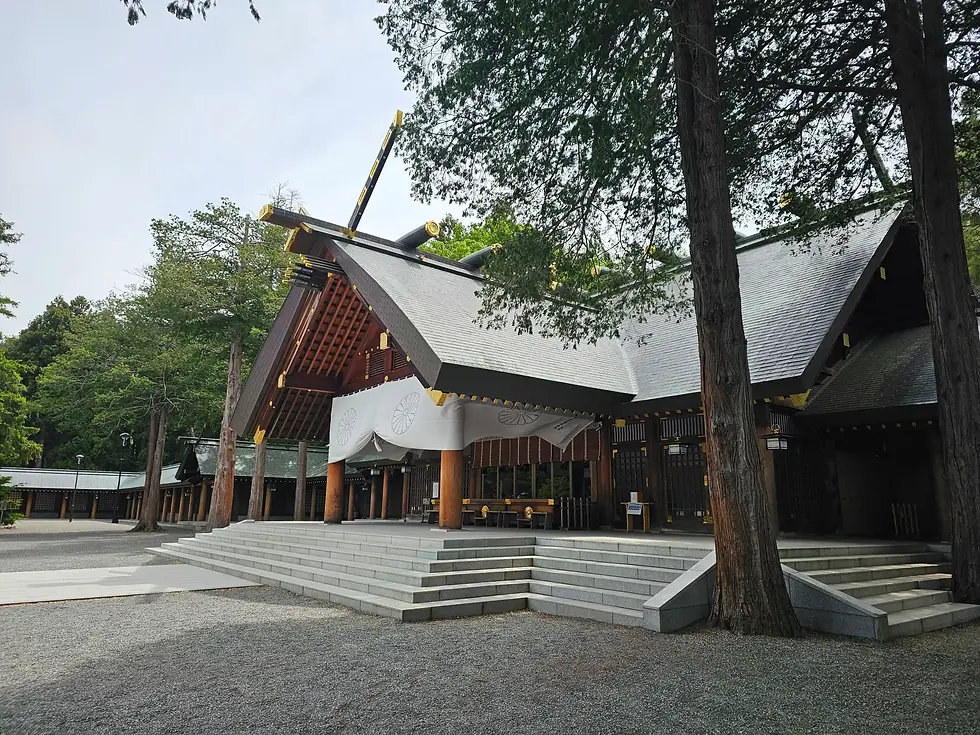
About 3 km from the Olympic Museum is Hokkaido Jingu, an impressive shrine where we were lucky enough to witness a wedding. You could easily while away a good hour here in the grounds and it is also free to enter. The cherry blossom here is supposed to be amazing, though we were happy with a cup of tea and a local cake..
We skipped the popular romantic viewpoint on the summit of Mount Moiwa for the Ski Jump views at the museum. If you want to visit it, Mount Moiwa Ropeway transports you part way up the 531 metre mountain, before a mini cable car takes you up to the summit, with its observation deck and restaurant, planetarium and theatre.
The city view from the Sapporo TV Tower is great, though we gave it a miss as we saw the tower and view every day from our hotel room window.
Further reading
Sports fans, if you liked this article then check out our guide to Silverstone Museum, Indianapolis Motor Speedway Museum, Jockey Club Rooms, Louisville Slugger Museum and Japan Olympic Museum. More sports related visitor guides coming soon.
Please note - I'm real
I visit every brand visitor centre and experience myself. My feedback is real, based on a single visit, but informed by years of experience designing and exploring brand experiences all over the world.
I love writing my own reflections, diving into a brand's history, doing the research and looking at spaces through the eyes of a commercial interior designer. With over 30 years of working with customers, I also enjoy watching how guests interact with guides, displays and spaces. Everything I share is honest, personal and entirely human, not AI generated.
That authenticity is important to me, and if it's important to you and you want to work with me, or share your experiences or want to suggest others, then I am happy to be contacted via this website.
Photographs: ©Julie White unless noted otherwise
Disclaimer - The views and opinions expressed are solely my own. I paid for the tours in full and any comments reflect my personal experiences on that day. Please drink responsibly. Please visit and garner your own thoughts and feel free to research the brand and the visitor centre in question.


Comments