


The Visitor Centre today is ... World of Wedgwood
Updated: Aug 11
Covering centuries of craft, design and perseverance. The World of Wedgwood is part museum, part working factory, part creative studio, and one of Britain's most compelling brand experiences.

My trip to the World of Wedgwood was so good that I've been twice. Well, that's not technically true. When I was very young, I went to the factory with my parents. My late Mum was a huge fan of her 1980s "Wedgwood blue" and white Jasperware. A small collection of it proudly adorned the windowsill in their lounge. To her, it was a show of status, aspirational, right up there with her G Plan furniture and her heated hostess trolley. They were dusted with care and we were absolutely not allowed anywhere near them.

I never got to ask her what it was that drew her to them. She wasn't particularly creative, so I can't imagine it was the craft. She wasn't a history buff, so not the brand's long and storied heritage then. Perhaps it was simpler. She just liked them. At the time I thought they were very uncool.
It wasn't until my teens, when I was harbouring the entirely unfounded ambition of leaving school to become an internationally famous ceramicist/sculptor, that I began to appreciate what the craft of pottery actually involved. My hours on the art room wheel produced what I can only describe as rudimentary bowls in strangely organic forms, which is a generous way of saying my pieces sucked. But I loved every minute of it. The feel of wet clay in my hands. The pure pleasure of making something. The jeopardy of throwing, turning, and firing. It was meditative, grounding. And heaven knows I needed it back then.
As an adult, I'd often wondered whether ceramics might be my creative salvation from a turbulent world. I've lost countless hours scrolling Instagram, watching the likes of Florian Gadsby's hypnotic reels. After years of watching the Great Pottery Throw Down on TV, where we all become armchair experts confidently critiquing techniques most of us know absolutely nothing about, how bad could I actually be? It took me nearly forty years to get back into a pottery studio. That studio was at the World of Wedgwood, the home of a brand that this year celebrates its 267th anniversary.
As someone who spends their professional life studying brand experiences and how they tell their histories, I was fascinated to see how one of the oldest companies in the UK brought their formidable storied past to the modern visitor. Wedgwood is one of those names that carries enormous cultural weight, not just as a pottery brand, but as a piece of British history.
I left with a new found appreciation of the craft, creativity, innovation and pure perseverance that goes into keeping a brand like this alive. I also left with a smile on my face and covered in clay!
The Potteries history
To understand Wedgwood, you first have to understand the place that made it possible. Stoke on Trent, a unique city formed from the federation of six historic towns: Tunstall, Burslem, Hanley, Stoke, Fenton and Longton, collectively known as "The Potteries," sits in the hills of Staffordshire, nestled in between Birmingham and Manchester.
Up until around 1700 it was a quiet stretch of villages with a population of only a few thousand. But what made it extraordinary was what lay beneath: rich seams of clay and coal, the two essential ingredients for making pottery, bricks and tiles.

By 1740 it was already the undisputed centre of pottery production in England. Some of the most celebrated names in British ceramics grew out of this same patch of ground: Spode, Royal Doulton, Moorcroft, Middleport, Wedgwood all called this region home.
At the industry's peak, there were up to 4,000 bottle kilns (known for their distinctive bottle-shaped chimney or hovel), billowing smoke into the Staffordshire sky. Just 47 remain, preserved as listed buildings, and none fire today.

The potteries had one significant problem back in the mid 1700's though. They were landlocked. They needed a safe, efficient route for transporting fragile ceramics to market, as well to bring in the vast amounts of raw materials needed like clay and coal. The answer wasn't going to be found on the pot-holed roads. They were truly dreadful.
With significant backing from local industrialists, most notably Josiah Wedgwood and other pottery barons, the answer was to be found on water. The Trent & Mersey Canal and the Caldon Canal, completed in 1777 and 1779 respectively, effectively linked the major sea ports of Liverpool (via the Mersey and Bridgewater Canal) and Hull (via the Trent).

Traffic was heavy and freight movement was still considerable into the 1950s, with cargoes including coal, salt, beer and, of course, pottery. The canals transformed the entire region's fortunes. Now maintained by the Canal & River Trust, they have a new life, as thriving tourism hotspots, enjoyed by boaters, cyclists, runners, and history and wildlife enthusiasts. I've enjoyed many a tipple in a pub beer garden on the banks of the canal.
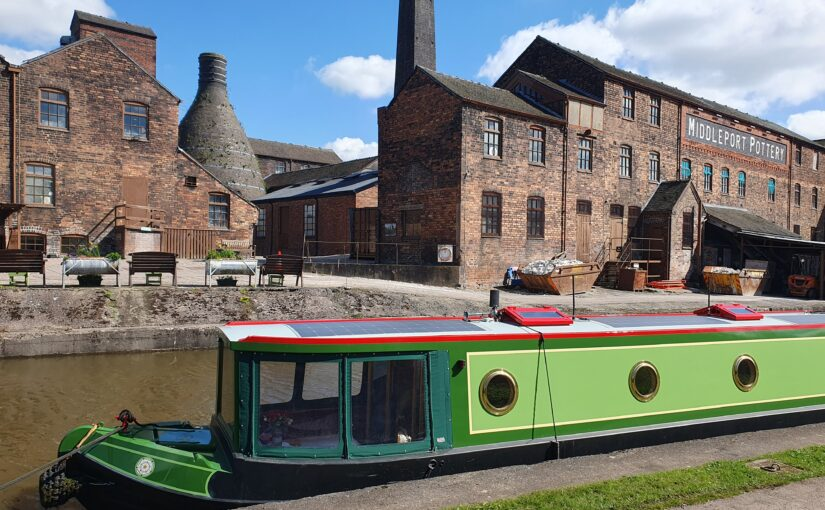
In the 1970s, 200 pottery factories were still operating. Today there are around 30. The legacy of The Potteries, though, is indelible. It is baked into the soil of the place, and into the story of every great name that came out of it.
Wedgwood - the brand history
Josiah Wedgwood led English pottery from a cottage craft to a prestigious art form. He was one of the founding fathers of the Industrial Revolution, a phenomenally successful businessman, innovator, marketing genius, tastemaker, and infrastructure builder. And all the while he was campaigning against slavery, advocating for the rights of women and the working classes, and befriending some of the greatest scientific minds of the age.

Josiah was born in Burslem in 1730, the youngest of at least eleven children. He left school at nine, having lost his father the same year, to work in the family pottery under his eldest brother. As if that wasn't enough, at eleven, smallpox left his right knee permanently damaged, and eventually cost him his leg entirely, which was amputated in 1768. Unable to work the foot pedal of a potter's wheel, he was pushed, early on, into the design, development and business side of the craft. It turned out to be the making of him. By 1759 he had mastered his trade and founded his own pottery. He was 29 years old. His plan was to become, as he put it, "Vase Maker General to the Universe." Now that's youthful ambition for you.
His big break came in 1765, when Queen Charlotte commissioned a complete tea service. Josiah, never one to miss an opportunity, gained permission to call himself Potter to Her Majesty, and renamed his cream earthenware Queen's Ware. Orders flooded in from across the globe. Empress Catherine the Great of Russia commissioned a 952-piece service in 1774, and Wedgwood's designs have graced royal tables ever since, including Queen Elizabeth II's coronation banquet in 1953.

Eagle-eyed viewers of Shonda Rhimes's Bridgerton, the Netflix show that chronicles the lives and loves of Regency aristocrats, albeit taking considerable liberties with the facts, might even spot a Wedgwood tea service or two, proof that even TV's Queen Charlotte appreciated the pioneering potter. And the "Regency and cottagecore" aesthetic has certainly driven a new wave of sales, with teapots, butter dishes and napkin rings becoming essential props for tablescaping TikToks.
Josiah's most celebrated wares were his jaspers, unglazed, matte stoneware that he spent years perfecting. What made it extraordinary was the range: green, lavender, sage, lilac, yellow, black, and white, and that very particular shade of blue that still carries his name today and my Mum's favourite. The surface decoration was equally distinctive, delicate bas-relief figures in contrasting white, applied by hand, that gave each piece the quality of a miniature classical sculpture.
In 1769, with financial backing from his wife's family, lucky him, Josiah opened Etruria, one of the first purpose-built modern factories in England, named after the ancient civilisation whose art had inspired his designs. Positioned deliberately beside the Trent and Mersey Canal he had championed, and with a grand family home alongside it, he installed housing for his workers, who he called Etrurians, in a community with healthcare and education at its heart. Long before Cadbury built Bournville or Lever Brothers created Port Sunlight, Josiah was already working from the same conviction: that people who lived and worked in decent conditions produced better work.

But the community came with rules, like no drinking, and he was famously exacting on the factory floor, known to smash any piece that fell short of his standards. (Sounds like the dreaded bucket of doom - for all you Pottery Throw Down fans). In his own words, he described turning "dilatory drunken, idle, worthless workmen" in 1765 into "a very good set of hands" by 1775. Charming.
He was also one of the most prominent voices of his time calling for the abolition of slavery. His cameo medallion bearing the image of an enslaved man in chains, with the words "Am I Not a Man and a Brother?", is considered by some scholars to be the first logo ever created for a political cause. Benjamin Franklin described it as comparable to the most powerful written pamphlet of the day.

Josiah was also a member of the Lunar Society of Birmingham, that remarkable gathering of industrialists and thinkers that included James Watt, Erasmus Darwin, and Joseph Priestley (1733-1804). You might know that last one. He's mentioned in my guide to the World of Coca-Cola as not only did he discover oxygen in 1774, he was also the inventor of carbonated water. He and Wedgwood first met by chance in 1762, when Josiah fell from his horse on a journey to Liverpool and ended up in the same inn as Priestley. They became lifelong pen friends, exchanging letters on chemistry and science for decades. He acted as a consultant to his friend throughout his life, analysing clay samples for Wedgwood and in return Josiah supported him financially until Priestley's death in Northumberland, Pennsylvania. You can visit his house and laboratory which is now a national historic monument.
What I find compelling about Josiah, from a brand perspective, is that he didn't just make beautiful things, he invented an entirely new way of selling them. He is widely credited as the father of modern marketing, and the list of techniques he pioneered reads like a first-year business school syllabus: direct mail, illustrated catalogues, money-back guarantees, free delivery, self-service, and what we'd now call buy one get one free.
In 1773 he published the Ornamental Catalogue, giving customers a menu of shapes and designs to choose from rather than simply taking what was available. His salesmen travelled the country carrying hand-annotated copies alongside tile samples of his glazes, and crucially, they reported back, feeding real-time market intelligence from retailer to designer. From his London showroom, run by partner and nephew Thomas Byerley, he drip-fed new products to build anticipation. You can see what the store might have been like in an image from 1809, which the brand used in their Showroom range back in 1998.

His personal life was equally rich. His eldest son John was a key figure in founding the Royal Horticultural Society (RHS) in 1804, and if you've read my guide to RHS Garden Bridgewater, you'll know what a remarkable institution that became. His daughter Susannah married Robert Darwin, and their son Charles, well, you might know him. He would go on to propose the theory of evolution. The family wealth funded Darwin's place on the Voyage of the Beagle. Quite the family tree.
When he died in January 1795, aged 64, Josiah had amassed a fortune of around £600,000, the equivalent of somewhere between £80 and £100 million today, and was considered one of the most important manufacturers in British history.
The Etruria site suffered badly from subsidence and air pollution, and became outdated. So, a 382 acre rural estate, located near the village of Barlaston, Staffordshire, was purchased by the Wedgwood family in 1936 for their new factory.

Earthenware production was slowly transferred from the Etruria site from 1940, until it finally closed ten years later. The new Barlaston factory was, at the time, the most advanced pottery in Britain, powered by electricity.
The company passed through generations of Josiah's family, surviving wars, economic downturns and the long decline of the Potteries, before eventually merging with Waterford Crystal in 1987 and then with Royal Doulton. With debts of about £400m, the combined group went into administration in January 2009, and the Wedgwood archive and collection came perilously close to being broken up and sold. It was saved by a public campaign and the intervention of the Art Fund, and is now held in trust as the V&A Wedgwood Collection. The brand itself was acquired by Finnish consumer goods company Fiskars in 2015.
At the time of writing, the brand faces fresh challenges. In early 2026, redundancies were announced at the Barlaston factory, described by union bosses as a "body blow" for the sector. The company has said it intends to focus on high-end handmade production going forward. Whether that proves to be a turning point or a further contraction, only time will tell, but the fact that people still care enough to be angry about it says something in itself.
Visiting the World of Wedgwood: What to Expect
The World of Wedgwood Visitor Centre design
Josiah Wedgwood wasn't just a pioneer of pottery. He was a passionate archivist and one of the first to understand that visitors were an asset, not just an audience. From as early as 1774 he was saving samples of his work, building a collection he always intended to be seen. A Wedgwood museum has been open to the public in various forms since 1906, first at the Etruria factory site and then, from 1952, at its current home in Barlaston, Staffordshire.

He was, in that sense, ahead of a trend that would define some of the great brand stories of the industrial age. Richard Arkwright's cotton mills at Cromford were drawing curious visitors in the late 18th century, marvelling at the sheer scale of what mechanised production looked like. By the mid-19th century, factory visits had become a recognised way for brands to build trust and show off. Huntley & Palmers, by 1860 the world's largest biscuit manufacturer, was welcoming notable guests, like Oscar Wilde, to its Reading factory. Rowntree's opened its Cocoa Works in York in 1890 with tours built in from the start. Cadbury was doing the same at Bournville, as was Lever Brothers at Port Sunlight (just up the road from where I was born). At Glen Grant Distillery in Scotland, Major James Grant, who inherited the distillery in 1872, created extraordinary gardens inspired by his travels across Africa and the Himalayas for the visiting public. And in 1887, Colonel E.H. Taylor Jr. built his Old Taylor Distillery in Kentucky, to resemble a medieval castle and visitors were given tours and sent home with complimentary bourbon. Opening the factory doors wasn't a gesture of goodwill. It was a statement. Brand advocacy and industrial tourism are not modern inventions.
In 1962, aware that the business was likely to go public and pass out of family hands, Wedgwood formally separated their museum from the factory, setting up the Wedgwood Museum Trust, as a deliberate act of protection, or so they thought.
I remember my trip to the Wedgwood factory in the early 1980s. I vaguely recall museum exhibits, walls of art and a viewing gallery where we could see the factory floor. I do remember being bored rigid.

A new museum building was opened in 2008, following a £10 million refurbishment. This state-of-the-art facility, by architects Hulme Upright, housed the entire 80,000-piece Wedgwood collection, including ceramics, manuscripts, and portraits, all under one roof, with what is described as an interactive "magic carpet" ride for visitors, allowing them to "fly" around the company's original Etruria factory, which had long been demolished. It won the Art Fund Prize for Museum of the Year in 2009.

When Waterford Wedgwood went into administration that same year, the pottery firm found they had a £134m pension deficit. In a cruel twist of fortune, the Wedgwood Museum Trust discovered that five of its staff had been part of the collapsed group's pension fund, making it responsible for the entire debt, as it remained a solvent, albeit small, business. After years of legal wrangling the High Court ruled that the collection, considered at the time by Unesco to be one of the UK's top 20 cultural assets, was not protected by the trust, and should be sold to help pay the bills.
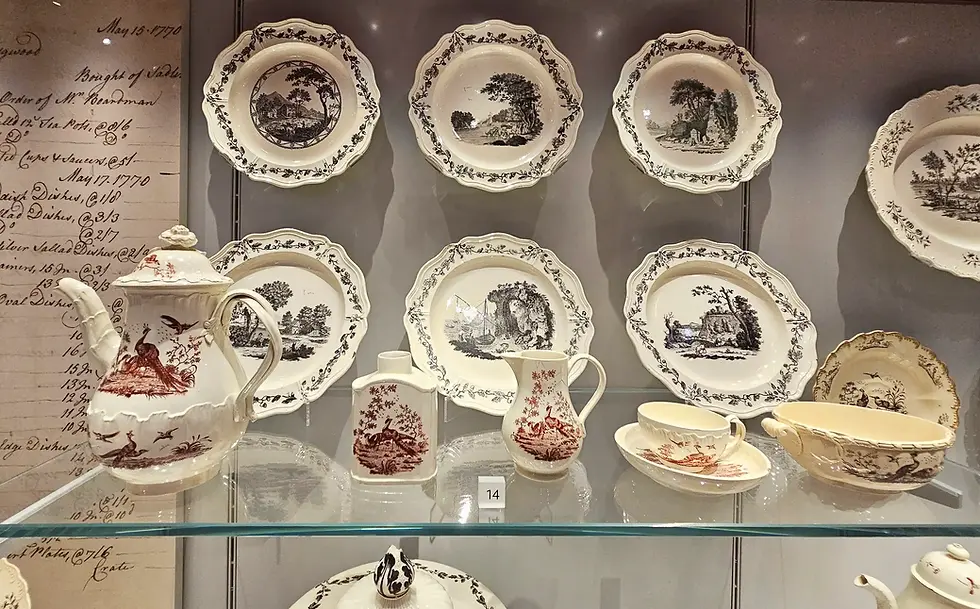
An appeal was launched by national art charity the Art Fund, and a total of £15.75m was raised to save the collection. More than 7,000 people donated with almost a third of them from the Midlands. Dr Stephen Deuchar, then director of the Art Fund, said the Save Wedgwood appeal had been the fastest fundraising campaign in the charity's 111-year history, reaching its target almost two months before its deadline. The collection was gifted to the Victoria and Albert Museum and loaned to the Wedgwood Museum in perpetuity.

Buoyed by that victory, plans were drawn up for a massive upgrade. Opened on July 15th 2015, Wedgwood's global headquarters had received quite the makeover, and hoped for 175,000 visitors a year. Designed by BHB Architects, in conjunction with World of Wedgwood's design department, £34m was plowed into the project.

The factory tour got a thorough reimagining and creative studios, for a bit of customer creativity, were added. The museum was transformed. But it went further than that, with a marina, new Corporate Headquarters and landscaped grounds. There are, of course, new dining spaces and shops. Because really, what is a bit of cultural enrichment without the promise of a good cup of tea and the temptation to buy a teapot you didn't know you needed?
World of Wedgwood Gardens
The guest journey starts in the courtyard, with tranquil gardens that John Wedgwood would no doubt appreciate. The design team referenced the "factory in the garden" concept, used in the design for the original 1930s Barlaston factory site.

It's the perfect place to soak up the sunshine, if we get any, or shop at one of their monthly pop up markets, featuring Independent local makers and small businesses from the Staffordshire area.

Reflecting the Wedgwood family’s long-standing connection to horticulture, the pottery shaped sculptures, which used to be willow, will no doubt add a pop of colour when the flowers growing up them are in full bloom.

There are sustainable gardens designed for wildlife.

And, in typical British fashion, the weather turned so we couldn't make use of the terrace. There is a selection of shops here too including SIXTOWNS by Bros Distillery, producing delicious craft spirits inspired by Stoke-on-Trent’s rich Potteries heritage, and a gorgeous homewares shop called Josiah & Co, certain to loosen the purse strings.

There's a few buildings that have been incorporated from the 2008 revamp.

Standing proudly outside the visitor attraction that bears his name, this replica statue of Josiah was cast in the 1950s. The original still stands outside Stoke's train station.

World of Wedgwood Foyer
Head into the welcoming foyer, and I was impressed on my latest visit to find a new reception desk, designed around the actual molds used in the pottery process.
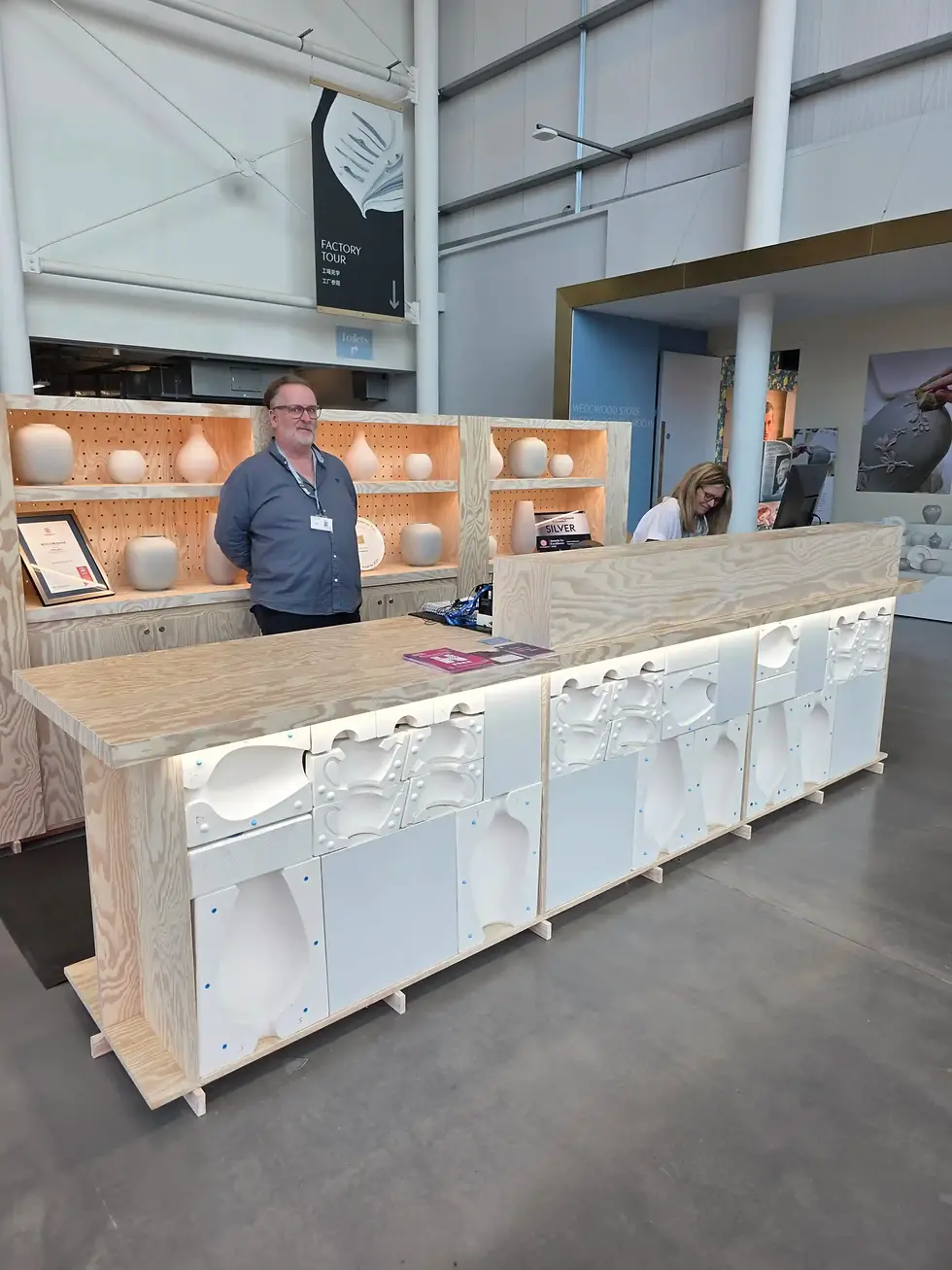
Simple peg boards now display essential visitor information.

There's space now for some seating and a little shop. Who doesn't need a good notebook, and the brand history book came home with me.

It was good to see a bit more for the younger visitor. The World of Wedgwood family mascots, Hedgwood and Friends were launched in 2025, based on the founder and his family. They're the perfect addition, a low cost gift and a toy that will be played with for years to come. World of Wedgwood already had lots for little ones to do such as pottery painting, a kids afternoon tea, and a nature trail and last month they launched a new, free indoor Play Space.

Hedgwood managed to find his way into my shopping bag. Look at his legs though. One of them is blue. Remember Josiah had his right leg amputated and had to wear a prosthetic. Not just a cute, cuddly bit of brand storytelling, but also a subtle nod to inclusivity. Well done Wedgwood.

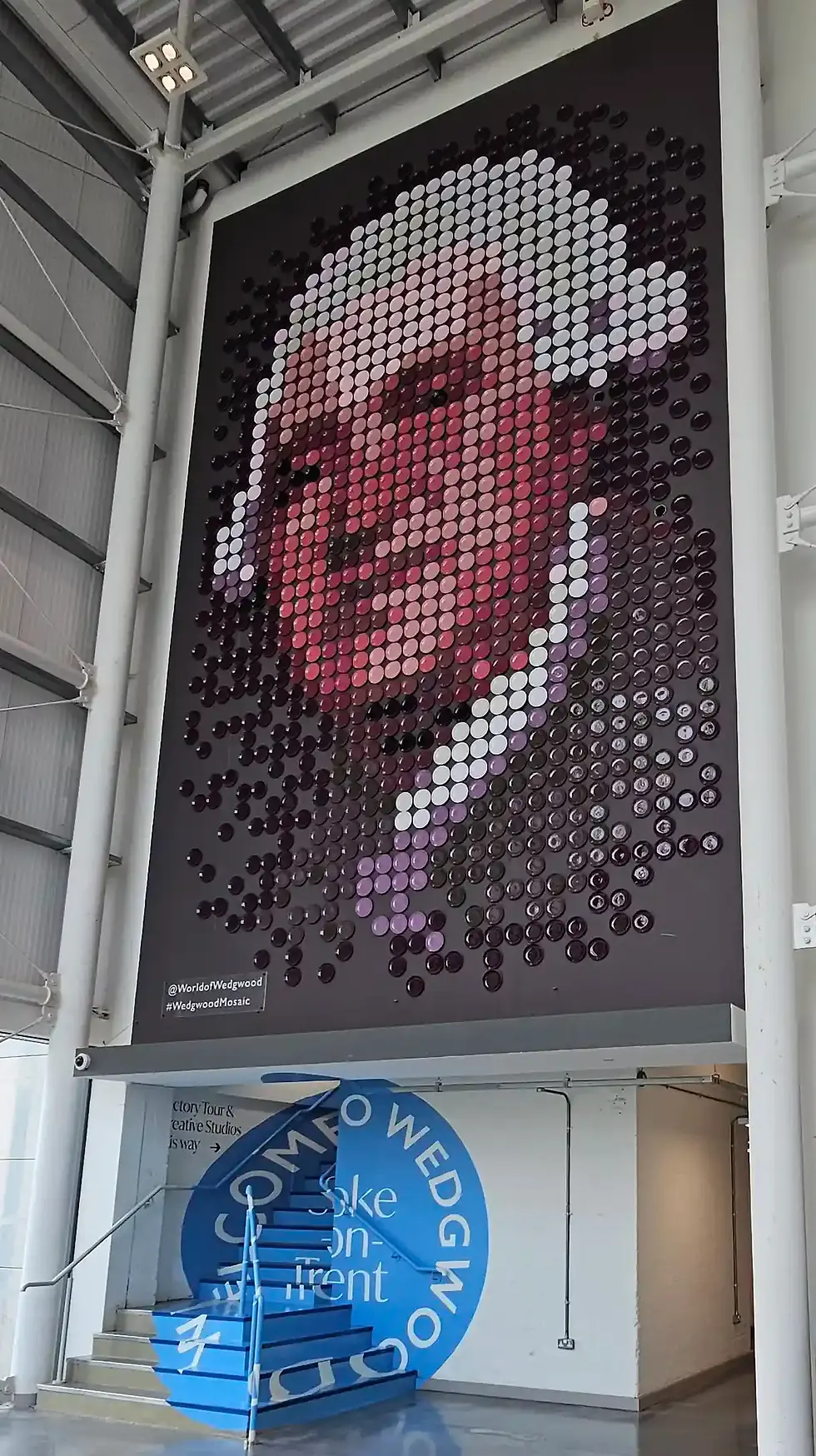
And you won't forget who you're here to learn about, as Josiah is immortalised in a dinner plate mosaic towering above you.
The World of Wedgwood tour
The factory tour is a no phone zone. That's nothing new. Our trusty guide let me take a few snaps before he got his microphone on and our group of 12 headed off.

During our hour on the factory floor, we got up close to the skilled artisans molding, casting and hand decorating pieces.

Often they would stop what they were doing and bring a piece over to us for closer examination. The painting had us transfixed. Talk about a steady hand. And they even told us where to find some of the pieces they were working on in the shop, so we could see the final result for ourselves, now with a much greater appreciation for what went into them.

Luckily there were videos of processes we couldn't see from our walkway, showing the finer details.

I do appreciate tactile objects and information panels to explain what we are looking at, as it helps to land the information delivered by the guide. You can see however, from the translations on the text displays, where the majority of the visitors come from. The Chinese and Japanese love the stuff he tells us.

Pottery classes at the World of Wedgwood
Turning up for our slot to become the next Keith Brymer Jones, we found out we were the only participants. Terrific. Private tuition. I'd be a bit worried if this happened a lot as this surely must be a huge draw for visitors.
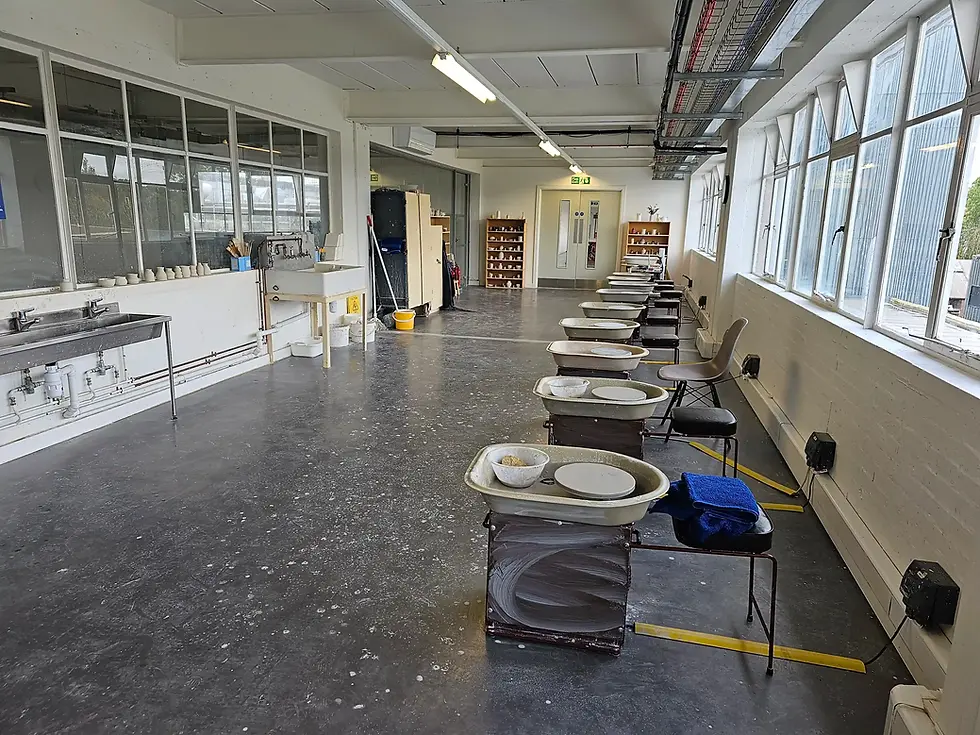
We got to make bowls, several of them, all great for snacks in front of the TV.

“Invention without experiment signifies very little,” Josiah wrote. “Everything derives from experiment[s].” So, I went a bit rogue, and made my own jug. We waited a few weeks for our pottery pieces to be fired and sent to us, and we feel proud of our unique creations.

V&A at the World of Wedgwood
Now for an area where you could easily return to several times and still not see everything. It is a design inspiration dream, and it's free. What's not to like?

Drawn from the vast V&A Wedgwood Collections Archive, which contains over 100,000 manuscripts relating to the Wedgwood family and factory, as well as thousands of treasures and artefacts explaining the history and process of ceramic manufacturing across the ages.
I won't be able to do it justice in this guide, as it's so comprehensive, but I will try to shine a light on a few elements that caught my eye, and some personal favourites.
Worth noting that there are plenty of hands on models, buttons to press, textures to touch, wheels to crank, and displays at heights for everyone, so you can play as you learn.
And yes, I may have been the only adult running around filling in the kids' stamping card. I'm a firm believer in the stamp station. The tactile charm of collecting physical stamps, like those I've gathered at the London Transport Museum and the Warner Bros. Studio Tour London: The Making of Harry Potter, should not be underestimated. They engage younger visitors, they delight the Japanese, who have elevated stamp collecting to something of an art form, and they give the rest of us a genuinely nostalgic way to document the places we explore. It's a simple joy, and the world needs more of that.

You can see Josiah's original cream earthenware trials. Each one a slightly different shade, a bit like a Farrow & Ball paint chart.

I love a good hand painted font, so I was immediately drawn to these Wedgwood Queen's Ware labels and weights.

There were some striking 1930s tea sets for the deco lovers.
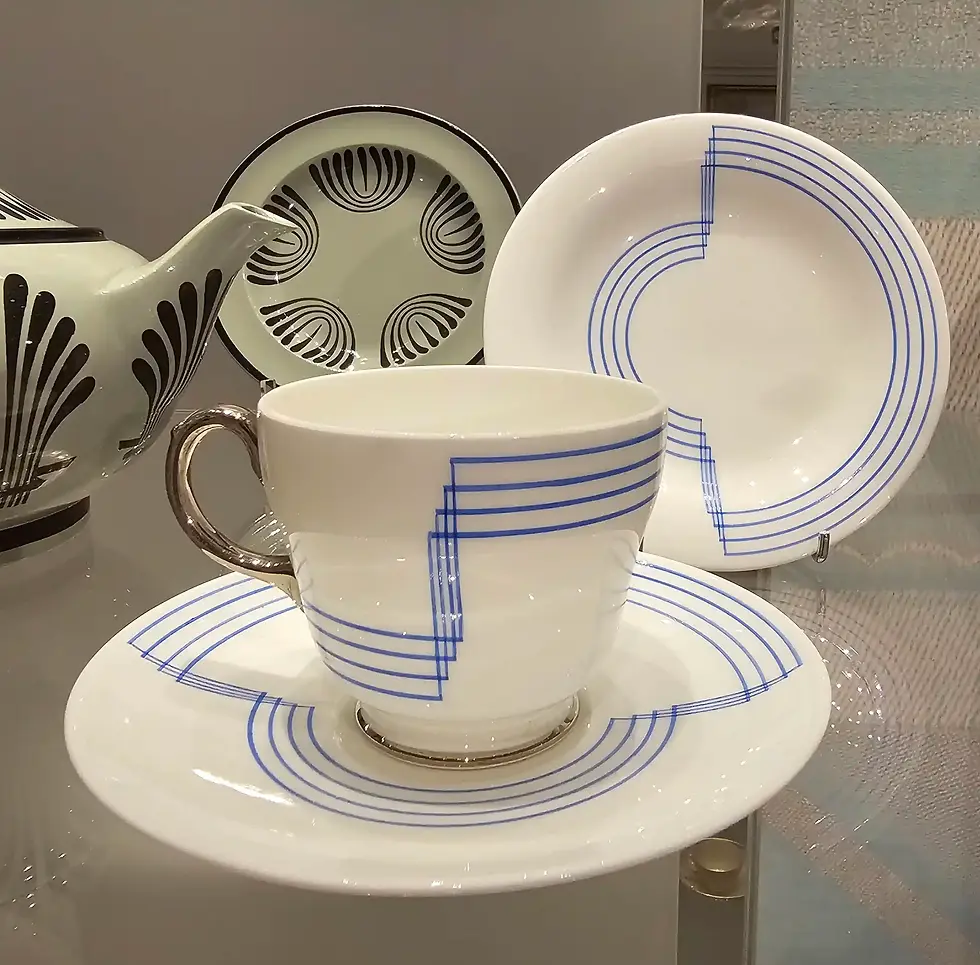

I happened upon a few whimsical works by celebrated British artist Eric Ravilious when I was researching my family tree. Ravilious painted the boat that my great grandfather captained moored in Bristol docks, the SS Britannia. Digging deeper, I was hooked, and have books and prints of his work on display in my home.

While Ravilious’ collaboration with Wedgwood lasted only a few years in the late 1930s, it produced a stunning body of work, transfer printed onto Wedgwood stock, including commemorative cups, travel plates, and the colourful alphabet mugs. These might have been initially designed for children, but the graphics are gorgeous and they're a little ceramic time capsule. Z for Zeppelin not Zoo! I have been trying to get my hands on an original for ages.

His Wedgwood pieces continue to be sought after by collectors today. We are so lucky to have these artworks, as Ravilious bravely became one of the first official war artists, documenting the Second World War, until tragedy struck in 1942, while on an aerial search mission above Iceland, when the aircraft carrying him was lost. He was just 39.
I couldn't walk past this towering jasperware centrepiece The Falcon Cannot Hear the Falconer, in black and cane gold, from artist-in-residence Dame Magdalene Odundo. British Kenyan artist and academic Dame Magdalene, used historic moulds from the Wedgwood library as inspiration for her stacked design, each layer of sprig moulding a deep, complicated narrative on the enduring legacies of the slave trade and political protest. Thought provoking and powerful.

I'm a fan of woodcut or lino prints and Clare Leighton's mid century scenes in graphic black and white are so eye catching.
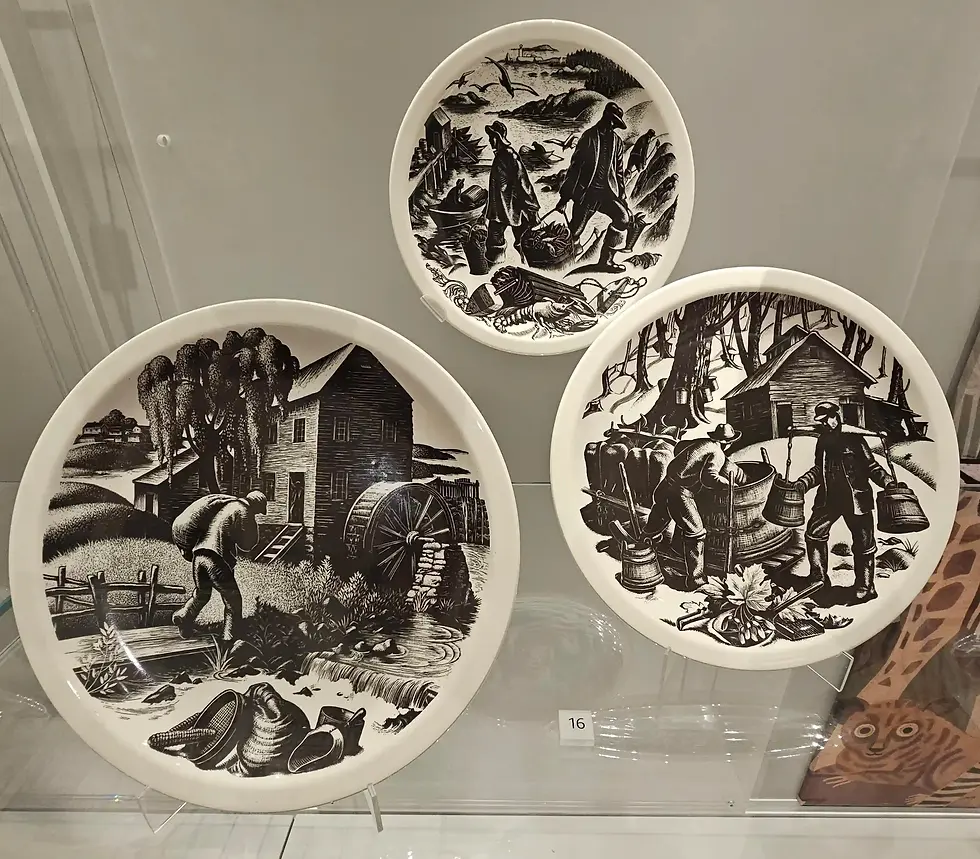
In 1948, the Wedgwood company asked the British-American artist to design a series of twelve artworks, that were transfer printed onto a limited edition set of creamware plates specifically for the American market, depicting the industries of New England.
I'll have to leave it there, as trust me, everyone that visits the collection will find something that speaks to them. It's genuinely impressive.
Learning room - The people of Wedgwood
What was nice to see was a break out education space, which had, for the casual visitor, a few images of the family and factory workers and a smattering of history.


And I do like seeing a brand that actively encourages past employees to contribute. Reminds me of the John Lewis Heritage Centre and Magasin du Nord Museum, who both had something similar, adding to their brand history with personal anecdotes.

It's always good to ask for feedback too, though I'm not sure all of these were entirely constructive! Kids will be kids.

Shopping at the World of Wedgwood
The large shop is dotted with table scapes, display stands and shelves, stacked with copious ceramics to be tempted by. most accompanied with AV screens, so the backdrops move. It stops everything feeling a bit static.
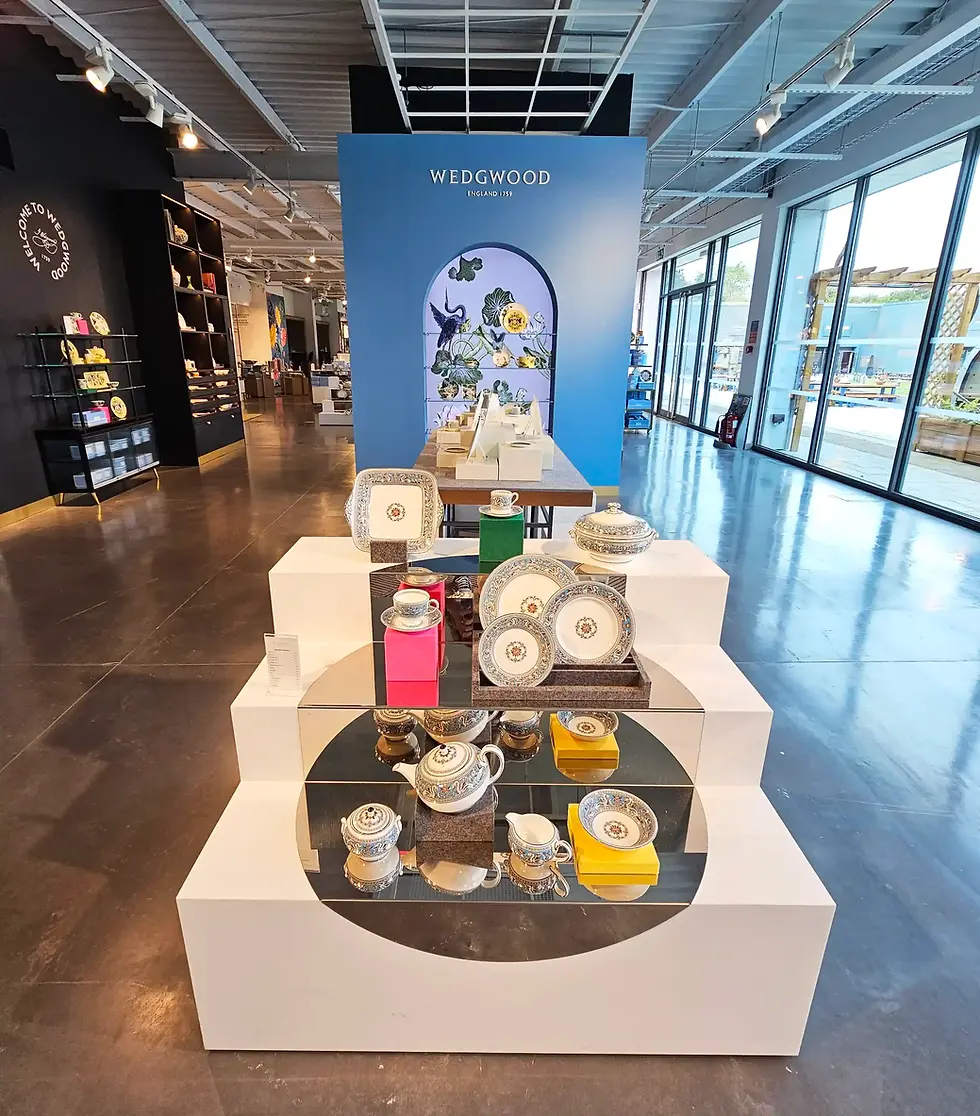
In 2022 Fiskars updated the retail space, to include products from much-loved brands including Wedgwood, Waterford, Royal Doulton and Royal Albert.

There really is something for everyone, whatever their taste. You just need slightly deep pockets, as great craft does not come cheap.

I like the modern mixed with the classical, so was drawn to the brand's crisp white Intaglio range, which has such a tactile quality, with its embossed patterns. And having seen the artisan's hand gilding skills on our tour, then we have a newfound respect for anything with gold detailing.

Funny how monochrome Jasperware just pops in front of a maximalist print.

For all those visitors wanting a little bit of royal memorabilia, then maybe a King Charles Coronation mug will find its way into your basket.

For those with hand luggage looking for a little trinket, then I always appreciate a brand Christmas bauble. I have quite the collection and each one is a precious memory from my travels.

The visual merchandising team knock it out of the park.

And, if you need a backdrop or three for a quick selfie, then you won't be disappointed.

Wedgwood Tea Room
If all that shopping and culture results in aching feet, then why not treat yourself to afternoon tea in the Gold Award–winning Wedgwood Tea Room like we did.

Is the World of Wedgwood worth a visit?
The World of Wedgwood is one of those visitor experiences that earns its place on the map, not just because of what it shows you, but because of what it makes you feel. This is a brand with over 260 years of history behind it, and the expanded site at Barlaston does it justice - not by putting it behind glass, but by keeping it alive.
The factory still makes pottery. The archive is still growing. New activities are still being added. And somewhere in the creative studios, a visitor, like me, is almost certainly making a mess on a potter's wheel and loving every second of it.
There is definitely a luxury feel, and often a price tag to match. The museum shop is beautiful, and the product range genuinely tempting. This is not a place you wander out of empty-handed. But the real luxury is how considered the whole experience is. Every touchpoint works. The staff are knowledgeable and warm. The food is good. The whole building feels so accessible. There is a welcome nod to local craft producers in the courtyard shops, and even the young, and the young at heart, will find fun among the facts. There's enough here to do to make a return visit, trust me.
In a world of rising costs, it is worth noting that general admission to the V&A Wedgwood Collection is free - and that is a genuine gem.
For anyone with an interest in industrial tourism, or in simply understanding what goes into making the things we use every day and rarely think about, this is a must-do. Just give it the time it deserves.
Plan your visit to the World of Wedgwood
Address
Wedgwood Drive, Barlaston, Stoke-on-Trent, Staffordshire, ST12 9ER
Website: World of Wedgwood
Getting to the World of Wedgwood
Luckily for me, World of Wedgwood is just over an hour from my family that live in the North West of England, so I tend to drive from their houses. However, I have also visited on longer journeys down south from Scotland, as afternoon tea there and a spot of shopping makes the perfect pitstop pick me up. If you're driving it is simple to get to. By train it is just 90 mins from London Euston and 35 mins from Manchester Piccadilly to Stoke-on-Trent Station, followed by a 15 minute taxi ride to the museum. There are local buses, and it's under an hour from Manchester airport. There's even access by canal - thanks to the work of the Canal & River Trust, restoring waterways such as the Trent & Mersey Canal. Just moor up at Bridge 104 and saunter along the path for 5 minutes and you're there.
How long was the visit?
We were there for several hours on both visits. Set aside longer than you think, especially if you're at all interested in the V & A museum. Afternoon tea will add extra time, as a mid visit break, which I can recommend.
How much are tickets?
Factory Tour tickets are £15 and concessions pay less.
Creative Studio tickets are from £7 for pottery painting and £35 for a throwing session. There's longer courses and even classes for little ones, like Potter Tots.
We paid for our tickets and this was not any form of advertisement.
Opening times
It's always worth checking with Wedgwood for their current opening times, as they can vary.
Currently they are open from 10:00 AM to and 5:00 PM every day and closed only 3 days a year. Tours and courses run at various times during the week and need to be booked in advance.
Where to stay for the World of Wedgwood
As, on this occasion, I did not need accommodation, you might want to look at the brand's website that has recommended lodgings listed.
What to see close to the World of Wedgwood
The last trip I made to Wedgwood was as a pit stop en route to the JCB Visitor Centre Experience and Factory Tour 18 miles away. If you like diggers, farm equipment or just industrial history, then a trip here is highly recommended. They run guided tours of the factory on Mondays and Fridays, which includes a brisk (little too brisk for me) tour of the museum there. My engineer husband obviously appreciated it. I will post a guide to this soon.

If you haven't had enough of pottery, then the Emma Bridgewater Factory is 6 miles away. Home to the brand's distinctive, hand-decorated earthenware pottery, their visitor centre offers afternoon tea, a factory tour and hands on crafting courses.

There are also tours available at Moorcroft Pottery, 8 miles from Wedgwood, home of their highly collectable, vibrant coloured, tubelined floral and landscape designs and a brand museum with over 125 years of history to explore.

For all Peaky Blinders fans, you can visit Middleport, the charity-owned heritage home of ‘Burleigh Ware’ ceramics, with a visitor centre, self guided heritage trail, factory tour, café, and working pottery. Parts of the Victorian pottery were used for filming Peaky Blinders series five.

But, less than 4 miles away from Wedgwood, is the location of immensely popular TV show The Great Pottery Throw Down, Gladstone Pottery Museum. They have just announced a collaboration with Duchess China, who are just a minute away, to run The Beyond the Bottle Oven experience.

Visitors can now tour both sites, checking out the atmospheric bottle ovens and original Victorian workshops, before watching contemporary fine china production. Each tour will cost £45 per person, including lunch, and will last 3-4 hours. Spaces are limited and due to filming schedules, the museum is not always open, so it is best to check before you travel and book online if you can.
If you're lucky enough to be a Bentley owner or customer, you can drive 24 miles from Wedgwood and visit the brand's behind-the-scenes factory tour and museum experience at their production facility in Crewe, Cheshire. It used to be open to the rest of us, but sadly it is now exclusive to the luxury car firm's clients.
And if you want to get outdoors, then I know the breath-taking Trentham Gardens well, as I graduated there. Reimagined, bit by bit, by the likes of Tom Stuart-Smith, who's excellent work I wrote about in my guide to RHS Bridgewater, the vast formal gardens have a backdrop of historic parkland and a Capability Brown designed lake. They're stunning any time of year.

Further reading
If homes and gardens are your thing then we have guides on our site such as our guide to Yankee Candle Village, Pendleton Woolen Mill, Magasin Du Nord Museum, RHS Garden Bridgewater or the John Lewis Heritage Centre. Guides to places like Noritake Ceramics and Royal Copenhagen coming soon.
Please note - I'm real
I visit every brand visitor centre and experience myself. My feedback is real, based on a single visit, but informed by years of experience designing and exploring brand experiences all over the world.
I love writing my own reflections, diving into a brand's history, doing the research and looking at spaces through the eyes of a commercial interior designer. With over 30 years of working with customers, I also enjoy watching how guests interact with guides, displays and spaces. Everything I share is honest, personal and entirely human, not AI generated.
That authenticity is important to me, and if it's important to you and you want to work with me, or share your experiences or want to suggest others, then I am happy to be contacted via this website.
Photographs: ©Julie White unless noted otherwise
Disclaimer - The views and opinions expressed are solely my own. I paid for the tours in full and any comments reflect my personal experiences on that day. Please drink responsibly. Please visit and garner your own thoughts and feel free to research the brand and the visitor centre in question.


Comments